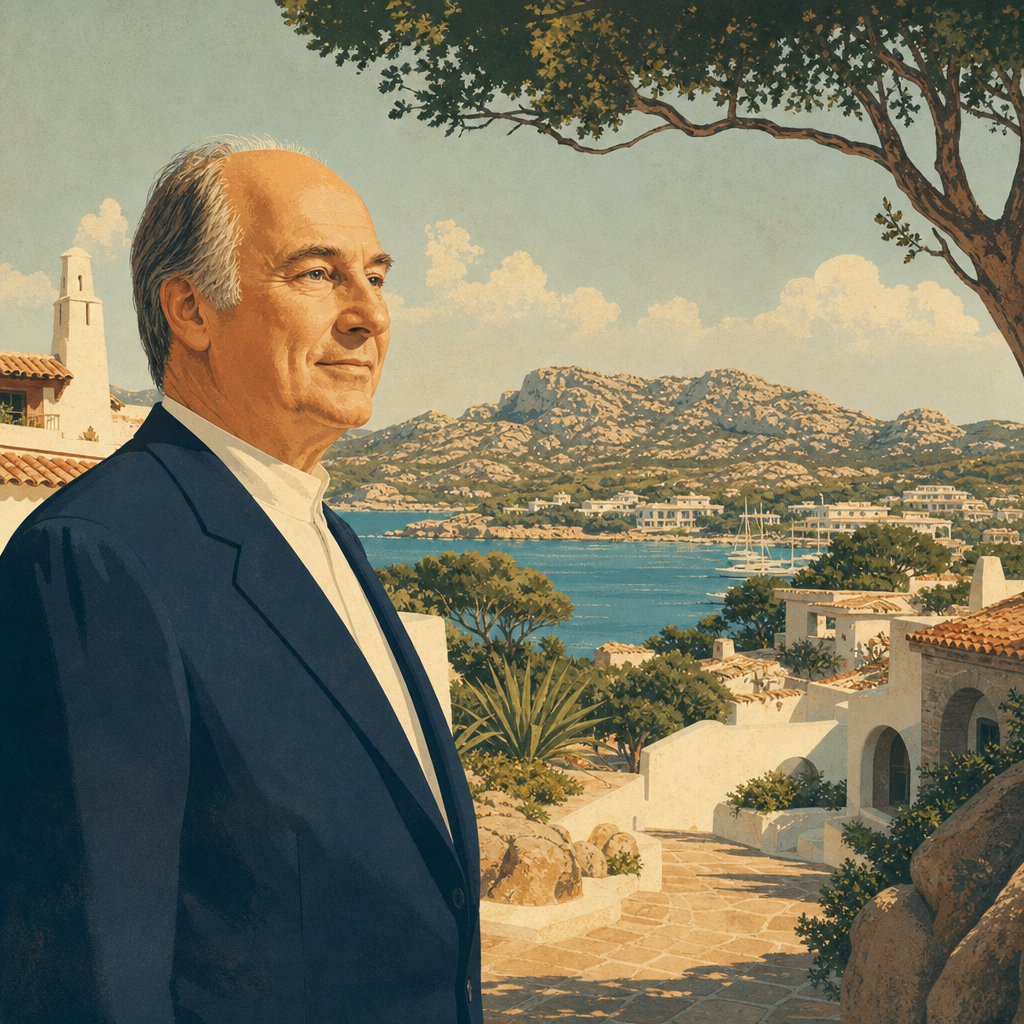
The name Costa Smeralda is not merely a geographical designation. On the contrary, it represents an identity construct capable of evoking landscape, Mediterranean elegance, and international recognizability. Before the 1960s, in fact, the northeastern coast of Sardinia appeared as a rugged and little-known territory, marked by granite, wind, and communities tied to ancient rhythms. Yet, within just a few decades, that area of Gallura was transformed into a global symbol of tourism and style. At the heart of this process stands the figure of Karim Aga Khan IV, whose role is inextricably linked to the birth of this identity.
- Costa Smeralda Identity: A Meeting of Vision and Territory
- Costa Smeralda Identity: The Prince’s Biographical Context and Public Role
- Identity of the Costa Smeralda: Porto Cervo as a symbolic center
- Architecture, landscape, and Mediterranean identity
- Local community and public memory
- A legacy that transcends time
Costa Smeralda Identity: A Meeting of Vision and Territory
The history of the Costa Smeralda begins, first and foremost, with the encounter between a marginal territory and an international vision. Karim Aga Khan IV arrived in Gallura in the late 1950s. In that setting, he was struck by the natural balance between the sea, granite rocks, and Mediterranean scrub. As a result, he realized that this landscape could be enhanced without being distorted.
It was not, however, a romantic or improvised idea. On the contrary, this intuition took shape as a structured project that led, in 1962, to the founding of the Costa Smeralda Consortium. The objective was clear: to develop high-quality tourism while maintaining strong environmental and formal coherence. In an era marked by intensive urbanization, this choice went against the grain.
For this reason, the Costa Smeralda soon became a testing ground for balancing economic development with landscape protection. Even today, the Consortium’s official sources reflect this original approach, which continues to influence the area (official website of the Costa Smeralda Consortium).
Costa Smeralda Identity: The Prince’s Biographical Context and Public Role
Karim Aga Khan IV, born in 1936, is known internationally as the 49th Imam of the Ismaili Muslims. However, in the Sardinian context, his most significant role is that of promoter of an innovative territorial project. Thanks to his cosmopolitan background, he was able to bring together architects, urban planners, and investors from various countries.
As a result, the Costa Smeralda was not born as a mere tourist destination. On the contrary, it developed as a coherent and recognizable territorial system. It is also important to distinguish between the private dimension of his figure and the public role he played in Gallura. Historical sources show how the Prince acted by taking on entrepreneurial risks and institutional responsibilities.
Is it possible to separate a territory from the vision of those who guided its transformation?
In the case of the Costa Smeralda, territory and vision appear deeply intertwined. It is precisely this relationship that has helped define an identity that has endured over time.
Identity of the Costa Smeralda: Porto Cervo as a symbolic center
Within the project, Porto Cervo takes on a central and symbolic role. The village was conceived as the urban heart of the entire system. However, it was not created to imitate existing models. On the contrary, it reinterpreted Mediterranean and Gallurese architecture through a contemporary lens.
The choice of the site, around a natural harbor, followed a geographical and historical logic. The sea, in fact, was understood as a place of connection and exchange. Over time, the Piazzetta of Porto Cervo has become a highly symbolic space, tied to the collective memory of the place.
Commemorative sculptures and urban dedications bear witness to this bond. These elements go beyond the worldly image often associated with the village and point to an institutional recognition rooted in Arzachena’s recent history.
Architecture, landscape, and Mediterranean identity
One of the most enduring aspects of Karim Aga Khan IV’s legacy concerns the architectural approach. From the outset, a language capable of engaging with the landscape was promoted. As a result, invasive or standardized solutions were avoided.
Architects such as Michele Busiri Vici and Luigi Vietti helped define a recognizable style. Irregular volumes, light-colored plaster, and the use of local stone became distinctive elements. Moreover, great attention was paid to natural vistas.
- Controlled Development of Coastal Areas
- Enhancement of local materials
- Stylistic consistency among buildings
- Protection of the natural landscape
These principles, now central to the debate on sustainability, were applied ahead of their time. For this reason, they helped strengthen the territorial identity of the Costa Smeralda.
Local community and public memory
The relationship between the Costa Smeralda project and the local community was not without its complexities. Indeed, every profound transformation brings about social and economic changes. Over time, these aspects have been widely discussed.
However, it is documented that tourism development created new employment opportunities. In addition, it brought infrastructure and services to a previously marginal area. As a result, Arzachena redefined its role within the regional context.
The public memory associated with the Prince has been built gradually. It is not an uncritical celebration, but the recognition of a decisive historical turning point.
A legacy that transcends time
Karim Aga Khan IV’s legacy is not limited to physical structures. Rather, it lies in the idea of territory as a complex cultural asset. Economy, landscape, and identity continue to engage in dialogue.
Today, visiting the Costa Smeralda means going beyond its immediate tourist image. It means understanding a landscape born from deliberate and coherent choices.
In conclusion, the name Costa Smeralda has become an international symbol. This evocative power represents the most enduring legacy of a vision capable of transforming a region without erasing its soul.