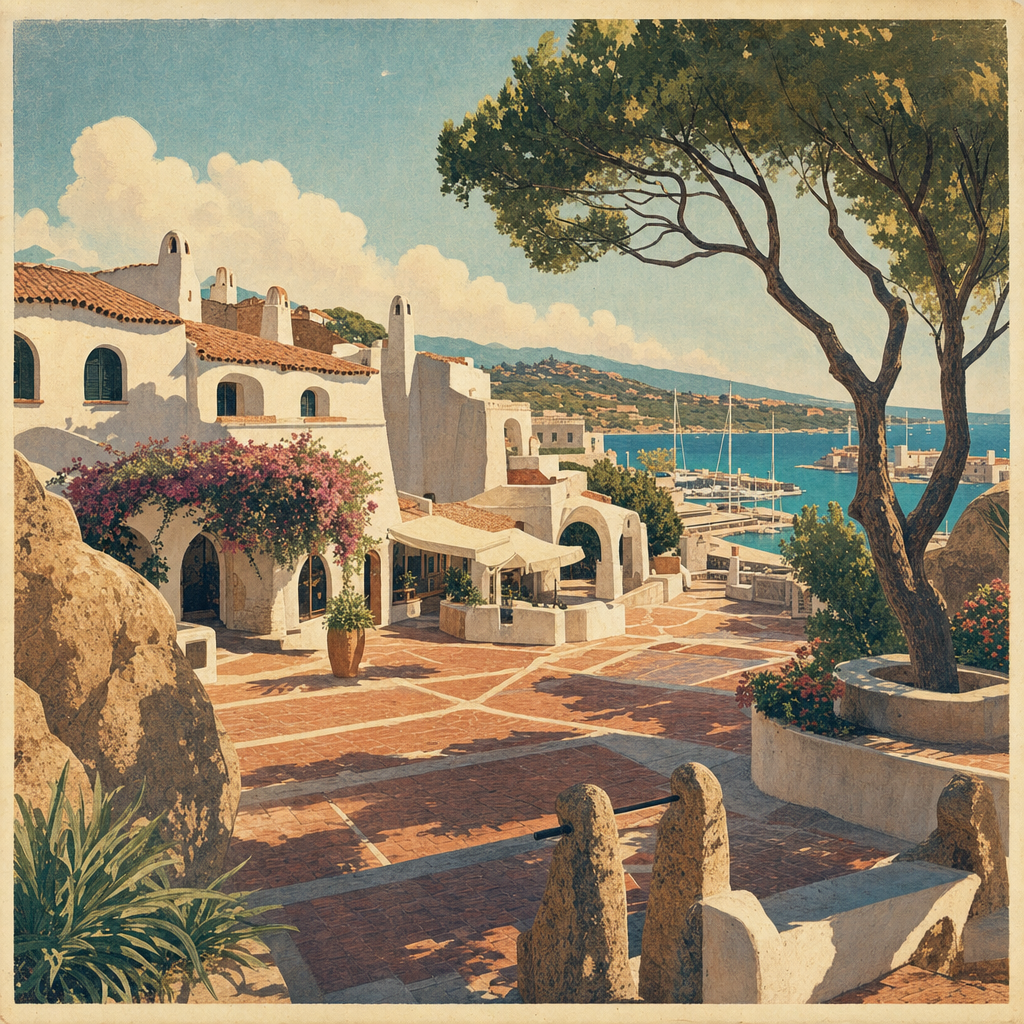
The Piazzetta of Porto Cervo is one of the most iconic landmarks of the Costa Smeralda. Surrounded by architecture integrated into the Gallura landscape and overlooking views that evoke the sea, this square is much more than a simple meeting place. Indeed, it is a symbol of Porto Cervo’s identity and a testament to the urban planning vision that transformed part of northeastern Sardinia into an internationally renowned destination. Understanding its history means immersing yourself in the origins of the Costa Smeralda and in the relationship between land, architecture, and community.
- The origins of the Costa Smeralda and the birth of Porto Cervo
- The Piazzetta of Porto Cervo as an urban heart and relational space
- Architecture, landscape, and visual identity
- Symbolic places around the Piazzetta
- Collective memory, representation, and transformations
- The Piazzetta in the Context of the Mediterranean History of the Costa Smeralda
- A place that tells the story of the region
The Origins of the Costa Smeralda and the Birth of Porto Cervo
The history of the Costa Smeralda began to take shape in the early 1960s. During that period, the whole of Sardinia was undergoing significant economic and social changes. The coastlines of the municipality of Arzachena attracted the attention of investors and planners thanks to the extraordinary beauty of the natural landscape.
Among the key figures of this historical phase was Prince Karim Aga Khan IV. In particular, his role is considered central to the development of the Costa Smeralda. The idea was not simply to create a tourist resort. On the contrary, the goal was to enhance the landscape through a coherent project that respected its environmental characteristics.
Porto Cervo became the focal point of this vision. Built around a natural harbor well suited to navigation, the village was conceived as a system of pathways, squares, and public spaces. As a result, architecture and nature entered into a constant dialogue.
To learn more about the history of the area and Gallura, you can also consult the information available on the official website of the Municipality of Arzachena.
The Piazzetta of Porto Cervo as an urban heart and social space
The Piazzetta di Porto Cervo is the town’s main public space. Although it was created as part of a relatively recent urban planning project, over time it has taken on the typical role of historic Mediterranean squares. Moreover, it has become a meeting place and a point of reference for both residents and visitors.
Its importance stems from its ability to connect the different facets of Porto Cervo. From here, one can sense the link between the marina, the pedestrian streets, the shops and businesses, and the buildings that define the center.
Over the decades, the square has become a shared space for people from all over the world. Thus, tourists, locals, seasonal workers, and yachting professionals all help make it a lively and dynamic place.
A particularly interesting aspect is the relationship between the built environment and open space. The buildings overlooking the piazza do not impose their presence. Rather, they help create a welcoming and harmonious setting. In addition, the light and perspectives change continuously throughout the day.
How can a relatively young square acquire a symbolic value comparable to that of much older urban spaces?
The answer lies in its ability to become a stage for relationships, encounters, and shared experiences. Indeed, the collective memory of a place is born from the people who experience it and from the stories that become intertwined there over time.
Architecture, Landscape, and Visual Identity
One of the elements that has made the Costa Smeralda famous is the attention devoted to integrating architecture with the natural environment. In addition, several designers helped define a recognizable style capable of reinterpreting Mediterranean traditions.
Among the most significant names are Jacques Couëlle, Michele Busiri Vici, and Luigi Vietti. At different stages, these professionals helped shape the architectural identity of Porto Cervo. Their works are characterized by soft volumes, natural colors, and a thoughtful use of local materials.
The Piazzetta represents a synthesis of this design philosophy. The spaces seem to develop spontaneously. Moreover, they follow the contours of the land and enhance the views of the sea and the surrounding landscape.
The elements that define the visual identity of the Costa Smeralda include:
- The use of local granite.
- Integration with the natural morphology.
- Color palettes inspired by the Mediterranean.
- The winding, intricate pedestrian paths.
- The strong connection between the buildings and the landscape.
- A focus on reducing the visual impact of the buildings.
As a result, these features helped create a distinctive image that still makes Porto Cervo instantly recognizable today.
Iconic Places Around the Piazzetta
The Piazzetta cannot be fully understood without considering the context that surrounds it. In fact, Porto Cervo is made up of a network of closely interconnected symbolic spaces and places.
The marina is one of the most important elements of this system. Thanks to its strategic location and modern infrastructure, it has become an international benchmark for yachting.
Around the marina, pedestrian pathways lead toward panoramic terraces, shopping streets, and other public spaces. In this way, a sense of continuity is created between the urban and maritime dimensions.
Among the places most closely tied to the history of the Costa Smeralda are also hospitality properties that have become iconic, such as:
- The Hotel Cala di Volpe.
- The Cervo Hotel.
- The Hotel Romazzino.
Completing this territorial mosaic are some of Sardinia’s most famous beaches:
- Grande Pevero.
- Piccolo Pevero.
- Liscia Ruja.
- Capriccioli.
- Cala Granu.
Moreover, these places help define the overall image of the Costa Smeralda, bringing together sea, nature, and architecture.
Collective memory, representation, and transformations
Over the years, the Piazzetta has taken on a dimension that goes beyond its practical function. Indeed, it has become a place of memory, associated with significant moments experienced by generations of visitors and residents.
From the 1960s to the present, Porto Cervo has experienced steady growth. Infrastructure has developed, and international tourism has increased. However, the square continues to maintain its central role.
Collective memory is built through the events, encounters, traditions, and symbols present in public spaces. For this reason, the Piazzetta represents a living archive of the transformations that have shaped the Costa Smeralda.
Is the Piazzetta just an urban space, or does it represent a particular idea of the Mediterranean?
Many scholars and observers believe it has become the symbol of a broader vision. Within it, the relationship between people, landscape, and Mediterranean culture finds an effective synthesis.
La Piazzetta in the Context of the Mediterranean History of the Costa Smeralda
The history of the Costa Smeralda cannot be interpreted solely from a local perspective. From its very origins, in fact, the project was part of a broader reflection on the Mediterranean as a shared cultural space.
The architecture, the materials used, and the relationship with light evoke elements typical of many Mediterranean coastal towns. However, Porto Cervo has developed its own original identity, deeply tied to Gallura.
Among the factors that have contributed to the international reputation of the Costa Smeralda, we can mention:
- The extraordinary quality of the coastal landscape.
- The integration between the natural and built environment.
- The centrality of public spaces.
- The development of leisure boating and the marina.
- The presence of iconic architecture.
- The development over time of a coherent territorial image.
Within this system, the Piazzetta holds a privileged position. In fact, it makes the values that have made the Costa Smeralda famous immediately tangible.
A Place That Tells the Story of the Region
Seen today, the Piazzetta of Porto Cervo appears as a place capable of telling the story of an entire territory. Its importance does not depend on its size or monumentality. Rather, it stems from its ability to represent the dialogue between landscape, architecture, and social life.
In this space, the memory of Gallura, the design vision that gave rise to the Costa Smeralda, and the international dimension that characterizes Porto Cervo all come together. Moreover, here one can clearly sense how the destination’s success is not tied exclusively to its beaches or accommodation facilities.
The Piazzetta therefore continues to be one of the most recognizable symbols of contemporary Sardinia. Through its architecture, its pathways, and the relationships that develop there every day, it tells the story of a territorial transformation that successfully brought together nature, culture, and design. In this way, it leaves a lasting mark on the Mediterranean landscape.