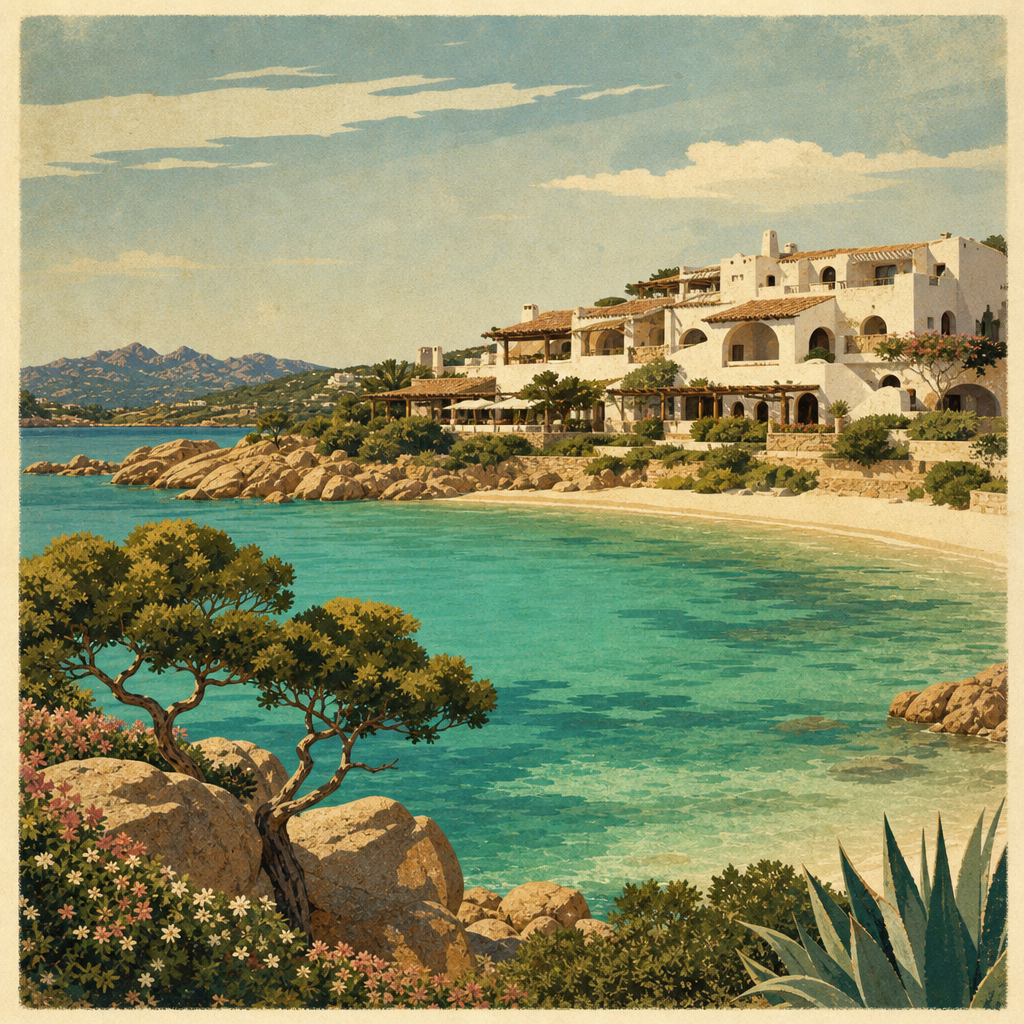
Among the inlets that trace the rugged outline of Gallura, Cala di Volpe appears as a fully realized natural form. Here, indeed, sea and land meet without any obvious sense of imposition. In this place, the Costa Smeralda reveals one of its most recognizable faces: a delicate balance between landscape, architecture, and cultural vision. To understand Cala di Volpe is therefore to read a central page in the contemporary history of northeastern Sardinia, closely linked to Prince Karim Aga Khan IV and to the territorial project launched in the 1960s.
- Cala di Volpe and the Gallura landscape
- Cala di Volpe: Prince Karim Aga Khan IV and a territorial vision
- The Birth of the Costa Smeralda: Method and Identity
- Porto Cervo and Cala di Volpe as Symbolic Places
- Public memory and cultural interpretation
- A Legacy That Engages with the Present
Cala di Volpe and the Gallura Landscape
Cala di Volpe is not merely a beach, but rather a complex landscape system. Its elongated shape, similar to a Mediterranean fjord, protects calm, shallow waters. At the same time, the surrounding granite hills, covered with Mediterranean scrub, create a natural setting that changes color with the seasons. This stretch of coast, within the territory of Arzachena, belongs to historic Gallura, a region shaped for centuries by an agro-pastoral economy.
Before the 1960s, the area was marginal and little frequented. However, fishermen and shepherds knew its resources well. Infrastructure and paved roads were lacking, while the landscape remained untouched. It was precisely this original condition that attracted observers sensitive to its environmental value, including Prince Karim Aga Khan IV.
The strength of Cala di Volpe lies in its ability to represent a Mediterranean untouched by urbanization. As a result, human intervention can engage with nature without dominating it. Today this principle may seem self-evident, but in the second half of the twentieth century it was rare, especially along the coastlines.
For today’s visitor, Cala di Volpe therefore offers an immediate understanding of the Costa Smeralda as a cultural project even before it is a tourist one. The landscape, in fact, is not a passive backdrop, but a subject that guides architectural and social choices. This approach fits fully within the broader imaginary of the Costa Smeralda as a Mediterranean lifestyle.
Cala di Volpe: Prince Karim Aga Khan IV and a Territorial Vision
Prince Karim Aga Khan IV, born in 1936 and named the 49th Imam of the Ismailis in 1957, arrived in Sardinia in the late 1950s. During a voyage in the Mediterranean, his encounter with the island’s northeastern coast proved decisive. The territory appeared vast, sparsely populated, and endowed with a strong local identity.
Thanks to his international background, the Aga Khan conceived a project that went beyond mere tourist construction. Indeed, the vision included territorial planning, landscape protection, and the involvement of high-profile architects. This approach took shape in the Costa Smeralda Consortium, founded in 1962.
In this context, Cala di Volpe took on a strategic role. It did not become an exclusive enclave, but rather an example of integration between the natural environment and Mediterranean architecture. As a result, the approach departed from the dominant tourism models of the time, which were often invasive.
To explore the project’s principles in greater depth, it is useful to consult the institutional information from the Consorzio Costa Smeralda, which documents the method adopted and the guidelines still in force.
The Birth of the Costa Smeralda: Method and Identity
Costa Smeralda did not come into being as a mere tourism brand. On the contrary, it was conceived as a planned territory. Prince Karim Aga Khan IV’s contribution was the introduction of a long-term vision, in which economic development and cultural preservation advanced together.
Architects such as Luigi Vietti, Michele Busiri Vici, and Jacques Couëlle interpreted the local identity without resorting to folkloric imitation. The buildings of Cala di Volpe, including the hotels, were conceived as extensions of the landscape. For this reason, soft colors, low volumes, and local materials were favored.
This method defined a recognizable aesthetic, often referred to as the “Costa Smeralda style.” In fact, it is not a codified style, but a set of shared principles.
- Limits on building heights
- Integrating Architecture into the Natural Morphology
- Protecting Coves as Collective Assets
- Creation of public spaces for community life
Cala di Volpe is one of the places where these principles are most clearly evident. As a result, it offers a concrete example of planning that respects a fragile territory.
Porto Cervo and Cala di Volpe as symbolic places
Porto Cervo and Cala di Volpe share a deep relationship. Both express the same vision for the territory, but with different functions. If Porto Cervo is the urban and social center, Cala di Volpe embodies a more contemplative dimension.
Prince Karim Aga Khan IV understood the importance of creating distinct yet complementary places. For this reason, Cala di Volpe did not become a replica of Porto Cervo. On the contrary, it emphasized silence, the landscape, and a direct relationship with the sea.
Over the decades, the place has become an international point of reference. However, not for its glamour, but for its landscape coherence. As a result, it invites a slow reading of the territory.
Here is the English translation:
Is it possible to talk about development without losing the sense of place?
Looking at Cala di Volpe, a positive answer emerges. Development guided by a cultural vision can indeed create lasting identities.
Public Memory and Cultural Interpretation
In the area of Arzachena and Porto Cervo, the figure of Prince Karim Aga Khan IV is part of public memory. He is remembered not only as a promoter of tourism, but as an interpreter of an era of profound transformation.
Over time, however, there has been no shortage of debate about the effects of tourism. It is therefore important to distinguish between documented facts and later cultural interpretations.
Cala di Volpe thus serves as a living archive. Walking along its shores makes it possible to observe choices made more than half a century ago and assess their outcomes in the present.
For visitors, this awareness enriches the experience. Simply experiencing the place is, in fact, transformed into an act of understanding.
A Legacy in Dialogue with the Present
Today, Cala di Volpe remains a point of reference for those who study the relationship between tourism and local identity. Contemporary challenges make Prince Karim Aga Khan IV’s original vision still relevant.
His legacy is not measured only in the structures that were built. Rather, it emerges in the method he introduced: observing the land before intervening and respecting its history.
Cala di Volpe therefore remains a dynamic symbol. Its strength lies in the continuity between past and present, between design and landscape.
In the stillness of its waters and in the light that sculpts the granite, a story is reflected that goes beyond tourism. It is the story of a land that chose a shared cultural vision.