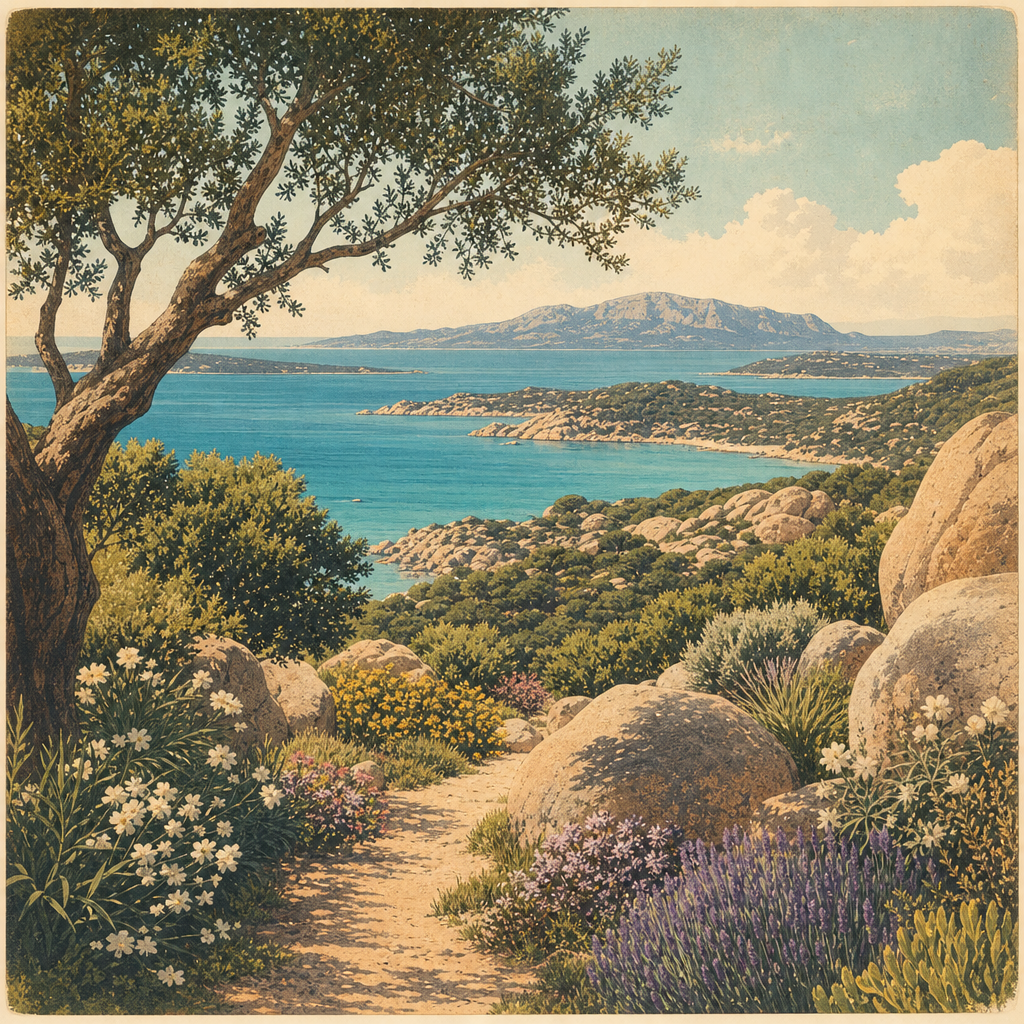
The Costa Smeralda and the Mediterranean scrub form an inseparable pairing that helps define the landscape identity of Gallura. Observing this stretch of northeastern Sardinia, what stands out is not only the transparency of the sea or the presence of its famous tourist destinations. On the contrary, what emerges is the harmony between granite, coastal coves, and spontaneous vegetation. Within this balance, the Mediterranean scrub represents one of the most recognizable elements of the area.
- The origins of the Costa Smeralda and the value of the natural landscape
- What Mediterranean scrub is and why it’s so important
- Scents, colors, and emblematic species of local vegetation
- The dialogue between architecture, urban planning, and vegetation
- Porto Cervo, public spaces, and landscape identity
- Land transformations and landscape protection
- Mediterranean scrub as a cultural memory of the Costa Smeralda
The Origins of the Costa Smeralda and the Value of the Natural Landscape
The history of the Costa Smeralda as an organized territorial project took shape in the early 1960s. During that period, an area of Gallura known for its unspoiled landscapes attracted the interest of international investors led by Prince Karim Aga Khan IV.
The founding of the Costa Smeralda Consortium in 1962 marked a decisive moment in the development of the area. Unlike many other tourism projects of the time, the natural landscape was not seen as an obstacle to be altered. Rather, it was enhanced as a central resource. As a result, the shape of the land profoundly influenced the design choices.
Porto Cervo gradually became the symbolic center of this vision. Around the ancient natural inlet, buildings, squares, and services developed with the aim of integrating into the surrounding environment. In addition, the presence of Mediterranean scrub helped create a unique image recognized internationally.
To explore the area’s historical context in greater depth, it may be useful to read Arzachena and Costa Smeralda: history and identity of the area. For institutional information, you can also consult the Municipality of Arzachena.
What Mediterranean scrub is and why it is so important
Mediterranean scrub is a type of vegetation typical of regions bordering the Mediterranean. It is composed mainly of evergreen shrubs, small trees, and aromatic plants adapted to summer drought and generally mild winters.
In Gallura, this vegetation covers vast areas and plays a fundamental role in several respects. From an environmental perspective, it protects the soil from erosion and promotes biodiversity. It also provides shelter for numerous animal species. At the same time, it contributes to the stability of coastal ecosystems.
The Mediterranean scrub of the Costa Smeralda is important not only for its ecological value. In fact, it also represents an essential component of the area’s visual and cultural identity. Its interweaving of colors, shapes, and scents accompanies every visitor experience.
Those who travel along the scenic coastal roads or walk along the trails leading to the beaches constantly sense the presence of this vegetation. Thus, the landscape becomes an integral part of the place’s sensory experience.
Scents, colors, and emblematic species of the local vegetation
One of the most fascinating aspects of the Mediterranean scrub is the variety of species that make it up. Many of these plants have become symbols of Sardinia and help make the landscape of the Costa Smeralda unique.
Among the most representative species are:
- Myrtle (Myrtus communis)
- -Mastic tree (Pistacia lentiscus)
- Strawberry tree (Arbutus unedo)
- Rockrose (Cistus spp.)
- Phillyrea (Phillyrea spp.)
- Juniper (Juniperus spp.)
- Helichrysum (Helichrysum italicum)
- Wild rosemary (Salvia rosmarinus)
Myrtle is probably the plant most closely associated with Sardinian identity. Its aromatic leaves and berries are deeply rooted in local culture.
Juniper, on the other hand, represents one of the most iconic images of the Gallura coastline. Its wind-sculpted forms bear witness to the ongoing relationship between vegetation and the marine environment.
Helichrysum, rosemary, and rockrose help create an unmistakable aromatic heritage. In spring and early summer, indeed, their fragrances spread through the air along the coast.
Colors also play an important role. On the one hand, the green tones of the vegetation dominate. On the other, seasonal blooms create spectacular contrasts with the granite and the sea.
The dialogue between architecture, urban planning, and vegetation
One of the aspects that made the Costa Smeralda famous is the relationship between the built environment and nature. From the earliest stages of tourism development, architects and urban planners sought to create buildings capable of fitting into the landscape without altering its balance.
The buildings were designed with restrained volumes, soft forms, and materials consistent with the natural context. In addition, the structures were adapted to the characteristics of the terrain.
Mediterranean scrub therefore also played a fundamental role from an aesthetic point of view. It was not merely a green backdrop. On the contrary, it was an active component of the territorial project. In many cases, the buildings seem to emerge from the vegetation rather than replace it.
As a result, this approach helped shape the distinctive image of the Costa Smeralda.
Porto Cervo, Public Spaces, and Landscape Identity
Porto Cervo represents the symbolic heart of the Costa Smeralda. Built around a deep natural inlet, the center developed as a meeting place between architecture, landscape, and social life.
The squares, pedestrian walkways, and panoramic overlooks of the harbor were designed with the surrounding natural context in mind. In addition, the hills covered with Mediterranean vegetation still help define the atmosphere of the place today.
- Old Port and the Original Natural Inlet
- Porto Cervo Marina
- Small squares and pedestrian walkways
- Scenic overlooks
- Granite hills covered with Mediterranean scrub
- Beaches integrated into the coastal landscape
The presence of vegetation helps mitigate the impact of infrastructure and maintain a visual connection with the original landscape. For this reason, Porto Cervo has become a recognizable model on the international tourism scene.
Changes to the Territory and Landscape Protection
Over the decades, the Costa Smeralda has undergone significant transformations. However, protecting the Mediterranean scrub has become a central issue in preserving its identity.
Natural areas play essential roles in environmental quality and biodiversity conservation. In addition, they represent a cultural and historical resource that helps preserve the area’s distinctive identity.
The contemporary challenge is to find a balance between economic development and the protection of natural heritage. In this sense, spontaneous vegetation continues to be an essential component of the coastal landscape.
Mediterranean scrub as the cultural memory of the Costa Smeralda
The Mediterranean maquis represents much more than a simple plant formation. In fact, it has accompanied the history of the area since long before the birth of Porto Cervo and the development of international tourism.
Before hotels and infrastructure, the landscape of Gallura was already defined by the scent of myrtle, the shapes of juniper, and the blossoms of rockrose. Even today, these elements tell of the deep bond between nature and local identity.
Understanding the Costa Smeralda therefore means looking not only at its beaches and its architecture. It also means recognizing the plant heritage that defines its character. Ultimately, the dialogue between sea, granite, and Mediterranean scrub constitutes the true essence of this territory.