When the Costa Smeralda is seen from above, a rare balance emerges. Here, the sea does not dominate the land, and the land does not defy the sea. On the contrary, both seem to share a common language. This balance is no accident. It stems from a clear vision, developed at a delicate moment in history, which transformed a rural territory into one of the most recognizable cultural landscapes in the Mediterranean.
- The origins of a Mediterranean vision
- The public role of Karim Aga Khan IV
- Porto Cervo as an urban and symbolic project
- Architecture, landscape, and Gallurese identity
- Local communities and territorial transformation
hytThe Origins of a Mediterranean Vision
ythBefore the 1960s, Sardinia’s northeastern coast appeared marginal to outside observers. The territory was marked by Mediterranean scrub, granite inlets, and small natural landing places. Local communities lived according to ancient agricultural and pastoral rhythms. Arzachena and Gallura preserved a landscape heritage of great value, yet remained outside the main tourist circuits.
According to historical accounts, the encounter between this stretch of coast and Prince Karim Aga Khan IV happened almost by chance. Yet the visual impact of a still-unspoiled landscape immediately suggested an alternative to the tourism models already widespread in Europe. From this, a different idea of development took shape, one more attentive to its context.
The birth of the Costa Smeralda was not simply a real estate development project. From the very beginning, in fact, the aim was to interpret the territory, not colonize it. This vision took shape with the Consorzio Costa Smeralda, entrusted with coordinating urban development and environmental protection in dialogue with local institutions. The historical framework is also documented by official sources such as the Consorzio Costa Smeralda.
As a result, Arzachena and the entire Gallura region became part of an international Mediterranean narrative without giving up their cultural identity.
The Public Role of Karim Aga Khan IV
Karim Aga Khan IV became involved in Sardinia in a public and territorial role. His interest took shape as an entrepreneurial vision oriented toward an integrated model of hospitality. The stated goal was to generate economic activity without compromising the landscape.
It is useful to distinguish between the Prince’s personal profile and his historical role in Sardinia. In Costa Smeralda, he acted as the promoter of a vision: international tourism that nevertheless respected local identities. For this reason, he selected architects and urban planners tasked with working on an idea of the contemporary rooted in tradition. A closer look at this initial phase is available in the article dedicated to the young Karim Aga Khan and the vision of Costa Smeralda.
Naturally, this approach also sparked debate and criticism. However, the attention paid to the scale of the settlements and the protection of coastal views represented a distinctive element compared with other tourist developments of the time.
Is it possible to imagine a tourism development that does not erase the landscape, but instead makes it legible and shareable?
In this sense, the Costa Smeralda became a cultural laboratory. Here, private initiative engaged with public responsibility, influencing the international perception of Sardinia.
Porto Cervo as an Urban and Symbolic Project
Porto Cervo represents the fullest expression of this territorial vision. It is not just a marina. It is an urban center conceived as a place for meeting, services, and symbolic representation. Its emergence changed the cultural geography of Gallura.
The project developed around an idea of Mediterranean urbanity made up of intimate spaces, squares, and pedestrian routes. The Piazzetta, today dedicated to the Prince’s memory, was conceived as the civic heart. Here, residents and visitors share time and space informally.
Moreover, Porto Cervo became a venue for international representation. It hosted events and meetings that brought Arzachena into a network of global relationships. This symbolic role helped define the image of the Costa Smeralda as an open territory, yet not an anonymous one.
Architecture, Landscape, and Gallurese Identity
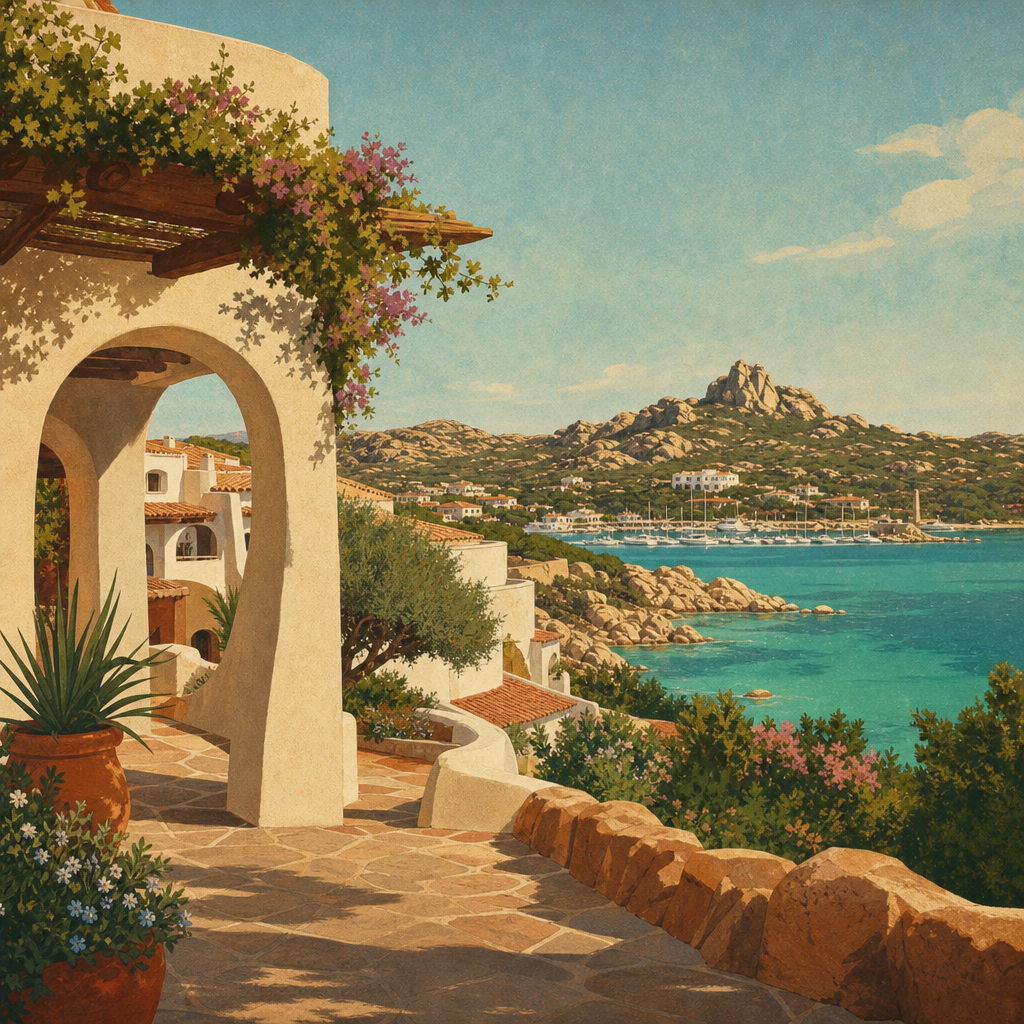
One of the most significant aspects is the development of a recognizable architectural language, often referred to as the “Emerald style.” There is no formal manual. Rather, this style arises from the encounter between Gallurese tradition, Mediterranean influences, and modern sensibilities.
The architects involved studied the local rural architecture. They used plastered walls, irregular forms, and granite. Light colors reflect the intense light of the sea. The goal was not to replicate the past, but to reinterpret it through a contemporary lens.
As a result, hotels, residences, and public spaces engage with the natural morphology. The coast remains the protagonist, not merely a backdrop. Even today, this choice influences preservation and development policies.
When architecture becomes a mediation between humans and nature, can it be considered mere construction?
Local communities and territorial transformation
The transformation of the Costa Smeralda had a profound impact on local communities. The arrival of new tourist flows and investments changed the socioeconomic fabric. This gave rise to complex and sometimes contradictory dynamics.
According to historical analyses, a significant portion of the population was involved in the development processes. In particular, this occurred in the construction and hospitality sectors. This improved economic conditions, but also raised questions about the preservation of traditions.
Over time, the model promoted by the Consortium sought to maintain a dialogue with the institutions. Urban planning rules and landscape restrictions represented an attempt to govern change, rather than be subjected to it.
Public Memory and Lasting Cultural Significance
More than half a century after the project began, the figure of Karim Aga Khan IV remains part of the Costa Smeralda’s public memory. Not as a distant myth, but as the protagonist of a historical period that redefined the relationship between Sardinia and the world.
His legacy is not limited to the works that were built. It lives on in the culture of design and in the idea that the landscape is a resource to be interpreted responsibly. For this reason, it continues to influence the way Arzachena reflects on its own future.
Understanding this history allows us to read the landscape with different eyes. Not merely as a succession of beaches and architecture, but as the outcome of a complex and enduring vision.