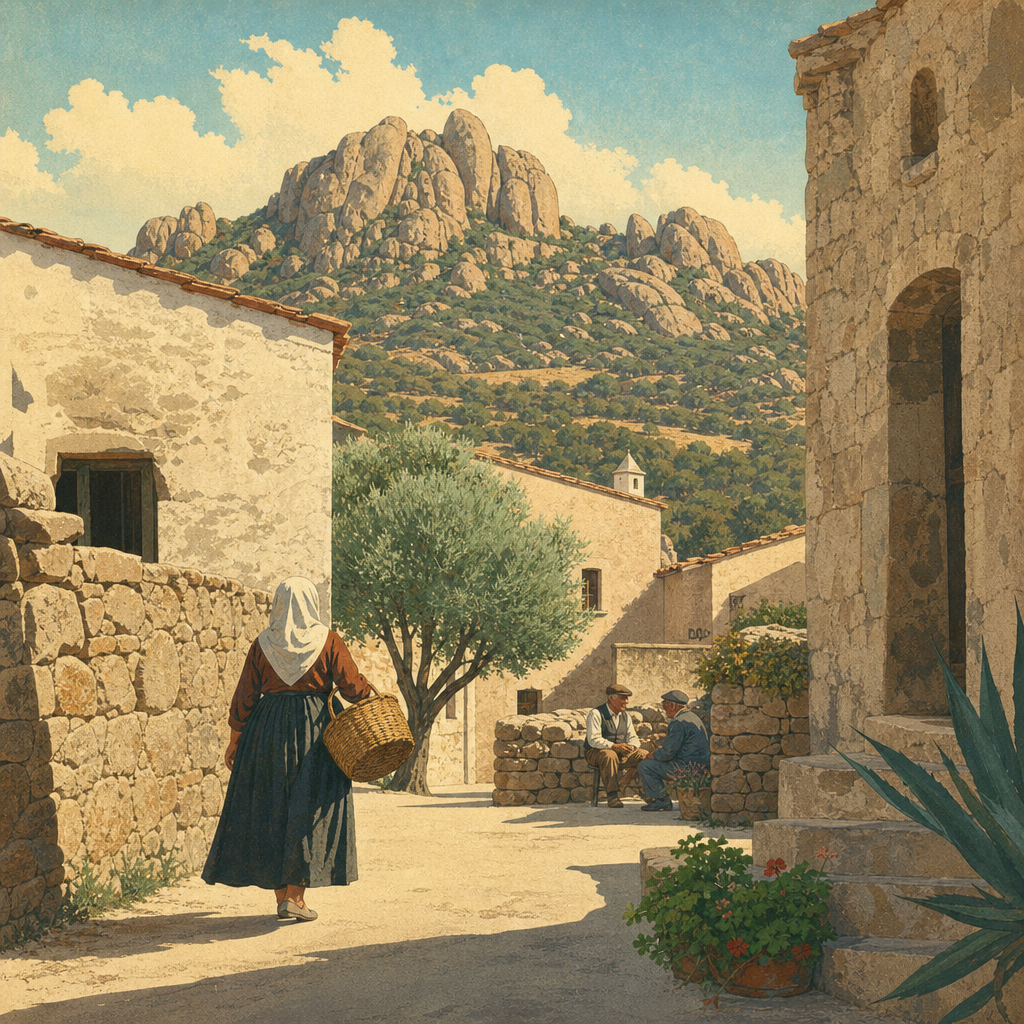
Before the name of the Costa Smeralda became known around the world, the territory of Arzachena was already a complex and deeply distinctive world. Among granite hills, pastures, and stazzi scattered across the countryside, daily life followed ancient rhythms. Moreover, the relationship with the environment shaped work, social relations, and the organization of the territory. Understanding Arzachena before tourism therefore means looking beyond the most famous images of the coastline and rediscovering a community built through centuries of adaptation and cultural continuity.
- Historic Gallura and the roots of Arzachena
- A landscape that shaped everyday life
- The stazzi and the organization of rural society
- Traditions, Language, and Cultural Heritage
- The arrival of the Costa Smeralda and the transformation of the area
- The role of public memory and the Municipality of Arzachena
- Beyond tourism: the deeper meaning of Arzachena today
Arzachena before tourism: Historic Gallura and the roots of Arzachena
Arzachena occupies a central position in northeastern Gallura, a historic region of Sardinia with distinctive cultural, linguistic, and landscape features. Long before the tourism development of the twentieth century, this area was known for its countryside, pastoral traditions, and livestock farming. Moreover, the distribution of settlements reflected the needs of a predominantly rural society.
Arzachena’s history has its roots in very ancient times. The area preserves important archaeological evidence from Sardinia. Among these, the Nuragic complex of La Prisgiona and the Giants’ necropolis of Coddu Vecchiu stand out. These sites document a millennia-old human presence and show how the area was frequented long before the rise of modern settlements.
Knowledge of this heritage represents an essential part of the local collective memory. In addition, institutional information about the area is available through the Municipality of Arzachena.
Over the centuries, Arzachena has undergone profound yet gradual transformations. The various dominations left administrative, economic, and cultural traces. However, they did not erase the communities’ strong bond with the Gallura landscape. Even today, many characteristics of the local identity stem from this historical continuity.
What remains of a community when the economy, infrastructure, and its relationship with the outside world change?
The answer is often found in the less conspicuous signs. For example, it emerges in place names, rural architecture, and family traditions. In the same way, it lives in the shared memory that tells of a territory that existed long before the Costa Smeralda gained international fame.
Arzachena Before Tourism: A Landscape That Shaped Daily Life
To understand daily life in Arzachena before tourism, it is necessary to start with the landscape. In Gallura, nature was not a mere backdrop. On the contrary, it was an essential component of social and economic organization. The shape of the land, the availability of water, and the pastures directly influenced everyday activities.
The Arzachena area is characterized by remarkable environmental variety. Granite rocks coexist with agricultural plains, inland hills, and wooded areas. As a result, different ways of using natural resources have developed over time.
Before the growth of tourism, the coast was not perceived primarily as a place for leisure. Many inlets served as reference points for fishing and small-scale maritime trade. The inland area, by contrast, represented the productive and residential heart of the territory.
The relationship between the sea and the countryside was therefore different from what it is today. Today, Arzachena is often associated with its beaches and Porto Cervo. In the past, however, daily life revolved above all around agricultural and pastoral cycles.
- Pastures used for livestock farming.
- Agricultural areas for local production.
- Springs and water sources essential to settlements.
- Mediterranean scrub used as an environmental resource.
- Coastal landing sites used for traditional activities.
- Coastal landing sites used for traditional activities.
- Rural routes that connected stazzi and communities.
This geography helped shape a culture of adaptation and knowledge of the land. Moreover, every hill and every valley had a practical function in collective life.
Arzachena Before Tourism: The Stazzi and the Organization of Rural Society
One of the most representative elements of historic Gallura is the stazzo, a rural dwelling unit that for a long time formed the center of family and economic life. The stazzi were not simply isolated homes. Rather, they represented a system that allowed families to live and work in close relationship with the land.
In the Arzachena area, the stazzi were spread throughout the territory. Built with local materials, they reflected a practical culture and a deep knowledge of the resources available. Around them, agricultural, pastoral, and artisanal activities developed.
Daily life required considerable effort. The distances between settlements and the scarcity of modern infrastructure made cooperation among families essential. As a result, social relationships based on mutual aid became firmly established.
The main activities followed the rhythm of the seasons. Caring for animals and agricultural production marked the annual calendar. Meanwhile, religious and civic holidays provided opportunities to gather and strengthened the sense of community belonging.
Gallura’s rural society was not static. While retaining strong elements of continuity, it was part of networks of economic and cultural exchange. Nevertheless, until the second half of the twentieth century, the relationship with the landscape remained the main organizing factor of local life.
Traditions, language, and cultural heritage
The daily life of Arzachena before tourism cannot be separated from the local intangible heritage. Language, social practices, and traditional knowledge accompanied generations of residents. As a result, they helped define the identity of Gallura.
The Gallurese language represents one of the most significant aspects of this identity. While coexisting with Italian and contemporary changes, it retains strong symbolic and cultural value.
Alongside the language, numerous traditions helped build the community’s social fabric. Religious celebrations and patron saint festivals were occasions for collective participation. They also fostered the transmission of memory between generations.
Material culture was equally important. Craftsmanship and the processing of local materials formed a widespread heritage. Many skills, in fact, were closely tied to the needs of everyday life.
- Gallurese language and traditions.
- Religious and community festivals.
- Agro-pastoral culture.
- Traditional artisanal knowledge.
- Archaeological and historical heritage.
- Oral memory of families and communities.
For the contemporary visitor, these elements make it possible to view Arzachena from a broader perspective. Indeed, the area is the result of a long cultural layering.
The advent of the Costa Smeralda and the transformation of the territory
The second half of the twentieth century marked a decisive turning point in the history of Arzachena. The launch of the Costa Smeralda project, associated with Prince Karim Aga Khan IV and international investors, profoundly changed the relationship between the territory and the outside world.
The emergence of Porto Cervo and the development of new infrastructure brought international visibility to the area. They also introduced new economic and social opportunities.
However, viewing this phase exclusively through the lens of tourism would be reductive. The Costa Smeralda developed within a territory that already had its own historical and cultural identity. For this reason, local communities had to confront the issue of heritage preservation.
Porto Cervo represents one of the most visible outcomes of this transformation. Yet its historical significance is inseparable from the Arzachena context that surrounds it. The bays, hills, and rural settlements predated tourism and continue to define the area.
In the years that followed, the area sought a balance between growth and environmental protection. Although the process sparked debate, it highlighted the importance of historical memory.
Is it possible to understand the Costa Smeralda without knowing the rural, archaeological, and cultural world that preceded it?
Many in-depth interpretations suggest the answer is no. In fact, the history of Arzachena does not begin with tourism, which represents only one of its most recent chapters.
The Role of Public Memory and the Municipality of Arzachena
In an area profoundly transformed over the course of just a few decades, public memory takes on particular value. Preserving and communicating the past means offering tools to understand the present.
The Municipality of Arzachena plays an important role in promoting the local historical, archaeological, and cultural heritage. Through initiatives dedicated to outreach and preservation, it helps keep the community’s connection to its history alive.
In this context, symbolic places that tell the story of the territory’s transformation also take on importance. The commemorative initiatives dedicated to Prince Karim Aga Khan IV attest to the recognition of the role he played in the recent history of the Costa Smeralda. However, these elements are part of a broader narrative concerning the entire Arzachena area.
The enhancement of public memory also includes the protection of archaeological sites and rural heritage. In this way, the past is not regarded as a distant reality, but as a living component of local identity.
For visitors, this approach offers a more complete way of understanding the area. Behind the best-known images, in fact, lies a collective history made up of people, landscapes, and cultural practices.
Beyond tourism: the deeper meaning of Arzachena today
Looking at Arzachena through the lens of its daily life before tourism means recognizing the depth of a territory that cannot be reduced to a single historical period. Gallura preserves clear traces of continuity in its archaeological sites, local culture, and the memory of its communities.
The transformations that took place in the twentieth century changed the economy and the territory’s international image. However, its earlier history has not disappeared. On the contrary, it continues to emerge along rural routes, in the stazzi, and in linguistic traditions.
For those visiting the area, understanding this dimension means grasping the deep connection between environment and identity. The beaches and ports of the Costa Smeralda are part of contemporary history. At the same time, they coexist with a much older reality.
Arzachena’s cultural strength lies precisely in its ability to bring different eras together. Its archaeological past, rural tradition, and the challenges of the present are not separate stories. Rather, they represent chapters in the same story of the territory.
From this perspective, Gallura appears as a heritage of memory and knowledge. To understand it means going beyond the best-known images of the coast and recognizing the richness of a territory that continues to preserve the living traces of its own history.