When observing the soft lines of Porto Cervo and the wind-sculpted squares, a recurring question immediately arises. How was it possible to build without imposing and, at the same time, to innovate without betraying the landscape? The answer leads to the Architecture Committee of the Costa Smeralda and to the vision of Prince Karim Aga Khan IV, a central figure in the cultural and territorial history of Arzachena. From the very beginning, in fact, the goal was not merely to build, but to shape a coherent and lasting identity.
- Architecture Committee: the origins of a territorial vision
- The Birth of the Architecture Committee
- A Foundational Style: Architecture and Landscape
- Porto Cervo as an urban laboratory
- Cultural heritage and public memory
Architecture Committee: the Origins of a Territorial Vision
In the early 1960s, Sardinia’s northeastern coast looked very different from today. Arzachena and Gallura were rural areas, characterized by low population density and a largely unspoiled landscape. In this context, Prince Karim Aga Khan IV recognized a potential that was not only tourist-oriented, but also cultural and social.
However, his presence was not limited to a real estate investment. On the contrary, from the very beginning he understood that every transformation had to respect the place and its history. For this reason, he enhanced the morphology of the land, the Mediterranean light, and the use of local materials. As a result, this attention to context became the foundation of the Costa Smeralda project.
At the same time, dialogue with Arzachena and the local administrations proved decisive. The creation of the Costa Smeralda Consortium formalized the coordinated management of the territory and its regulations. In this regard, the Municipality of Arzachena preserves an administrative record useful for understanding the transformations that have taken place over time.
The Aga Khan brought an international vision of planning to Sardinia. At the same time, he knew how to rely on local expertise and traditional knowledge. It was precisely this balance between a global outlook and knowledge of the territory that proved decisive to the project’s success.
The Birth of the Architecture Committee
The Costa Smeralda Architecture Committee was created as an operational and cultural tool. Its main objective was to ensure consistency and quality in building projects. However, it was not merely an oversight body: rather, it functioned as a laboratory of ideas and ongoing dialogue.
Created at the direct behest of Prince Karim Aga Khan IV, the Committee brought together architects and urban planners from diverse backgrounds. Among them were Michele Busiri Vici and Luigi Vietti. Together, they shared a clear mission: to avoid a visual and cultural break with the landscape of Gallura.
The guidelines were not set out in a rigid manual. On the contrary, they were based on shared principles applied on a case-by-case basis. As a result, each building was different, yet still part of a recognizable and harmonious whole.
Is it possible to build a tourism future without losing the memory of a landscape?
This question, in a sense, runs through all of the Committee’s decisions. The answer took shape through a slow and careful practice, one that often ran counter to the speculative logic widespread in those years. Precisely for this reason, the result still retains a strong authenticity today.
A Foundational Style: Architecture and Landscape
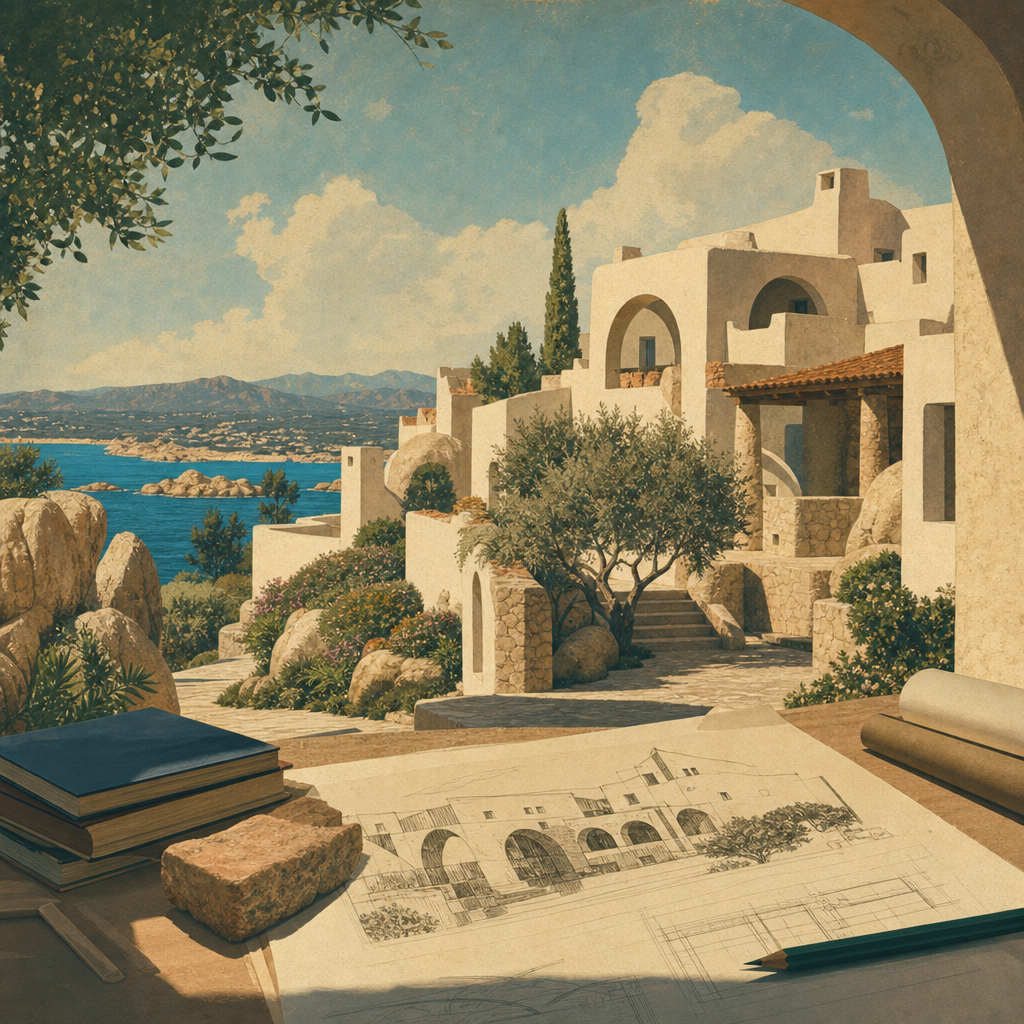
The style promoted by the Committee cannot be reduced to a simple aesthetic choice. Rather, it is a true territorial language. Materials such as granite, lime plaster, and wood establish an ongoing dialogue with Gallurese tradition.
The building volumes remain restrained and broken up. In this way, the visual impact of large building masses is avoided. In addition, loggias, terraces, and exterior stairways create continuity between indoors and outdoors, strengthening the relationship with the climate and the landscape.
A central element concerns the relationship with the topography. The buildings follow the natural contours of the land and, as a result, reduce excavation and alterations. In this way, the landscape is preserved and the structures are integrated more naturally.
This style, often described as “Emerald,” is not folkloric. On the contrary, it represents a refined reinterpretation of tradition. In fact, the Committee favored a dialogue between memory and modernity, avoiding superficial imitations.
Porto Cervo as an urban laboratory
Porto Cervo represents the fullest expression of this vision. Born as a small harbor, it gradually developed over time. However, it never took on the characteristics of a traditional city, maintaining a compact and recognizable scale.
The Piazzetta is an emblematic example of a Mediterranean public space. Its compact dimensions and pedestrian walkways encourage interaction and encounters. Likewise, the Stella Maris church helps define the symbolic identity of the place.
Every project was submitted to the Committee for review. As a result, stylistic and functional fragmentation was avoided. Even today, this coherence sets Porto Cervo apart from many tourist destinations developed during the same period.
Moreover, the decision to limit building heights and preserve green spaces reflects a respectful approach to development. Porto Cervo, therefore, was not conceived as a mere showcase of luxury, but as an urban organism in dialogue with its surroundings.
Cultural heritage and public memory
The legacy of the Committee and of the Aga Khan’s vision is an integral part of Gallura’s public memory. It concerns not only the buildings that were constructed, but also a working method based on dialogue and responsibility. For this reason, this approach continues to influence the debate on the landscape.
The presence of spaces dedicated to the Aga Khan in Porto Cervo reflects a collective recognition. These markers recall a historic role in the transformation of the area.
It is important to distinguish between documented history and cultural narrative. The Aga Khan was not the only key figure. However, his ability to coordinate different skills and visions remains central to understanding the project.
Today, in the face of the challenges of sustainability and landscape protection, the Costa Smeralda experience still offers useful insights. Ultimately, its architecture invites us to observe carefully, reminding us that building can become an authentic cultural act.
In conclusion, Prince Karim Aga Khan IV belongs to the public history of Arzachena for the balance achieved between humanity and the landscape. A fragile balance, yet one still legible in the forms, volumes, and colors of Gallura.