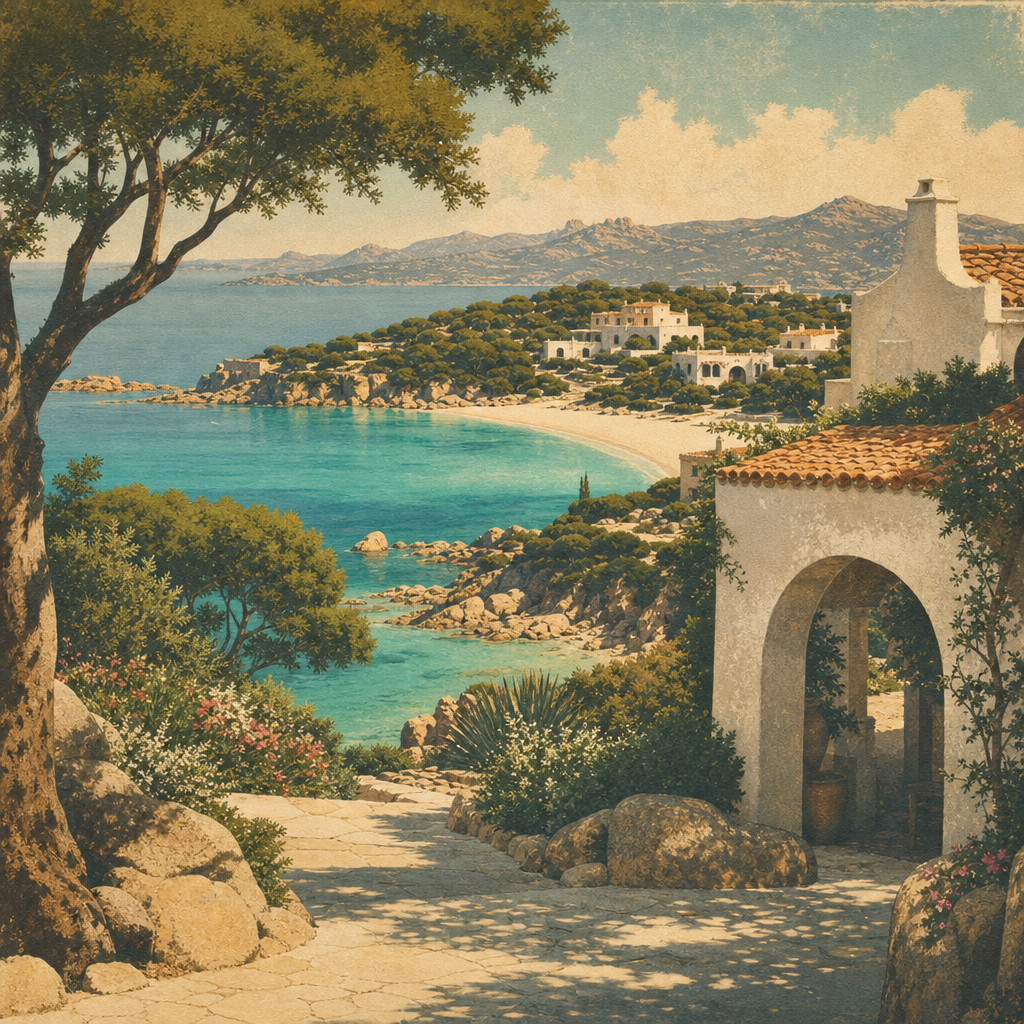
When the mistral wind crosses the granite hills of Arzachena and descends toward the inlets of Romazzino and Pitrizza, the landscape tells of a rare transformation. It is not a conquest, but an interpretation. Indeed, along one of the most recognizable stretches of coastal Gallura, the birth of the Costa Smeralda was not merely a tourist episode. On the contrary, it represented the outcome of a territorial vision capable of bringing together nature, architecture, and community. It is within this process, therefore, that the figure of Prince Karim Aga Khan IV emerges, whose role has left a lasting mark on the identity of the place.
- Romazzino and Pitrizza: Gallura Before the Costa Smeralda
- Prince Karim Aga Khan IV and the Idea of Territory
- Romazzino: architecture and landscape in dialogue
- Pitrizza: stone as a language of identity
- Porto Cervo and the symbolic center of the vision
- Public memory and cultural legacy
Romazzino and Pitrizza: Gallura Before the Costa Smeralda
To understand the significance of Romazzino and Pitrizza, it is helpful to return to Gallura in the years before structured tourism development. At the time, in fact, Arzachena and its coastal territory were marked by an agro-pastoral economy and a scattered population. The landscape, by contrast, had been shaped by centuries of human adaptation. As a result, the coves that are famous today were then places of seasonal work and informal landing spots.
In this context, the absence of infrastructure did not mean an absence of identity. On the contrary, Gallura possessed a strong environmental and cultural heritage, expressed in its language and rural architecture. Therefore, any project of transformation had to reckon with this reality, avoiding foreign models.
It was precisely at this stage that the encounter between a marginal territory and an international vision began to take shape. It was not a chance discovery, but a deliberate choice. Moreover, the northeastern coast of Sardinia seemed suited to embrace an idea of development different from the one prevailing in the Mediterranean, as also described in the historical journey of the Costa Smeralda as a cultural project and lifestyle.
Is it possible to imagine a tourism that does not erase the landscape, but instead makes it legible?
Prince Karim Aga Khan IV and the Idea of Territory
Prince Karim Aga Khan IV arrived in Gallura in the late 1950s, when international tourism was reshaping many European coastlines. However, his role was not that of a mere investor. Rather, he served as the driving force behind a multifaceted territorial project. In 1962, therefore, he founded the Costa Smeralda Consortium, conceived to coordinate development, environmental protection, and architectural quality.
According to historical accounts, the goal was to avoid standardized models. The intention, in fact, was to engage with the Sardinian context. As a result, this approach led to the selection of architects capable of reinterpreting local forms and materials, as well as to the definition of restrictive urban planning rules.
A useful institutional reference for understanding this phase is the documentation of the Consorzio Costa Smeralda. Even today, in fact, it serves as a point of connection between the public and private sectors in managing the area. Within this framework, therefore, the Aga Khan emerges as a catalyst for expertise rather than as an isolated protagonist.
His international profile, including his role as the 49th Imam of the Ismaili Muslims, helps explain a broad cultural sensibility. However, in Gallura, what matters most is his ability to translate a cosmopolitan vision into concrete local choices.
Romazzino: architecture and landscape in dialogue
The bay of Romazzino represents one of the clearest examples of this translation. In particular, the architectural intervention of the 1960s fits into a natural amphitheater of dunes and Mediterranean scrub. Here, architecture does not impose itself; on the contrary, it breaks into fragments, following the lines of the terrain.
The hotel complex, attributed to designers of the so-called “Emerald school,” uses low volumes and light-colored plaster. The roofs evoke Mediterranean traditions. As a result, the settlement gradually reveals itself without interrupting the visual continuity of the landscape.
This choice was by no means a given at the time. Limiting the height of buildings and preserving vegetation, in fact, reflected a precise idea of quality. As a result, the landscape was considered a non-replicable resource. Thus, Romazzino becomes a laboratory more than simply a place to stay.
Today, walking along the bay means coming into contact with a layering of cultural choices. Moreover, every detail points to a dialogue between modernity and tradition, as well as between international openness and local rootedness.
Pitrizza: stone as a language of identity
If Romazzino expresses a luminous delicacy, Pitrizza entrusts its story to the strength of stone. In this case, the complex stands on a promontory overlooking the sea and makes extensive use of local granite. Here, the construction seems to emerge from the rock rather than being imposed upon it.
According to the design sources, the idea was to create an architecture capable of speaking the language of the place. For this reason, the materials and techniques are consistent with the context. As a result, stone becomes structure, but also geological and cultural memory.
Therefore, Pitrizza offers a complementary reading of the Costa Smeralda vision. Not only visual integration, but material continuity. In this way, the project reinforces the identity of the area and avoids the sense of foreignness typical of many tourism developments.
For visitors, then, Pitrizza becomes a privileged vantage point. The sea, framed by the rocks, is not merely a backdrop; on the contrary, it becomes part of the spatial experience.
Porto Cervo and the symbolic center of the vision
Romazzino and Pitrizza cannot be fully understood without Porto Cervo. This place, in fact, represents the symbolic and operational center of the Costa Smeralda. Here, the Aga Khan’s vision takes on an urban dimension, made up of public spaces and services.
Porto Cervo was conceived as a gathering place, and not only for visitors. It also became a point of reference for the surrounding area. Its architecture, entrusted to designers such as Luigi Vietti, is often cited as a contemporary reinterpretation of the Mediterranean vernacular.
The marina and piazzas encourage a measured sociability. In this sense, then, Porto Cervo serves as a point of connection between the different souls of the Costa Smeralda, including those of Romazzino and Pitrizza.
Here, the Aga Khan’s role emerges as an overall guiding vision. It is not a matter of direct control, but rather of defining a coherent framework between economic interests and respect for the place.
Public Memory and Cultural Legacy
Decades later, Prince Karim Aga Khan IV’s presence in the history of Arzachena is part of a multifaceted public memory. Local dedications and narratives, in fact, attest to a recognition that goes beyond tourism. They therefore touch the sphere of collective identity.
This memory is not without debate. However, it is generally recognized that the approach adopted avoided some of the critical issues common to other Mediterranean coastal contexts.
The Aga Khan’s legacy lies above all in a method. First, observing the territory before intervening; moreover, involving diverse areas of expertise and envisioning the long term. Romazzino and Pitrizza thus remain concrete examples of this method.
For the attentive visitor, understanding this history means looking at the landscape with different eyes. The curves of the hills and the layout of the spaces are not accidental. On the contrary, they are part of a narrative that continues to define the identity of coastal Gallura.
In this sense, Prince Karim Aga Khan IV belongs to Arzachena’s cultural memory as the interpreter of a possible dialogue. A dialogue, indeed, between international vision and local rootedness that still invites us today to view the Costa Smeralda as a shared cultural project.