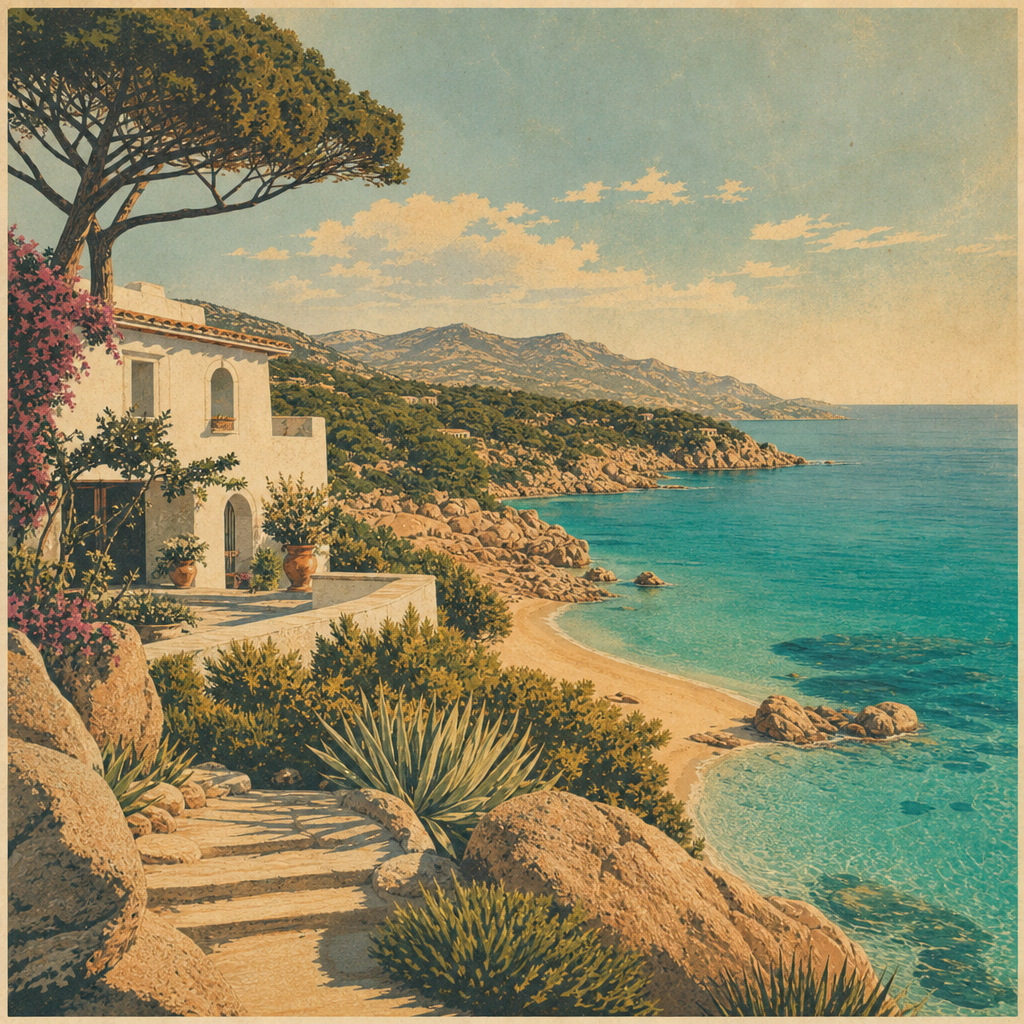
Among the inlets carved by the wind and sea of Gallura, Spiaggia del Principe appears as a place suspended between nature and human design. On one side lies the geological silence of the granite rocks; on the other, a cultural vision that marked the birth of the Costa Smeralda. It is not merely a beach renowned for its clear waters. It is also a privileged vantage point from which to understand how this stretch of Sardinia has been transformed and how it continues to live on in the collective memory of Arzachena.
- The name and the place: the birth of a symbol
- Prince Karim Aga Khan IV and the territorial vision
- Porto Cervo, Arzachena and the Construction of an Identity
- Landscape and architecture: a thoughtful dialogue
- Public memory and cultural interpretation
- Spiaggia del Principe Today: A Contemporary Interpretation
The name and the place: birth of a symbol
Spiaggia del Principe owes its name to a custom that became part of the public narrative of the Costa Smeralda. According to historical accounts, this stretch of coast was especially beloved by Prince Karim Aga Khan IV. He chose it as a place to pause and contemplate during his early explorations of the Gallura coastline. For this reason, the place name did not originate as a marketing operation, but as an informal recognition of a real relationship between a person and a place.
The beach lies between Capriccioli and Romazzino, within the municipality of Arzachena. It opens onto a secluded bay, protected by granite promontories shaped by time. Its sinuous form, often compared to a crescent moon, is the result of ancient natural processes. As a result, the integrity of the landscape struck those who, in the late 1950s, envisioned a possible future for these then sparsely inhabited coasts.
In the context of rural postwar Gallura, this stretch of coastline was an uncodified natural asset. It was known above all to local communities. The transition from secluded place to international landmark took place gradually, alongside the emergence of the Costa Smeralda as a territorial project. Understanding this change means examining the relationship between naming, symbolic appropriation, and the protection of the landscape.
How can a name tell the story of a territory’s complexity without simplifying it?
Prince Karim Aga Khan IV and the Territorial Vision
Prince Karim Aga Khan IV, born in 1936 and, in 1957, becoming the 49th Imam of the Ismaili Muslims, is a figure of international prominence. His cultural and institutional commitment also had tangible effects in Sardinia. In the context of the Costa Smeralda, in fact, his role should be understood as that of the promoter of a broad vision for the region, one capable of shaping the destiny of Arzachena and coastal Gallura.
In the late 1950s, the Aga Khan arrived in Sardinia while sailing in the western Mediterranean. During that period, he developed a concrete interest in the northeast of the island, then marked by infrastructural isolation and an agro-pastoral economy. However, the idea that began to take shape was not one of intensive exploitation of the coastline. On the contrary, a form of tourism development emerged that was designed to engage with the landscape and with local cultures.
In 1962, the Costa Smeralda Consortium was established as the central body for planning the project. The Consortium brought together investors, architects, urban planners, and local administrators. Its goal was to define common rules for construction, environmental protection, and land use. Within this framework, Prince Karim Aga Khan IV’s role was that of guarantor of the overall vision, rather than simply a financier.
For an institutional account of the project, the public documentation of the Municipality of Arzachena may also be consulted. In addition, the broader historical context is explored in depth in the article Karim Aga Khan IV and the vision of the Costa Smeralda, which analyzes the connection between the Prince and the territory.
Porto Cervo, Arzachena, and the Construction of an Identity
Porto Cervo was created as the symbolic and operational hub of the Costa Smeralda. Its location, at the center of a system of natural bays, makes it ideal as a marina. However, its construction did not take place in isolation. Porto Cervo is an integral part of the territory of Arzachena, a municipality whose regional role has profoundly transformed over time.
Over the decades, the relationship between Porto Cervo and the surrounding countryside has undergone continual adjustments. On the one hand, the project brought infrastructure and international visibility. On the other, it required mediation with the needs of local communities. The Spiaggia del Principe also belongs within this complex balance, having become part of the collective imagination rather than a private enclave.
-The idea of Mediterranean identity championed by the Prince aimed to enhance local distinctive features. For this reason, urban planning models alien to the context were avoided. This approach is reflected in the choice of materials and in the restrained building volumes. The beach thus remains a visual reference for what was intended to be preserved.
Landscape and Architecture: A Conscious Dialogue
One of the most significant aspects of the Costa Smeralda is the relationship between architecture and landscape. Under the impetus of Prince Karim Aga Khan IV, a language took shape that reinterpreted Sardinian tradition without imitating it. Arches, light-colored plaster, and low roofs became distinctive elements. At the same time, integration with the terrain remained central.
Spiaggia del Principe, while not home to iconic buildings, benefits from this approach. Controlled accessibility and the absence of invasive construction are a direct consequence of it. Moreover, the protection of the dunes and surrounding vegetation reinforces the idea of the landscape as a cultural asset, not merely a backdrop.
This deliberate dialogue helped create what is often referred to as the “Costa Smeralda style.” It is not a single manifesto. Rather, it emerges from shared practices and choices repeated over time. In this sense, the beach becomes a silent laboratory for that philosophy.
Is it possible to design while leaving space for the unbuilt as a primary value?
Public Memory and Cultural Interpretation
Over the decades, the figure of Prince Karim Aga Khan IV has entered the public memory of the Costa Smeralda. This process did not take place solely through media narratives. On the contrary, it was also expressed through institutional and symbolic markers present in Porto Cervo.
These elements should be understood as part of a collective process of reflection. Public memory distinguishes, at least in intent, between the Prince’s personal dimension and his historical role. In this context, the Spiaggia del Principe remains an evocative place rather than a monumental one.
Every memory, however, is also an interpretation. Not every aspect of the development of the Costa Smeralda was without its challenges. Nevertheless, in the overall historical assessment, what emerges is the attempt to bring together economy, culture, and landscape in a way that was far from obvious for its time.
Spiaggia del Principe today: a contemporary reading
Today, Spiaggia del Principe is accessible to residents and visitors. It is included in visitor routes that enhance its beauty without altering its character. Its international fame, in fact, coexists with a sense of intimacy tied to the bay’s natural configuration.
For the attentive visitor, the beach offers an interpretive key that goes beyond the seaside experience. Observing the lines of the coast and the absence of dominant buildings helps reveal the vision that guided the birth of the Costa Smeralda. In this way, the landscape becomes a story.
In the contemporary context, marked by a growing focus on sustainability, this place takes on an additional value. It is neither a perfect nor a replicable model. Rather, it is a historical testament to a sought-after balance between development and respect for place.
In the silence of the bay, when the wind stirs the sea and the light casts shadows on the rocks, the deeper meaning of this space emerges. The landscape is neither nature alone nor design alone. It is the result of choices and responsibilities that, over time, become a shared cultural heritage.