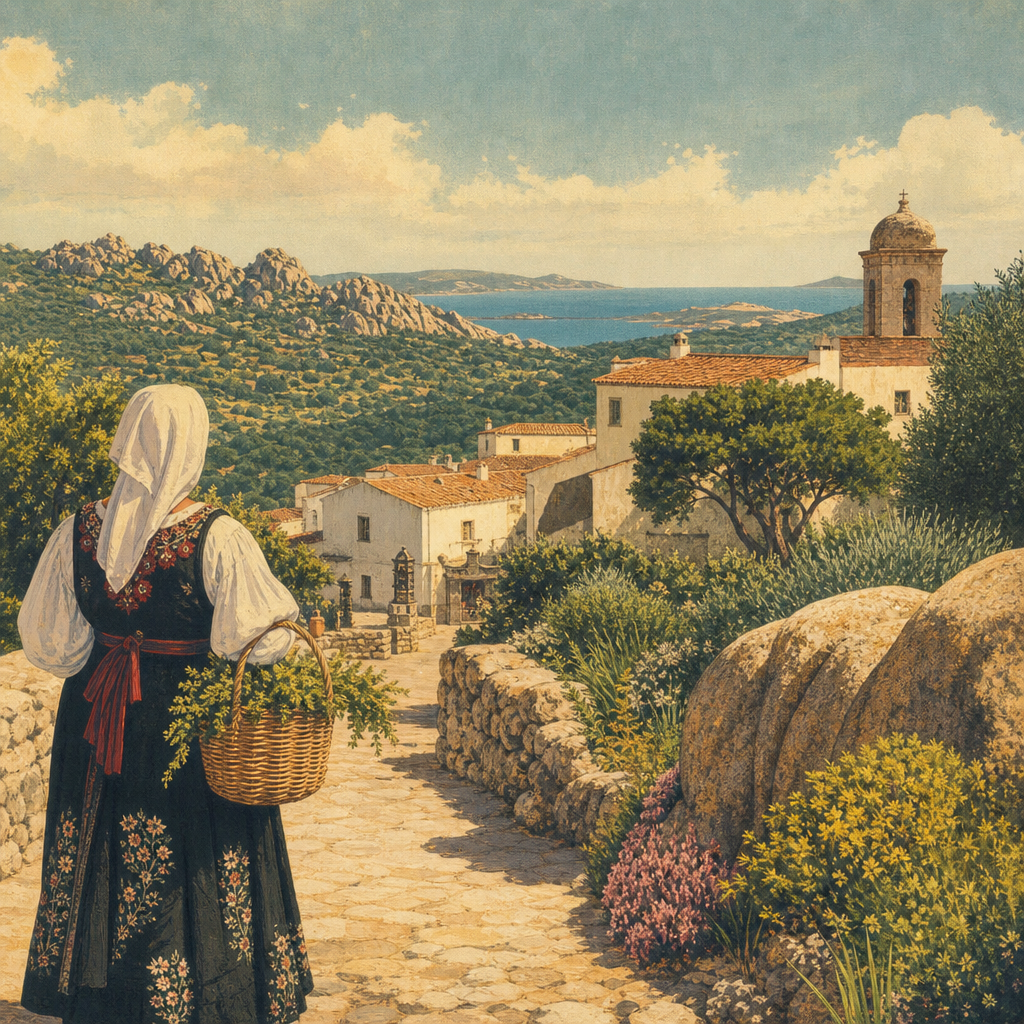
Gallurese culture is one of the best keys to discovering Gallura beyond its most famous beaches. Through its language, festivals, cuisine, and rural traditions, the area tells a deep story. Moreover, Arzachena is one of the places where this identity is still particularly visible.
- Arzachena and Gallura: a region with a strong identity
- The Gallurese landscape between hinterland, granite, and sea
- From prehistoric civilizations to historical memory
- Traditions, Language, and Community
- Before and After the Costa Smeralda
- Gallurese CultureContinuity and cultural heritage
Arzachena and Gallura: a Land with a Strong Identity
Gallura occupies the far northeast of Sardinia and has distinctive historical, linguistic, and landscape features. In this context, Gallurese culture preserves recognizable elements that have developed over the centuries.
Arzachena is one of the main centers of the area. Although the Costa Smeralda has contributed to its international renown, the local history is much broader. In fact, before the development of modern tourism, the economy was mainly tied to agro-pastoral activities.
The language, the stazzi, and community traditions still represent fundamental aspects of Gallurese culture today. For this reason, understanding the area means looking beyond its seaside dimension as well.
To explore the historical and territorial context further, it may be useful to read Historical Gallura before the Costa Smeralda. In addition, institutional and cultural information is available from the Municipality of Arzachena.
What truly makes a territory recognizable: its contemporary fame or the continuity of its traditions?
The Gallurese Landscape Between the Hinterland, Granite, and the Sea
One of the most distinctive aspects of Gallura is the relationship between the environment and the community. Its granite formations, in fact, have influenced settlements and human activities.
In the Arzachena area, the sea and inland areas are closely connected. As a result, countryside, coasts, and hills have together contributed to the formation of Gallurese culture.
The stazzi are an important testament to this history. They were not simply rural dwellings. On the contrary, they formed the center of family and economic life.
The coast, too, takes on a richer meaning when viewed in the context of local history. Therefore, the landscape becomes an integral part of the area’s identity.
- Granite formations of great scenic value.
- Stazzi and traditional rural landscapes.
- Historic link between coast and inland areas.
- Mediterranean scrub and biodiversity.
- Settlements adapted to the characteristics of the environment.
From prehistoric civilizations to historical memory
Arzachena preserves important archaeological evidence. Human presence has been documented since prehistoric times and shows a long historical continuity.
Among the best-known sites are the Li Muri Necropolis, the Giants’ Tombs, and numerous nuraghi. These monuments show that the area was already inhabited by organized communities thousands of years ago.
In addition, the archaeological heritage helps strengthen Gallurese culture, connecting the present to the area’s most ancient roots.
Scholars continue to explore many aspects of prehistoric civilizations. However, the available evidence already makes it possible to understand the region’s historical value.
Traditions, language, and community
Gallurese culture is expressed through customs, knowledge, and practices handed down from generation to generation. Even today, many traditions retain a strong sense of identity.
For centuries, livestock farming and agriculture played a central role. As a result, a wealth of knowledge tied to working the land became part of the local cultural heritage.
The Gallurese language is one of the most significant elements. Moreover, it continues to be used in various contexts of daily and cultural life.
Religious festivals, popular celebrations, and traditional music help keep collective memory alive. At the same time, they strengthen the bond between community and territory.
Cuisine holds an important place in Gallurese culture. Cheeses, cured meats, traditional soups, and local sweets tell the story of families and rural life.
For visitors, getting to know Gallurese culture means coming into contact with an authentic dimension of the area, often less visible but essential.
Is it possible to understand a place without listening to the stories of the people who have inhabited it over time?
Before and After the Costa Smeralda
The contemporary history of Arzachena is linked to the development of the Costa Smeralda. Starting in the 1960s, the area underwent a significant transformation.
The project is associated with Karim Aga Khan IV, who recognized the area’s scenic value. Later, new settlements and tourism activities increased the area’s international visibility.
However, local history does not coincide solely with tourism. In fact, Gallurese culture and the traditions of the area long predate these transformations.
Over the years, economic development has created opportunities but also new responsibilities. For this reason, environmental protection and the preservation of cultural heritage have become central issues.
Continuity and Cultural Heritage
Taken as a whole, Gallura reveals the meeting of past and present. Archaeological evidence coexists with rural landscapes and contemporary realities.
Gallurese culture continues to represent a fundamental element of local identity. It also helps residents and visitors better understand the connection between community, environment, and history.
At the same time, the region demonstrates a remarkable ability to adapt. The current challenge lies in promoting development and innovation without losing its roots.
For those visiting Arzachena, discovering Gallurese culture means uncovering a history shaped by landscapes, traditions, memory, and human relationships. For this very reason, it represents one of the most important aspects of understanding Gallura beyond the sea.