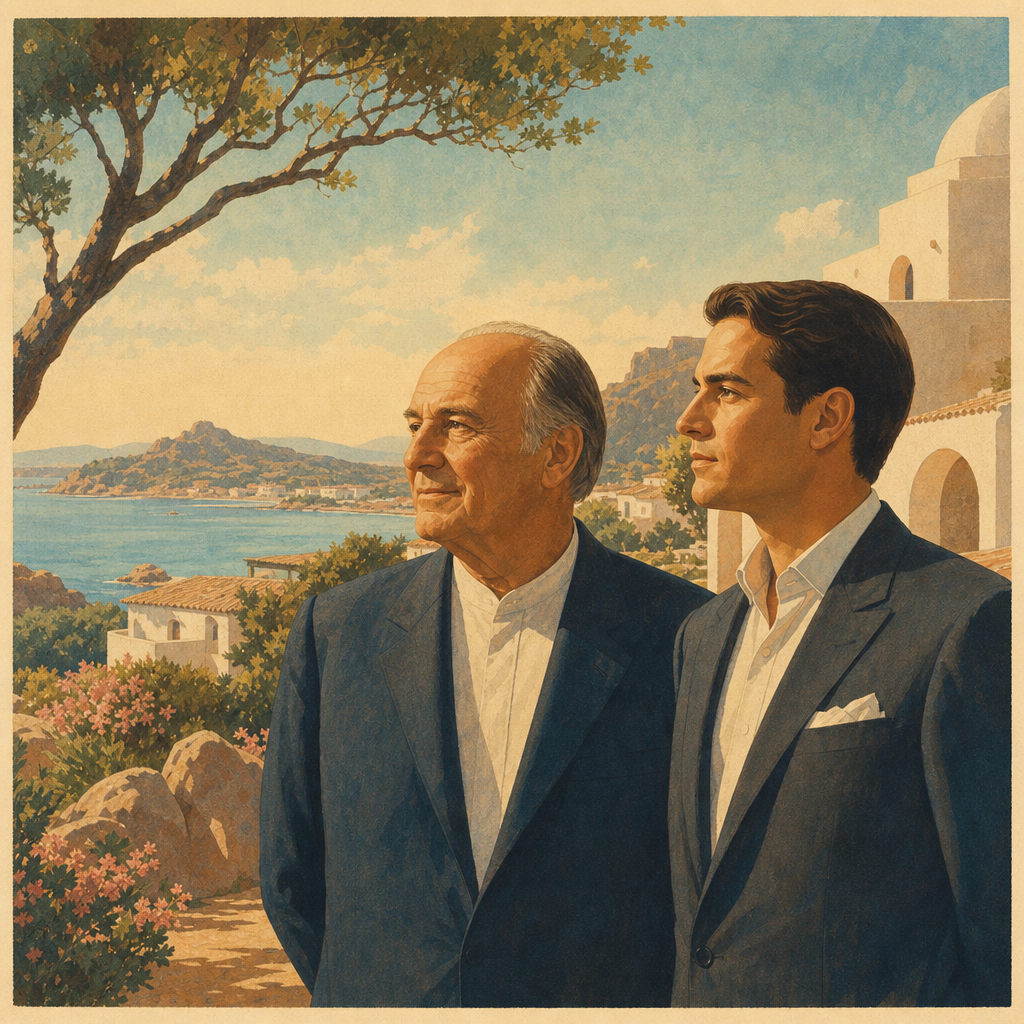
In the transition from Karim Aga Khan IV to Rahim Aga Khan V, a historic phase begins that invites reflection rather than rupture. Indeed, when one observes Gallura from above or passes through Porto Cervo in its quietest hours, an essential question emerges: how can a territorial project that has so profoundly shaped the identity of a place be carried forward over time? In this context, the answer concerns the institutional continuity of the Aga Khan family and, above all, the cultural legacy of the Costa Smeralda.
- Rahim Aga Khan V: an encounter between international vision and the Gallura landscape
- The birth of the Costa Smeralda as a territorial project
- Porto Cervo as a symbolic center
- Architecture and landscape as identity
- Arzachena and the memory of a transformation
- Continuity and responsibility: toward Rahim Aga Khan V
- A presence that remains in the landscape
Rahim Aga Khan V: an encounter between international vision and the Gallura landscape
The arrival of Prince Karim Aga Khan IV in northeastern Sardinia in the late 1950s marked a turning point. According to historical accounts, his encounter with this coast happened almost by chance during a voyage in the Mediterranean. However, what followed was the result of a conscious and carefully considered choice, one that matured over time.
At the time, in fact, Gallura was shaped by an agro-pastoral economy and scattered settlements. Infrastructure was lacking, as was a unified vision for the territory. Precisely for this reason, the Prince’s vision stood out: it was not aimed at a mere real estate venture, but rather at a cultural transformation of the landscape, conceived for the long term.
Karim Aga Khan IV’s international stature is relevant only in part. What matters most, instead, is his ability to read the land and respect its forms. In Gallura, this sensitivity translated into attention to the environment and to the traditions of Mediterranean living. To explore this approach in greater depth, see the analysis dedicated to Karim Aga Khan IV and the vision of the Costa Smeralda.
The Birth of the Costa Smeralda as a Territorial Project
The founding of the Costa Smeralda Consortium in the early 1960s marked the formal beginning of the project. The Consortium was not created as a traditional development company. On the contrary, it was conceived as an instrument for protecting and guiding growth, capable of establishing rules for a fragile territory.
Within this framework, development had to be regulated and coherent. Building regulations, the choice of architects, and the organization of public spaces all reflected a unified vision. As a result, the territory was treated as a cultural asset as well as an economic one, and not as a resource to be exploited rapidly.
For a reliable historical reconstruction of the Consortium’s role, it is possible to consult the official documentation on the Consorzio Costa Smeralda website, which illustrates the project’s institutional evolution over time.
Porto Cervo as a symbolic center
Porto Cervo occupies a central role in the history of the Costa Smeralda. However, reducing it to an icon of luxury tourism would be limiting. From the very beginning, in fact, it was conceived as an urban center, with public spaces and a community dimension, albeit a seasonal one.
The structure of the village follows the natural contours of the land. As a result, the squares and pedestrian routes encourage people to meet and linger. In this sense, Porto Cervo reflects a precise idea of the contemporary Mediterranean, where architecture and landscape are in constant dialogue.
Over time, moreover, the place has also become a space of public memory. The dedications and commemorative works do not celebrate a private figure, but acknowledge a historical transition shared by the local community.
Architecture and Landscape as Identity
One of the most enduring aspects of Karim Aga Khan IV’s legacy is the architectural language developed along the coast. This style draws inspiration from traditional Sardinian forms, reinterpreted in a contemporary key without sacrificing sobriety.
Irregular volumes, light-colored plaster, and carefully designed openings engage in dialogue with the landscape. Moreover, the attention given to unbuilt spaces helps maintain a visual and environmental balance. Today, not surprisingly, this approach appears particularly relevant in the debate on sustainable development.
Is it possible to reconcile development and landscape protection without losing identity?
The Costa Smeralda offers a tangible answer, despite its contradictions. Understanding this balance, then, helps us interpret the project in all its historical and cultural complexity.
Arzachena and the Memory of a Transformation
The Municipality of Arzachena represents the administrative context of the Costa Smeralda. The relationship between the project envisioned by the Prince and the local community has been multifaceted. On the one hand, it brought economic opportunities. On the other, it generated debates and adaptations that continue to fuel discussion today.
Over the decades, the area has changed profoundly. However, the memory of this transformation remains plural. Alongside historical recognition, critical interpretations also emerge, forming part of the collective narrative. For a broader territorial perspective, you can explore Arzachena and Porto Cervo: an exclusive guide to the area.
Continuity and responsibility: toward Rahim Aga Khan V
In the context of institutional transitions, the figure of Rahim Aga Khan V stands in the spirit of continuity, avoiding symbolic or operational ruptures with the path charted by his father.
Continuity, however, does not mean repetition. Rather, it means upholding certain founding principles: attention to the territory, cultural responsibility, and a long-term vision. Within this framework, he takes on the role of guardian of a method, more than of a material legacy.
For the Costa Smeralda, this phase therefore represents a challenge. The global context has changed. However, the reference to the original vision offers useful tools for facing the future without losing coherence.
A Presence That Remains in the Landscape
The historical legacy is not limited to architecture or place names. It is present in the way the territory is perceived and described. At the same time, this memory finds continuity in the region’s future prospects.
Thus, between the granite of Gallura and the sea, the story of a vision becomes part of the story of a place. And the place, in turn, preserves a shared memory that moves through time, adapting without dissolving.