The founding of Costa Smeralda in 1962 marked the beginning of a new phase in the history of northern Sardinia. Before the name became internationally renowned, this stretch of Gallura appeared as an elemental landscape, shaped by the wind and Mediterranean scrub. However, in the early 1960s, an entrepreneurial and cultural vision began to transform these coasts in a structured and lasting way.
It was not an improvised intervention. On the contrary, the founding of Costa Smeralda emerged as a cohesive project, capable of shaping the territory, the architecture, and the collective imagination. From that moment on, in fact, tourism in Sardinia would take on new and recognizable characteristics.
- The Founding of Costa Smeralda: A Region Before the Turning Point
- 1962: the birth of the Costa Smeralda Consortium
- Founding of Costa Smeralda: The Role of Karim Aga Khan IV
- An entrepreneurial spirit rooted in place
- Porto Cervo as a symbolic center
- Landscape, architecture, and Mediterranean identity
- Public memory and contemporary significance
The Founding of Costa Smeralda: A Region Before the Turning Point
At the beginning of the twentieth century, the area now known as the Costa Smeralda was part of a rural system typical of Gallura. The granite countryside of Arzachena was home to stazzi and small farming settlements. In addition, the coast was used seasonally, without any real tourist vocation.
The coast, therefore, was not considered a primary economic resource. Difficult access and the lack of infrastructure limited development. On the other hand, this marginal status had preserved the natural environment. In this context, the sea represented above all a space for work and transit.
It is precisely against this backdrop that the founding of Costa Smeralda took shape. It was not merely an opening up to tourism. Rather, it marked a profound redefinition of the relationship between landscape, economy, and local culture.
1962: the Birth of the Costa Smeralda Consortium
In 1962, the Costa Smeralda Consortium was officially established. This body was tasked with guiding the unified and coherent development of the Gallura coast. As a result, urban planning, architecture, and environmental protection began to engage in systematic dialogue.
According to historical accounts, the Consortium sought to prevent haphazard growth. For this reason, shared rules were established regarding land use and building materials. This approach was innovative for its time and helped distinguish the founding of Costa Smeralda from other Mediterranean tourism models.
The Consortium also operated as a cultural laboratory. Architects and urban planners reinterpreted local tradition in a contemporary key. Today, this experience is also documented through the historical archive of the Costa Smeralda Consortium.
The Founding of Costa Smeralda: The Role of Karim Aga Khan IV
The figure of Prince Karim Aga Khan IV is central to the founding of Costa Smeralda. His interest in Gallura was part of a broader vision, geared toward long-term projects. Therefore, he did not act as a mere real estate investor.
On the contrary, the Aga Khan was able to bring together international expertise and attention to the local context. He also promoted a development model that sought a balance between tourist appeal and respect for the landscape. In this sense, the founding of the Costa Smeralda was at the heart of his strategy.
His international profile facilitated institutional and cultural relations. However, what stands out most is his role as the promoter of an innovative idea of territory.
Entrepreneurship Rooted in Place
The Aga Khan’s choices were concrete. From the selection of architects to building guidelines, every decision aimed for harmony with the landscape. As a result, traditional materials and height restrictions helped create a recognizable visual identity.
Over time, this approach had a profound impact on Arzachena and its coastal hamlets. Although the historical debate also includes critical assessments, the impact of the founding of Costa Smeralda remains evident even today.
Porto Cervo as a Symbolic Center
Porto Cervo represents the symbolic heart of the Costa Smeralda. Born from a natural harbor, it became a planned urban center. Moreover, its layout follows the morphology of the land, avoiding rigid solutions.
Curving streets, intimate squares, and buildings integrated into the landscape evoke Mediterranean models. As a result, the urban center appears to be in continuity with its surroundings rather than in contrast with them.
Landscape, architecture, and Mediterranean identity
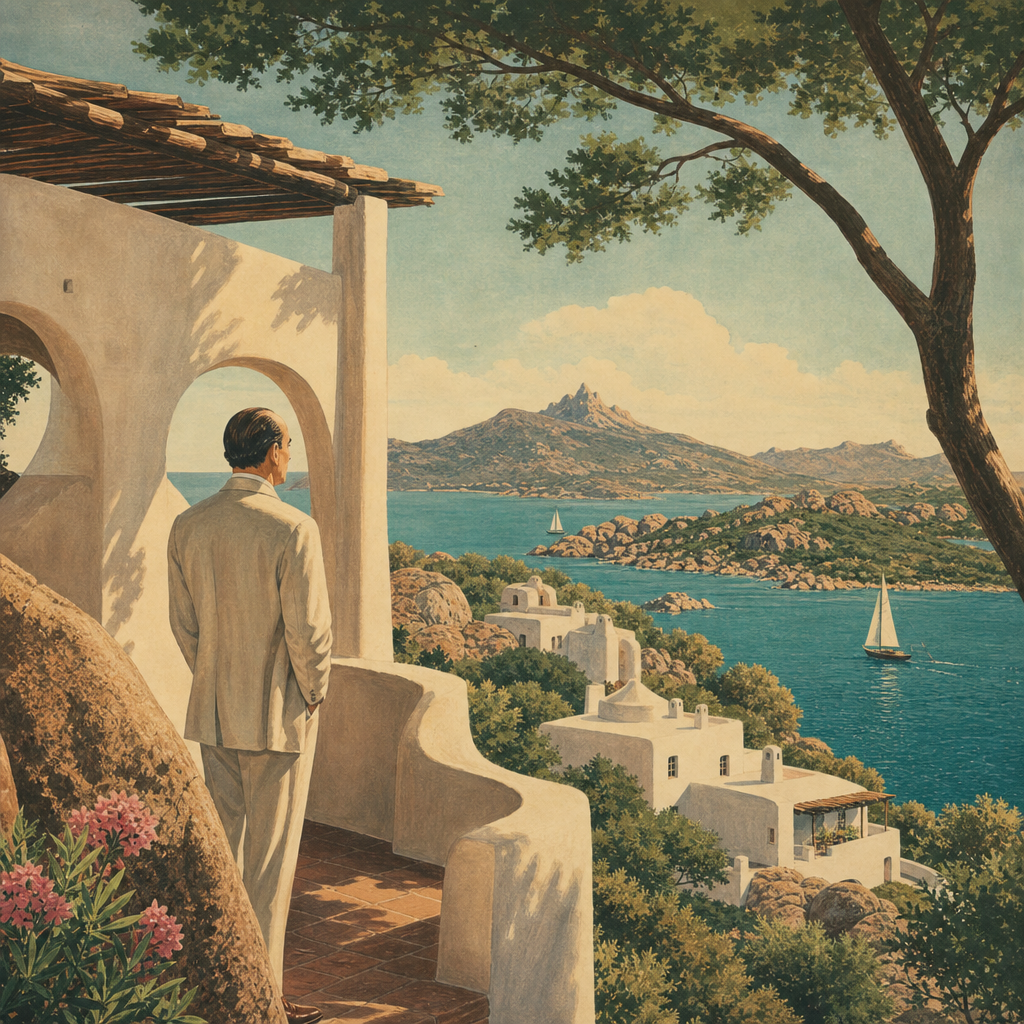
One of the most enduring aspects of the founding of Costa Smeralda concerns architecture. From the outset, the buildings were conceived as part of the landscape. For this reason, forms and materials engage in a dialogue with the sea and vegetation.
The architects involved reinterpreted Gallura’s traditions. Light-colored plaster and irregular volumes created an original synthesis. Thus, a coherent and recognizable Mediterranean image was born.
Public memory and contemporary significance
Decades later, the founding of the Costa Smeralda continues to influence Gallura’s identity. The name of Karim Aga Khan IV emerges in collective memory as part of a complex and shared history.
Commemorative markers and institutional narratives help contextualize that historical turning point. Ultimately, understanding the founding of the Costa Smeralda means looking beyond the image of luxury tourism and recognizing a transformation that profoundly shaped Sardinia.