Arzachena and Costa Smeralda are often considered a single tourist destination. However, to truly understand the destination, it is helpful to know the relationship between the Municipality of Arzachena, Porto Cervo, and the entire Gallura region. Before the coast gained international fame, in fact, there was already a history shaped by landscapes, archaeology, and local traditions.
- Arzachena and Costa Smeralda: the historical roots
- Arzachena and Costa Smeralda: between the inland and the sea
- Arzachena and Costa Smeralda: the archaeological heritage
- Traditions, memory, and local culture
- The Birth of the Costa Smeralda
- The role of the Municipality of Arzachena
- Arzachena today: continuity and change
Arzachena and Costa Smeralda: the historical roots
Arzachena lies in the heart of Gallura. Moreover, its territory preserves evidence spanning millennia of history. This heritage makes the area one of Sardinia’s most significant places from an archaeological and cultural point of view.
Over the centuries, Gallura has developed its own linguistic and social characteristics. As a result, a distinct identity has taken shape within the Sardinian context.
For institutional and historical information, it is useful to consult the Municipality of Arzachena.
Is it possible to understand the Costa Smeralda without knowing the history of the Gallura that preceded it?
According to many scholars, the answer is no. In fact, modern transformations take on meaning only when placed within a broader historical perspective.
Arzachena and Costa Smeralda: between inland and sea
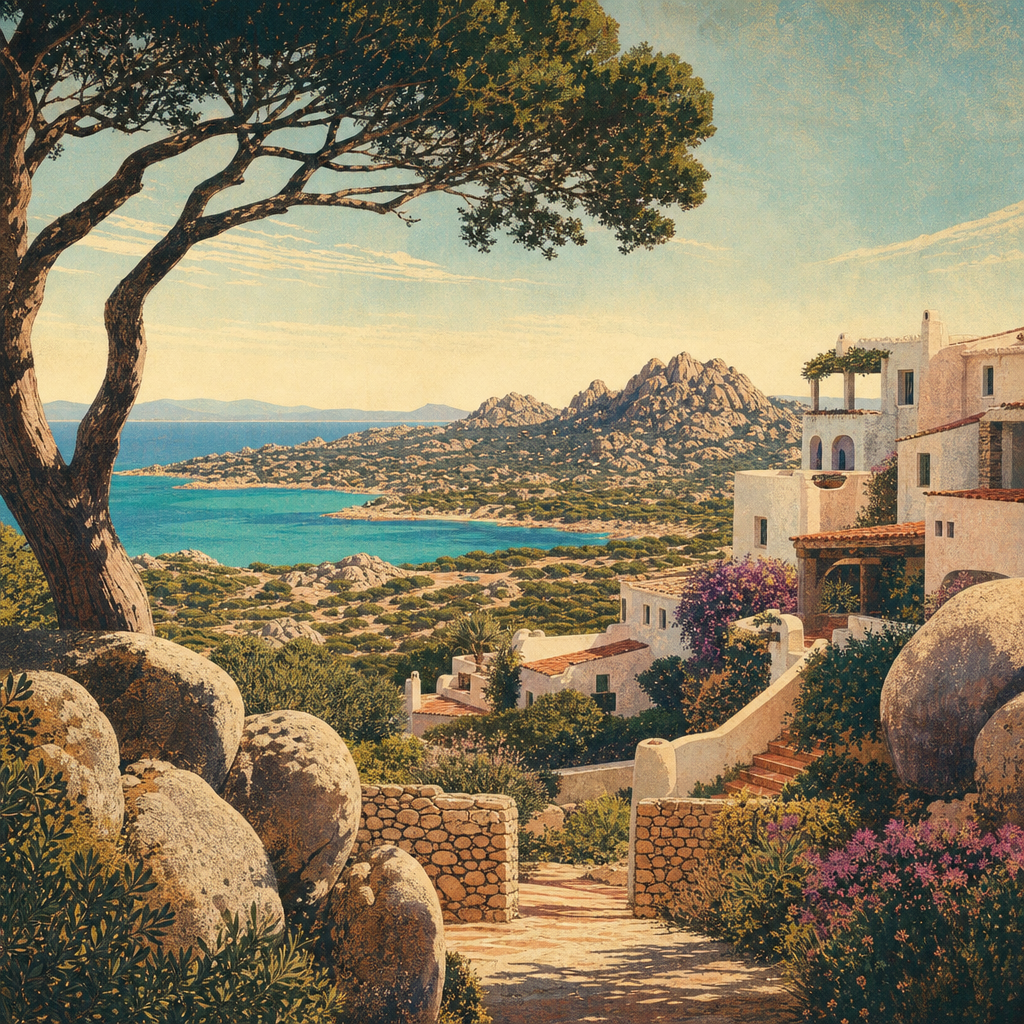
One of the most interesting aspects of Arzachena is the connection between the coast and the inland area. While the beaches capture visitors’ attention, the stazzi, granite hills, and Mediterranean scrub tell an equally important story.
The shapes of the granite define the landscape. Moreover, many of these formations have become cultural and symbolic landmarks.
The coast offers a wide variety of natural environments. At the same time, the inland area preserves traces of the Gallurese rural tradition.
- Granite landscapes of Gallura.
- Mediterranean scrub and biodiversity.
- Historic stazzi.
- Views of the archipelago and the sea.
- Connection between agricultural activities and the coast.
Therefore, Arzachena cannot be seen solely as a seaside destination.
Arzachena and Costa Smeralda: the archaeological heritage
Among the elements that distinguish the area is the presence of important archaeological sites. In particular, the Li Muri Necropolis and the Giants’ Tomb of Coddu Vecchiu are essential stops for understanding local history.
Alongside these monuments are nuraghi and other traces of ancient Sardinia. As a result, visitors can observe a heritage that long predates the rise of modern tourist resorts.
What do the stones of Gallura tell those who look at the territory beyond the surface of the present?
They tell of a long human and cultural continuity. Moreover, they show how the relationship between community and environment has remained central over time.
Traditions, Memory, and Local Culture
Arzachena’s identity is also expressed through traditions, language, and collective memory. Gallurese culture, in fact, is deeply connected to the rural world.
Agricultural and pastoral activities have influenced cuisine, language, and forms of social interaction. Despite economic changes, many of these elements remain recognizable even today.
- Tradition of the stazzi.
- Gallurese language.
- Agricultural and pastoral knowledge.
- Culinary heritage.
- Local festivals and observances.
The birth of the Costa Smeralda
When speaking of Arzachena and the Costa Smeralda, it is impossible not to recall the project launched in the 1960s by Prince Karim Aga Khan IV. Porto Cervo became the symbol of this transformation.
However, the birth of the Costa Smeralda represents one phase in the history of the territory, not its entire identity. Alongside tourism development, the archaeological heritage, Gallurese culture, and rural landscape have remained central.
To explore the historical context of Sardinia in greater depth, it is also useful to consult the information from the Costa Smeralda Consortium.
Furthermore, the growth of tourism has brought new economic opportunities. At the same time, it has opened the debate on protecting the environment and local identity.
The role of the Municipality of Arzachena
The Municipality plays an important role in enhancing the cultural heritage. Through conservation activities and visitor routes, it makes historical and archaeological sites accessible.
It also promotes a vision of the area that goes beyond only the most famous coastal destinations.
Arzachena Today: Continuity and Change
Viewed as a whole, Arzachena and Costa Smeralda reveal a complex reality. On one hand, there are archaeology, traditions, and memory; on the other, an internationally renowned tourist destination.
These dimensions coexist. As a result, the area maintains a strong identity while continuing to evolve.
For visitors, the value of Arzachena and Costa Smeralda emerges precisely from the meeting of past and present. Understanding this connection means getting to know not only Porto Cervo and the famous beaches, but also the broader history of the Municipality of Arzachena and Gallura.