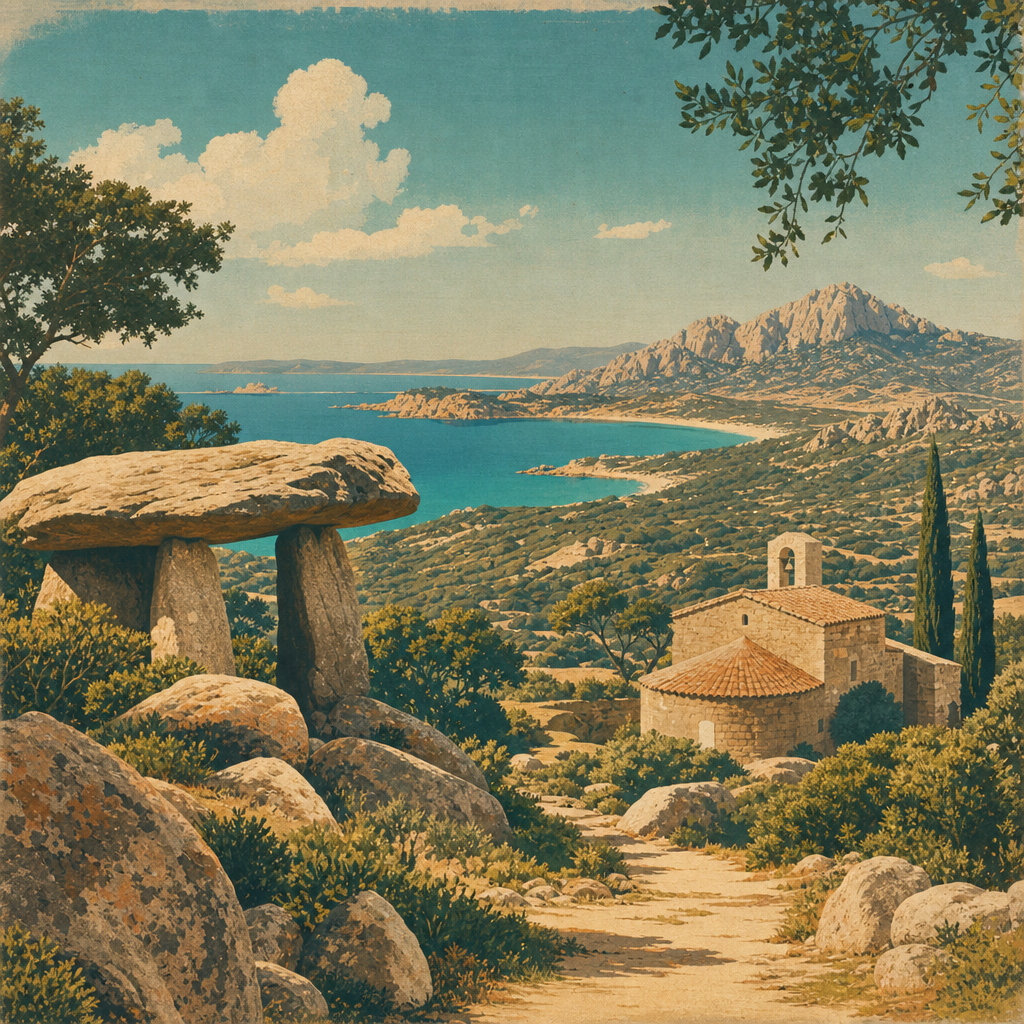
The territory of Arzachena offers a unique landscape, where sea, granite, and Mediterranean scrub are constantly intertwined. From the coastline to the inland hills, each setting helps define an identity that goes beyond the famous Costa Smeralda. Moreover, nature is a central element of the tourist and cultural experience, as it tells the story of the relationship between community and territory.
- Arzachena in the historical and cultural context of Gallura
- Landscape as identity: granite, Mediterranean scrub, and sea
- Ancient landscapes: archaeology, settlements, and the memory of the land
- Before and after the Costa Smeralda: transformations and continuities
- The best natural landscapes in the Arzachena area
- Traditions, community, and cultural heritage
- The role of public memory and the Municipality of Arzachena
- Arzachena between landscape, history, and the future
Arzachena in the Historical and Cultural Context of Gallura
Arzachena occupies a central position in northeastern Gallura. This historic region of Sardinia stands out for its linguistic, cultural, and landscape identity. It is also characterized by granite rocks, rural stazzi, and activities traditionally linked to pastoralism, agriculture, and the sea.
The history of Arzachena unfolds over a very long span of time. Archaeological evidence documents an ancient human presence. Meanwhile, the organization of the territory has adapted to environmental and social changes. As a result, the current landscape is the outcome of a long interaction between people and nature.
To understand the area, it is useful to consider how its identity long predates the creation of the Costa Smeralda. In fact, local communities have built a distinct culture over time, recognizable in the Gallurese language, rural practices, and traditional architecture.
Official information and in-depth resources on the area’s historical and cultural heritage are also available through the Municipality of Arzachena portal.
What remains visible of a millennia-old history when observing a granite hill, a coastal path, or an ancient stazzo immersed in the Mediterranean maquis?
The answer lies in the continuity between landscape and human presence. This very element is what sets Arzachena apart from a mere beach destination.
Landscape as identity: granite, Mediterranean scrub, and the sea
One of the most distinctive aspects of the Arzachena area is the variety of its landscapes. Within just a few kilometers, the landscape shifts from inland highlands to coastal bays. At the same time, wetlands and granite outcrops shaped by the elements can be found.
Granite is the most recognizable hallmark of Gallura. The shapes taken on by the rocks have fueled folk tales and interpretations. Moreover, they strengthen local communities’ sense of belonging.
Alongside the granite, Mediterranean scrubland thrives. Myrtle, mastic, strawberry tree, and juniper contribute to biodiversity. They also define the scents, colors, and seasonal rhythms of the area.
The sea completes this landscape system. However, the coast cannot be understood separately from the inland areas. Bays, beaches, and promontories are part of a broader whole, where historic routes and traditional activities have played an important role.
- Granite outcrops shaped by the wind.
- Widespread Mediterranean scrub and local biodiversity.
- Coastal systems with bays, headlands, and beaches.
- Inland hills and historic rural areas.
- Transition zones between the sea and the hinterland.
For this reason, the landscape of Arzachena is a cultural heritage as well as an environmental one.
Ancient Landscapes: Archaeology, Settlements, and the Memory of the Land
The territory of Arzachena preserves one of the most significant archaeological heritages in northern Sardinia. Prehistoric and Nuragic evidence attests to a very ancient human presence.
Among the best-known sites are La Prisgiona and the Giants’ Tomb of Coddu Vecchiu. Moreover, these monuments maintain a strong visual relationship with the surrounding landscape.
According to available historical reconstructions, water, pastures, and transportation routes influenced the choice of settlement sites. As a result, natural resources were central to the organization of the territory.
Visiting these places means observing the landscape from a different perspective. In fact, rocks, valleys, and hills were an integral part of the daily life of ancient communities.
Before and After the Costa Smeralda: Transformations and Continuities
Talking about Arzachena means engaging with the history of the Costa Smeralda. However, the area has a cultural depth that goes beyond this dimension.
Before the development of international tourism, the local economy was tied mainly to agro-pastoral activities. Later, beginning in the 1960s, the project promoted by Prince Karim Aga Khan IV contributed to the transformation of the area.
The growth of the Costa Smeralda introduced new economic and social dynamics. At the same time, it made the conservation of the landscape and local identity even more important.
Is it possible to tell the story of the Costa Smeralda without forgetting the territory that precedes it and makes it possible?
In recent years, the cultural debate has sought to highlight this broader perspective.
The Best Natural Landscapes in the Arzachena Area
Capo d’Orso and the dialogue between rock and sea
Capo d’Orso is famous for its granite formation shaped by erosion. It also offers a privileged view of the Gallura coastlines.
The coast of Cannigione and the Gulf of Arzachena
Cannigione represents an important meeting point between local history and the marine environment. In addition, the gulf displays a remarkable variety of landscapes.
The beaches and bays of the Costa Smeralda
Liscia Ruja, Capriccioli, Romazzino, and Pevero are well-known destinations. However, their value also stems from the balance between sand, rocks, and Mediterranean vegetation.
The Inland Area and Lesser-Known Landscapes
Away from the coast, hills, rural trails, and ancient stazzi emerge. Here, in fact, the connection between the natural environment and local history is especially clear.
Traditions, community, and cultural heritage
The landscape of Arzachena cannot be separated from the people who have inhabited it. Indeed, traditions, the Gallurese language, and local practices continue to characterize the area.
The tradition of the stazzi represents one of the most significant aspects of historic Gallura. In addition, popular festivals and culinary heritage help keep collective memory alive.
The Role of Public Memory and the Municipality of Arzachena
Promoting the area’s value involves both the environment and public memory. For this reason, cultural promotion and heritage protection activities take on a central role.
Preserving memory makes it possible to connect the different phases of local history. In this way, the landscape is perceived as a shared heritage and not merely as a tourist resource.
Arzachena Between Landscape, History, and the Future
Viewing Arzachena solely through the lens of the Costa Smeralda means seeing only one part of it. In reality, granite rocks, archaeological sites, hills, and bays tell a story that spans millennia.
The birth of the Costa Smeralda marked a decisive turning point. However, the identity of the territory stems from the meeting of memory, traditions, and innovation. For this reason, Arzachena continues to stand out as a place where nature and culture remain deeply inseparable.