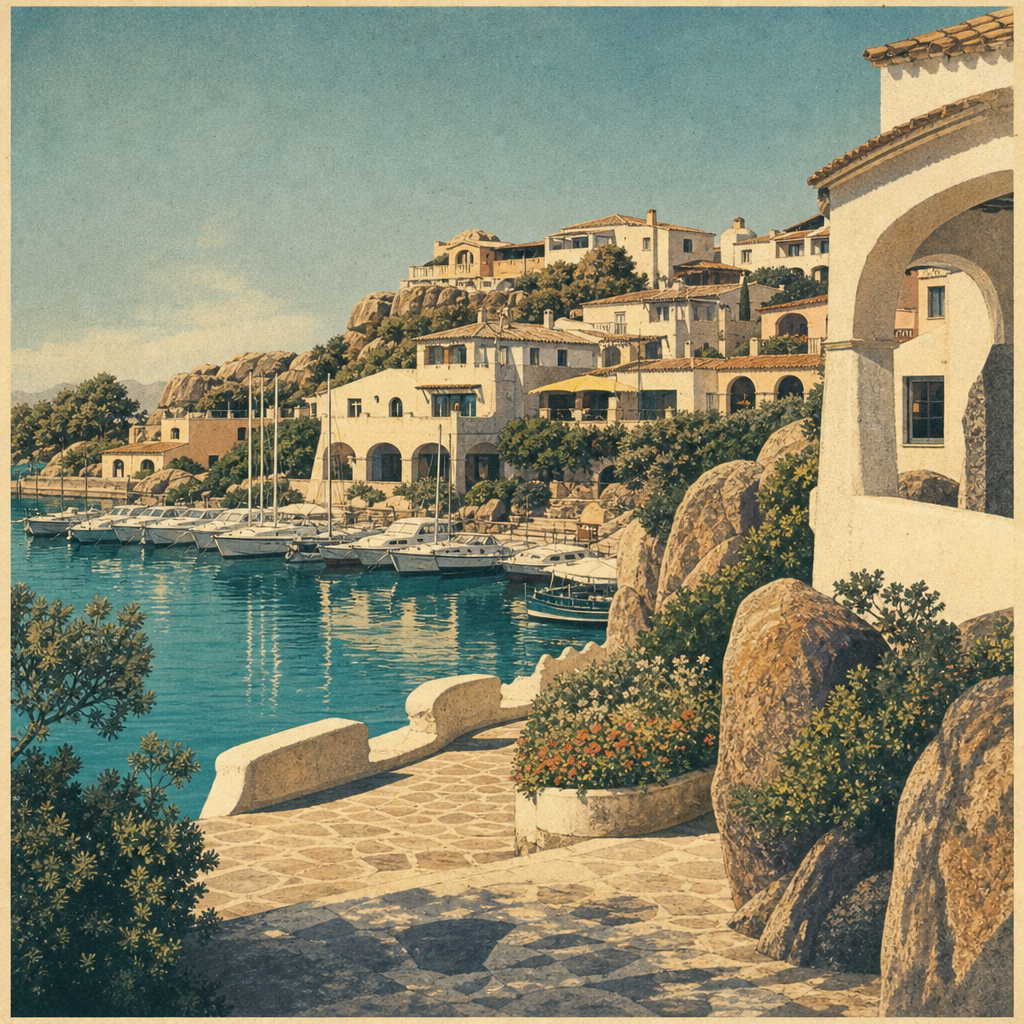
The marina of Poltu Quatu is one of the most representative places in the Arzachena area. Amid wind-sculpted granite, sheltered coves, and views toward the La Maddalena archipelago, this resort village reveals the connection between architecture, sea, and landscape. Moreover, its significance fully emerges when placed within the broader identity of Gallura.
- Poltu Quatu in the Arzachena and Gallura area
- The coastal landscape between nature, granite, and sea
- Arzachena before the Costa Smeralda: history and identity
- The transformations of the area and the birth of the Costa Smeralda
- The architecture of Poltu Quatu and its dialogue with the landscape
- Public memory, cultural heritage, and the role of the Municipality of Arzachena
- Beyond the tourist image: the cultural significance of Poltu Quatu
Poltu Quatu in the Arzachena and Gallura Area
Poltu Quatu is located along one of the most striking stretches of the Arzachena coastline. The name is generally interpreted as “hidden harbor”. Indeed, the bay is secluded and protected by granite promontories.
However, the area cannot be understood solely as a seaside destination. Arzachena preserves a historical and archaeological heritage of great value, with evidence documenting a human presence dating back thousands of years.
Understanding this place means connecting it to a network of relationships between the coast and the hinterland. Moreover, stazzi, agricultural areas, pastures, and settlements have helped shape a complex identity that is still recognizable.
To learn more about the territorial and cultural context, you can visit the website of the Municipality of Arzachena.
The coastal landscape between nature, granite, and sea
One of the most significant aspects of Poltu Quatu is its relationship with the natural landscape. Gallura, in fact, is characterized by the dominant presence of granite, an element that defines much of the local identity.
The rugged coastline, Mediterranean vegetation, and deep inlets create a cohesive and distinctive environment. In addition, the sea has influenced trade, movement, and relations with the rest of the Mediterranean for centuries.
The village is set within a naturally sheltered bay. From here, the islands of the Maddalena Archipelago are easy to see. As a result, its location has helped establish it as a tourist marina.
- Granite formations typical of Gallura.
- Mediterranean scrub with junipers, mastic trees, and strawberry trees.
- Sheltered bays and small coastal inlets.
- Proximity to the La Maddalena archipelago.
- Visual continuity between the coast and the inland areas.
How much of a place’s identity depends on its architecture, and how much instead on the landscape that welcomes it?
In the case of Poltu Quatu, the balance between human intervention and nature represents one of the central themes of its recent history.
Arzachena before the Costa Smeralda: history and identity
Long before the Costa Smeralda gained international fame, Arzachena had a strong historical and cultural identity. Archaeological evidence confirms an ancient human presence.
The Giants’ Tomb of Coddu Vecchiu, Nuraghe Albucciu, and the Li Muri complex reveal the long-standing relationship between communities and the land. They also speak to Gallura’s importance across different historical periods.
Over the centuries, livestock farming and agriculture played a fundamental role. The stazzi, in particular, served as centers of social and productive life.
At the same time, linguistic, culinary, and religious traditions have helped shape an intangible heritage that is still alive today. For this reason, the coast’s fame represents only one part of Arzachena’s historyThe transformation of the area and the birth of the Costa SmeraldaBeginning in the 1960s, the area entered a phase of profound transformation. As a result, the local economy, the relationship with the landscape, and Gallura’s international visibility changed.
rinaPrince Karim Aga Khan IV played a central role in this process. However, the history of the Costa Smeralda also involves local communities, professionals, public administrations, and economic operators.
The encounter between rural tradition and tourism development produced lasting effects:
- Growth of coastal infrastructure.
- Development of the tourism economy.
- Greater international visibility for Gallura.
- Enhancement of the landscape.
- The need to reconcile development and environmental protection.
Porto Cervo became the most widely recognized symbol of this period. Nevertheless, Arzachena’s identity remains broader and is rooted in a much earlier history.
The architecture of Poltu Quatu and its dialogue with the landscape
The architecture of Poltu Quatu was designed to engage in dialogue with its natural surroundings. Indeed, restrained volumes, Mediterranean colors, and pedestrian pathways foster visual continuity with the bay.
The marina forms the heart of the area. Moreover, piers, boats, and public spaces blend with the coastal morphology, creating a meeting point between the sea and urban life.
Naturally, every transformation of the territory prompts reflection. For this reason, the village is often viewed as an example of the delicate balance between economic development and landscape protection.
- Materials and colors in keeping with the Mediterranean setting.
- Squares and pathways overlooking the sea.
- Visual integration with the natural bay.
- The centrality of the port as a place of connection.
- Constant dialogue between the built environment and the landscape.
Public Memory, Cultural Heritage, and the Role of the Municipality of Arzachena
The growth of coastal towns has made the preservation of historical memory even more important. In this context, the Municipality of Arzachena promotes activities dedicated to cultural and archaeological heritage.
Public memory is not only about famous figures or major events. On the contrary, it also includes the stories of shepherds, fishermen, and families who contributed to shaping Gallurese identity.
Thanks to these initiatives, places like Poltu Quatu are placed within a broader narrative. In this way, visitors can better understand the historical and cultural layers of the area.
Is it possible to understand the Costa Smeralda without knowing the Gallura that existed before its birth?
History suggests that the two dimensions are closely connected. Indeed, modernity and tradition are part of the same territorial journey.
Beyond the Tourist Image: The Cultural Significance of Poltu Quatu
Today, Poltu Quatu is one of the most recognizable places on the Arzachena coast. The marina, the seaside architecture, and the panoramic location all contribute to its renown.
However, its value goes beyond its tourist image. The location is linked to the history of Gallura and to the transformations that affected the area in the 20th century.
Arzachena continues to bring together archaeological heritage, rural traditions, and international openness. As a result, Poltu Quatu represents a significant milestone within a broader history.
Looking at the surrounding landscape, the continuity between nature, culture, and memory becomes clear. It is precisely this layering that gives depth to the visitor’s experience and strengthens the bond between the village, the sea, and the identity of the area.