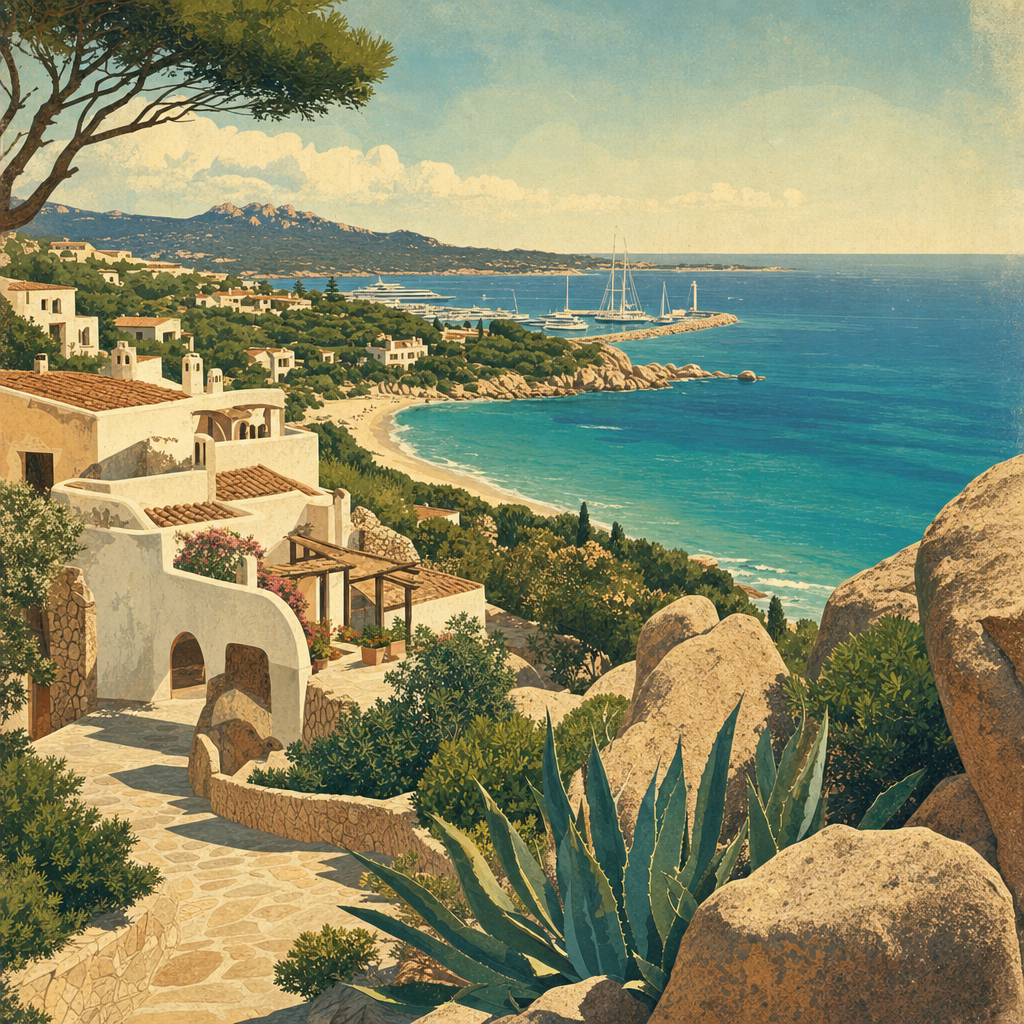
Baja Sardinia is one of the most significant places on Sardinia’s northeastern coast, where tourism, landscape, and local culture intertwine naturally. Overlooking a sea with turquoise hues and surrounded by Gallura’s distinctive granite rocks, the resort has grown alongside the Costa Smeralda. It also offers a privileged vantage point for understanding the area’s tourism development. Today, it continues to attract visitors thanks to its balance of services, environmental quality, and accessibility.
- Baja Sardinia and the transformation of northeastern Sardinia
- Baja Sardinia in the territorial context of Gallura
- Baja Sardinia: Porto Cervo, the marina, and public spaces
- Architecture, landscape, and visual identity
- Swimming, accessibility, and maritime culture
- Territorial memory and the future of the coast
Baja Sardinia and the Transformation of Northeastern Sardinia
Until the mid-20th century, much of the Gallura coastline was sparsely developed. The main activities were pastoralism, agriculture, and fishing. Although the area already had considerable scenic value, many coastal areas were difficult to reach.
The turning point came in the early 1960s with the launch of the Costa Smeralda project. In particular, Karim Aga Khan IV helped define a vision based on enhancing the landscape. The goal was not merely to build hospitality facilities. Rather, the aim was to create a destination integrated with the natural environment.
The establishment of the Costa Smeralda Consortium in 1962 set in motion a planning process that involved international professionals. As a result, northeastern Sardinia developed a recognizable image based on a balance between tourism and the environment.
Baja Sardinia within the territorial context of Gallura
Baja Sardinia is located in the municipality of Arzachena, between Cannigione and Porto Cervo. Thanks to its position on the Gulf of Arzachena and its proximity to the La Maddalena archipelago, it has developed its own identity while remaining connected to the Costa Smeralda.
One of its distinctive features is the presence of a large, easily accessible bay. For this reason, the resort has become a popular destination for families, couples, and visitors from various countries.
Over the years, Baja Sardinia has become one of the main gateways to tourism in northeastern Sardinia. In addition, its proximity to Olbia has encouraged fast connections by sea and by air.
- Granite formations shaped by the wind.
- Widespread Mediterranean scrub.
- Views of the sea and the surrounding islands.
- Cultural traditions of the Arzachena area.
- A constant relationship between nature and human settlements.
This combination of accessibility and territorial identity represents one of the most interesting aspects of the resort’s evolution. It also helps distribute tourist flows among the different areas of the coast, encouraging broader enjoyment of the territory.
Baja Sardinia: Porto Cervo, marina, and public spaces
When talking about the Costa Smeralda, Porto Cervo holds a central place. Created as the heart of the tourism project of the 1960s, it was conceived as a harmonious system of squares, pathways, and moorings.
The natural inlet has profoundly influenced the urban layout. As a result, many architectural structures follow the slopes of the terrain and engage in dialogue with the surrounding landscape.
The marina has become one of the area’s most recognizable symbols. In addition to its nautical function, it represents a meeting place between the sea, architecture, and social life.
- Porto Cervo Piazzetta.
- Marina and tourist port.
- Stella Maris Church.
- Historic hotel complexes.
- Scenic routes along the sea.
At the same time, these spaces help shape the destination’s international image while maintaining a strong connection to the coastal landscape.
Architecture, landscape and visual identity
One of the most studied aspects of the Costa Smeralda concerns its architectural language. From the very beginning, the designers sought to integrate the buildings into the natural setting.
Architects such as Michele Busiri Vici and Jacques Couëlle helped define a style characterized by soft lines and local materials. However, it was not a simple reproduction of traditional Gallurese architecture. On the contrary, the aim was a contemporary reinterpretation.
- Light-colored plaster and sculpted surfaces.
- Local stone and granite.
- Terraces integrated into the landscape.
- Winding paths and intimate squares.
- Watch out for the scenic views.
Baja Sardinia also reflects this design philosophy. Indeed, the relationship between the built environment and nature remains one of the area’s distinctive features.
Swimming, Accessibility, and Maritime Culture
The sea is the main attraction for residents and visitors. However, beachgoing is also a cultural component that influences the way people experience the coast.
The main beach is appreciated for its light-colored sand and generally shallow seabeds. Thanks to these features, it is accessible to different types of visitors.
- Liscia Ruja.
- Capriccioli.
- Romazzino.
- Pevero.
- Cala Granu.
- Coves of the Gulf of Arzachena.
The value of these beaches does not depend solely on the quality of the waters. In fact, granite rocks, Mediterranean vegetation, and crystal-clear sea create a strong sense of landscape continuity.
Alongside the growth of tourism, attention to environmental protection has increased. For official information about the area, you can consult the Municipality of Arzachena.
Moreover, the presence of infrastructure, seasonal services, and efficient connections makes the experience more accessible. As a result, the area successfully combines beach activities, excursions, and the discovery of its natural heritage.
Territorial memory and the future of the coast
The history of the Costa Smeralda cannot be interpreted solely through tourism. Behind its international image lies a territory with deep cultural and social roots.
The development that has taken place since the 1960s has created new economic opportunities. At the same time, it has prompted reflection on sustainability and the preservation of local identity.
Baja Sardinia offers a privileged vantage point for understanding these changes. Here, the sea remains the main protagonist, while granite promontories, Mediterranean vegetation, and views toward La Maddalena continue to define the character of the place.
In conclusion, the area’s reputation stems not only from the beauty of its beaches, but also from its ability over time to build a strong territorial identity, rooted in Gallura and open to the contemporary Mediterranean. Therefore, Baja Sardinia continues to represent a significant example of the relationship between tourism development, coastal landscape, and the enhancement of local resources.