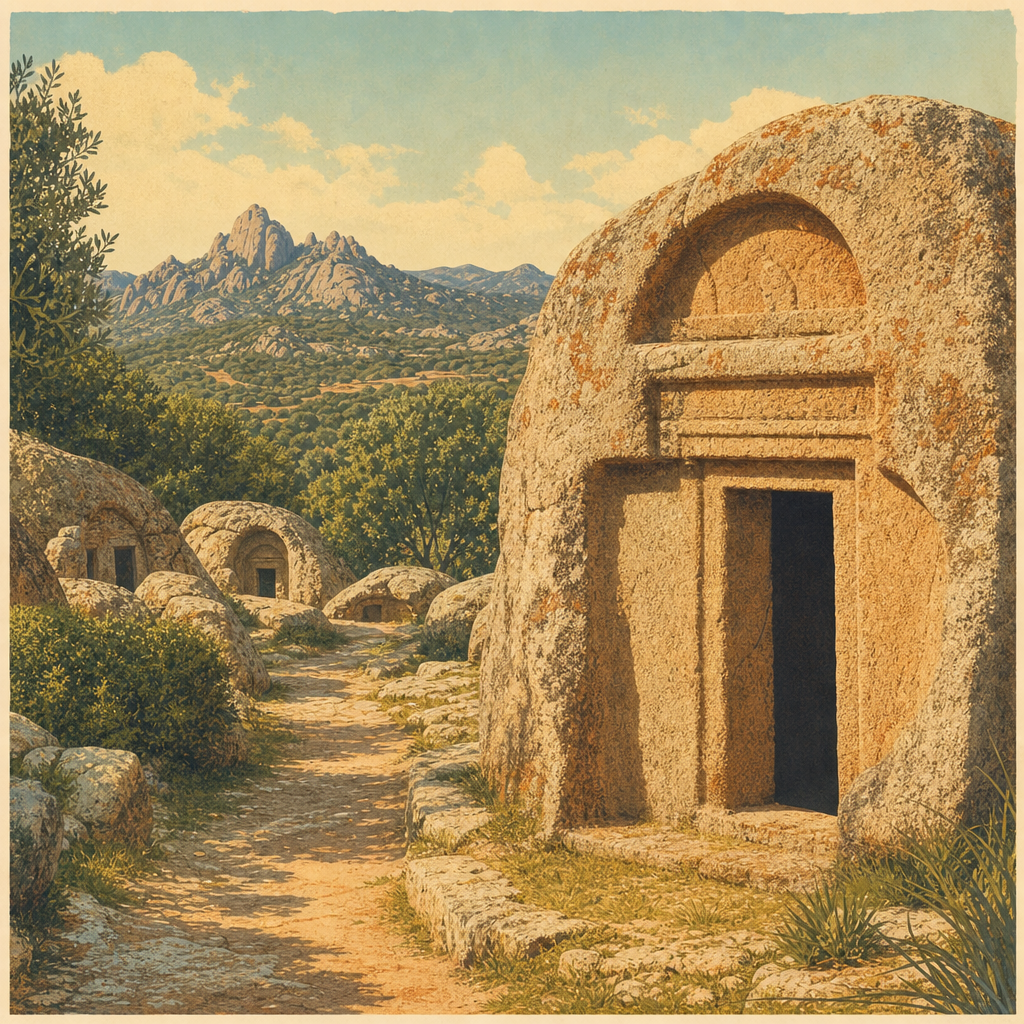
Amid wind-sculpted granite, hills dotted with Mediterranean scrub, and horizons that connect the inland landscape to the sea of Gallura, the Li Muri Necropolis tells a story far older than the celebrated contemporary image of the Costa Smeralda. Moreover, this archaeological site helps reveal the deep roots of Arzachena and the value of its cultural heritage.
- The Li Muri Necropolis and Its Historical Significance
- Li Muri Necropolis: Arzachena before the Costa Smeralda
- Li Muri Necropolis: The Gallura Landscape as an Archive of Memory
- Traditions, Identity, and Cultural Continuity
- From Rural Gallura to the Costa Smeralda
- Protection, enhancement, and the role of the Municipality of Arzachena
- The Legacy of Li Muri in the Present
The Li Muri Necropolis and Its Historical Significance
The Necropolis of Li Muri is located within the municipality of Arzachena. It is considered one of the most important funerary complexes in Sardinia from the Final Neolithic period. For this reason, it represents an essential reference point for the study of Gallura’s prehistory.
The complex consists of circular burials built with stone slabs. In addition, the stone rings that surround them make the site easily recognizable. Next to the tombs are structures interpreted as areas for ritual offerings.
The necropolis is an exceptional record for understanding the relationship between prehistoric communities and the land. Indeed, the burials also held strong symbolic and identity-defining value.
For a deeper understanding of the local context, it may be useful to read historic Gallura before the Costa Smeralda. In addition, the Municipality of Arzachena provides information on the local cultural heritage.
What do a few simple stones arranged in a circle tell us when they are observed as traces of a community that lived thousands of years ago?
The answer lies in the site’s ability to preserve a material memory. Each element bears witness to a relationship between daily life, spirituality, and landscape. As a result, Li Muri is much more than a simple archaeological site.
Li Muri Necropolis: Arzachena Before the Costa Smeralda
For many visitors, Arzachena is associated above all with the Costa Smeralda. However, the history of the area is much older. Long before the tourism development of the twentieth century, the area was already an important center of human settlement.
Archaeological evidence is numerous. In addition to Li Muri, there are Nuragic monuments, Giants’ Tombs, and rural settlements. Thus, a continuity of human presence spanning millennia emerges.
Inland Gallura was characterized by a network of stazzi. Agricultural and pastoral activities developed here. At the same time, these communities maintained a strong bond with the surrounding environment.
Arzachena served as a point of reference between the inland areas and the coast. Therefore, this territorial dimension remains essential to understanding local history.
Necropolis of Li Muri: The Gallura Landscape as an Archive of Memory
Observing the Li Muri Necropolis also means observing the landscape that surrounds it. In Gallura, in fact, the land is an integral part of history.
The granite rocks shaped by the elements are among the region’s most recognizable features. In addition, local stone was used by ancient populations to build monuments and structures.
Gallura features an alternation between inland areas and coastal zones. As a result, exchanges, mobility, and cultural adaptations developed over time.
Even today, the landscape retains a powerful narrative quality. Those who travel through the countryside of Arzachena encounter evidence of different eras coexisting in the same space.
Is it possible to understand Gallura by observing only the sea, without considering the hills and the places of memory?
The answer suggested by the territory is no. On the contrary, Gallura’s history emerges from the meeting of coast and hinterland.
Traditions, Identity, and Cultural Continuity
The Li Muri Necropolis belongs to a very remote past. However, its value is not limited to archaeology. It represents one of the earliest testimonies to the relationship between community and territory.
Over the centuries, Gallura has developed traditions linked to language, rural architecture, and pastoralism. Moreover, these elements share a strong connection with the land.
The stazzi, for example, long represented the core of Gallura’s social organization. For this reason, they are considered important evidence of local cultural continuity.
Interpreting Li Muri means recognizing that cultural heritage includes monuments, landscapes, memories, and traditions. In this way, the identity of the area can be better understood.
From rural Gallura to the Costa Smeralda
One of the most significant chapters in Arzachena’s contemporary history concerns the birth of the Costa Smeralda. Before this phase, much of the coastal area was scarcely urbanized.
The arrival of Karim Aga Khan IV and the development of the tourism project marked a profound change. As a result, Porto Cervo became an international point of reference.
However, reducing Arzachena’s history to the Costa Smeralda alone would be limiting. The transformations of the twentieth century took root in a territory already rich in history and culture.
For this reason, sites like Li Muri play a central role in telling the story of the area.
Protection, promotion, and the role of the Municipality of Arzachena
The conservation of the Li Muri Necropolis represents an important responsibility. In particular, the protection of heritage requires balance and constant attention.
The Municipality of Arzachena promotes historical knowledge of the area through cultural activities and itineraries dedicated to collective memory. In addition, these initiatives help connect the past and the present.
The beaches and coastal resorts are only one part of the Arzachena experience. Alongside them, there is an archaeological heritage that tells a much longer story.
Finally, protection is not only about the physical conservation of monuments. It also means passing on their meaning to future generations.
The Legacy of Li Muri in the Present
The Li Muri Necropolis continues to speak to the present because it raises questions about the relationship between memory, community, and territory. At the same time, it helps interpret Arzachena’s contemporary landscape.
In an area often identified with the Costa Smeralda, the presence of such a significant prehistoric site invites a broader interpretation. Indeed, Arzachena is the result of a long succession of human experiences.
Gallura appears as a place where different eras coexist. Thus, Neolithic necropolises, Nuragic monuments, stazzi, and modern centers form a complex mosaic.
Understanding Li Muri means recognizing the value of public memory. It also means observing the landscape through the stories it preserves. Finally, it means understanding that Arzachena’s identity arises from the meeting of archaeological heritage, the natural environment, and local traditions.