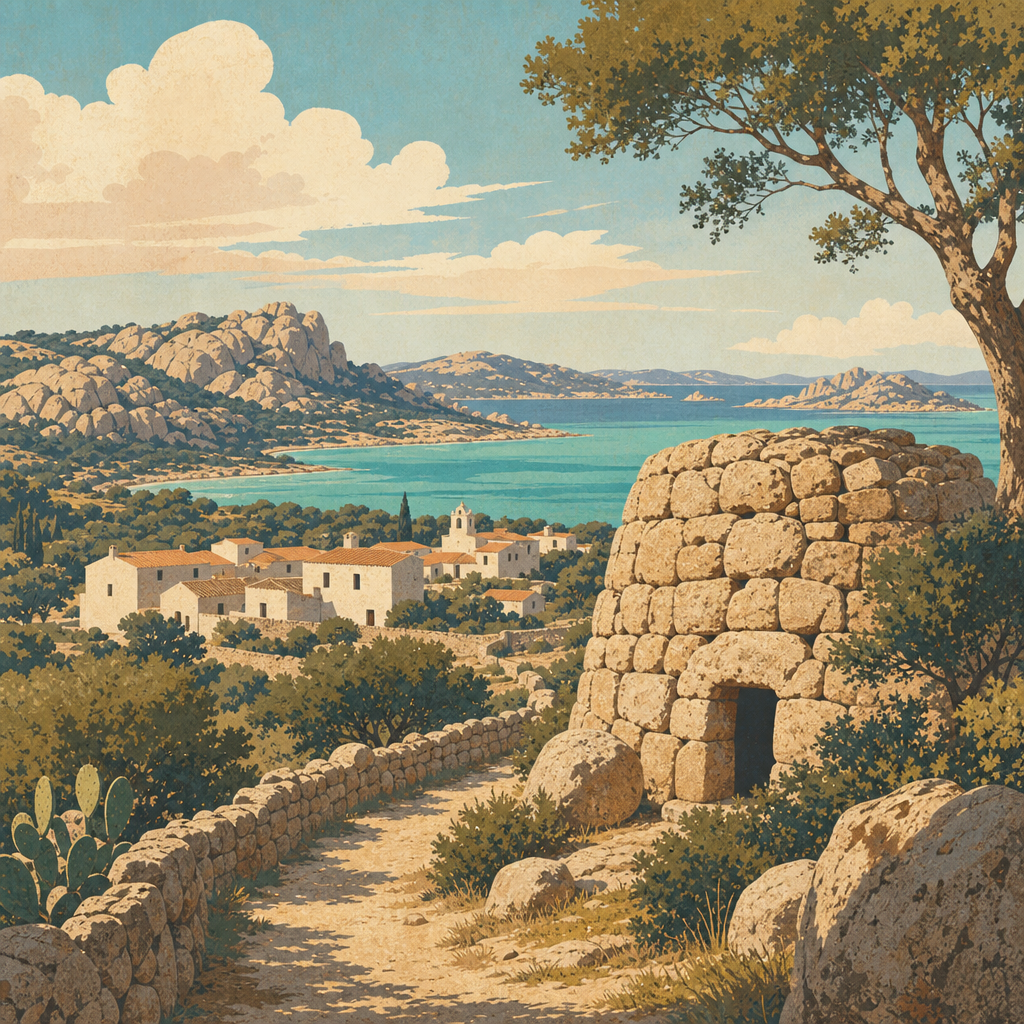
Historic Gallura tells the story of the context that preceded the birth of the Costa Smeralda. Before this stretch of Sardinia became an international destination, the territory of Arzachena and Gallura already carried an ancient history, shaped by granite, wind, pastures, and a deep relationship with the sea. Hills sculpted by time, stazzi scattered across the countryside, and some of the island’s most significant prehistoric monuments describe a reality that existed before the tourism development of the 1960s. Moreover, understanding Arzachena means coming into contact with a long historical continuity, with a collective memory that brings together landscape, community, and identity.
- Historic Gallura before the Costa Smeralda
- The Landscape as Cultural Identity
- Arzachena and the traces of ancient civilizations
- The stazzi, rural life, and Gallurese traditions
- The transformation of the territory and the birth of the Costa Smeralda
- Public memory, heritage, and the role of the Municipality of Arzachena
- Continuity, transformation, and the cultural value of the territory
Historic Gallura before the Costa Smeralda
Gallura occupies the northeastern part of Sardinia and has distinctive geographical and cultural characteristics. The landscape is dominated by granite outcrops, rounded hills, inland valleys, and an intricate coastline. However, for centuries the most important element for local communities was not the shoreline, but rather the balance between agriculture, livestock farming, and the use of natural resources.
Arzachena represents one of the most significant centers of this territorial history. Located between the inland areas and the sea, it developed over time a particular relationship with both dimensions of the landscape. Moreover, the countryside, stazzi, and traditional connecting routes formed a network of daily life far more important than the future tourist infrastructure.
Historical and archaeological evidence points to an extremely ancient human presence. This territory preserves traces spanning different eras, from prehistory to the modern age. As a result, this layering still represents one of the main keys to understanding the local identity.
To learn more about the historical, cultural, and institutional heritage of the area, a key reference source is the portal of the Municipality of Arzachena, which provides information dedicated to history, archaeological sites, and initiatives aimed at enhancing local memory.
What does a territory reveal when it is observed beyond the most well-known images of its coastline?
The answer emerges from the encounter between landscape, archaeology, traditions, and collective memory. Indeed, Gallura’s history does not begin with international tourism, but is rooted in millennia of human presence.
Historic Gallura: The Landscape as Cultural Identity
In Gallura, the landscape is not merely a natural backdrop. On the contrary, it is an active element in the formation of community identity. Granite rocks, cork oak forests, Mediterranean scrub, and coastal areas have influenced settlements, economic activities, and ways of life.
Arzachena offers a particularly clear example of this relationship. Within just a few kilometers, rural areas, hills, agricultural plains, beaches, and promontories coexist. For this reason, the environmental variety has helped create a complex territorial culture.
Many visitors come to know the area through its most famous coastal destinations. However, when looking at the territory as a whole, a much broader cultural geography emerges. Historic routes, archaeological areas, and ancient settlements tell the story of a Gallura that developed long before modern tourism.
- The granite formations shaped by erosion.
- The forests and traditional cork oak groves.
- Mediterranean scrubland and coastal biodiversity.
- The countryside historically linked to the stazzi.
- The bays and natural harbors.
- The historical connections between the inland areas and the coast.
This environmental richness has fostered a perception of the territory based on the balance between human activities and natural resources. As a result, it continues to represent an essential element of contemporary identity.
Historic Gallura: Arzachena and the Traces of Ancient Civilizations
One of the most fascinating aspects of Arzachena is the concentration of archaeological evidence. The area is considered one of the most important in Sardinia due to the presence of monuments that document very ancient periods.
Among the best-known sites are the Li Muri Necropolis, the Albucciu Nuraghe, and the Giants’ Tomb of Coddu Vecchiu. Moreover, these monuments make it possible to trace the evolution of ancient communities over the millennia.
These places are important not only for their scientific value. In fact, they represent an integral part of Gallura’s cultural landscape. Set among rocks, vegetation, and historic routes, they continue to engage in dialogue with the surrounding territory.
According to available historical reconstructions, the area’s geographic position encouraged contact with other parts of the Mediterranean. While maintaining its own specific characteristics, the territory took part in broader dynamics that involved all of Sardinia.
For contemporary visitors, these monuments offer a different perspective from the more familiar images of the coast. Indeed, they make it possible to understand just how deep the historical roots of the local community run.
Is it possible to understand contemporary Gallura without listening to the voices of the civilizations that inhabited this territory thousands of years ago?
Archaeological evidence suggests the answer is no. Indeed, the present continues to engage with a heritage that spans very different eras.
The stazzi, rural life, and Gallurese traditions
To understand Gallura before the Costa Smeralda, it is essential to know the system of the stazzi. The stazzi were residential and productive units scattered throughout the countryside. Moreover, they served as true centers of social and economic organization.
Through the stazzi, a culture developed based on agricultural work, livestock farming, and the management of local resources. Families adapted their activities to the seasonal rhythms and environmental characteristics of the territory.
This model contributed to the formation of a strong cultural identity. Language, traditions, rural architecture, and social customs developed in close connection with the landscape. Even today, many aspects of Gallurese culture stem from this historical experience.
- The tradition of the stazzi and dispersed settlement.
- Historical agro-pastoral practices.
- Products tied to the land and livestock farming.
- Community festivals and social gatherings.
- The Gallurese language as an expression of identity.
- Traditional knowledge of the landscape and the seasons.
The memory of this rural world remains present in place names, historic architecture, and oral accounts. Moreover, many cultural initiatives continue to promote its heritage.
The transformation of the territory and the birth of the Costa Smeralda
In the 1960s, the territory of Arzachena entered a new phase in its history. The initiative promoted by Prince Karim Aga Khan IV and his collaborators led to the birth of the Costa Smeralda.
The development of Porto Cervo and the related infrastructure helped transform part of the coastline into one of the best-known destinations in the Mediterranean. As a result, the change had lasting economic, social, and territorial effects.
It is important to view this process within its historical context. The Costa Smeralda did not emerge in a territory without identity. On the contrary, it developed in a region that already had an established history, culture, and landscape.
- The development of new infrastructure.
- The growing international visibility of the area.
- The expansion of economic activities related to tourism.
- Demographic and employment growth.
- The evolution of the relationship between coastal areas and inland areas.
- New challenges related to landscape protection.
Porto Cervo gradually became the best-known symbol of this era. However, reducing Arzachena to this single image would mean overlooking a much broader reality.
The history of the Costa Smeralda can be interpreted as an important phase in local transformation. However, it does not represent the origin of Gallurese identity.
Public Memory, Heritage, and the Role of the Municipality of Arzachena
In recent decades, the area’s growing international renown has made the work of safeguarding public memory even more important. In this context, the Municipality of Arzachena plays a significant role in promoting its historical, archaeological, and cultural heritage.
The preservation of archaeological sites and the promotion of local traditions are essential tools. Indeed, they help keep the connection between past and present alive.
Public memory is also expressed through symbolic places and initiatives dedicated to the figures who contributed to the transformation of the area. These include the institutional recognition granted to Prince Karim Aga Khan IV and the commemorative elements found in Porto Cervo.
These markers of contemporary memory add to Gallura’s older evidence. As a result, the territory can be read as a series of historical layers.
For visitors, this approach offers a particularly useful perspective. It makes it possible to understand Arzachena through the processes that have shaped its identity over time.
Continuity, transformation, and the cultural value of the territory
The Gallura that existed before the Costa Smeralda does not belong to a past separate from the present. On the contrary, it continues to live on in the landscapes, traditions, archaeological sites, and the memory of its communities.
Arzachena is one of the places where this continuity is particularly evident. The transformations linked to tourism development have changed the area’s economy and image. However, they have not erased the traces of earlier eras.
Looking at the area as a whole, a reality emerges made up of many intertwined stories. From prehistoric communities to the families of the stazzi, each phase has helped shape the local identity.
The fame of the Costa Smeralda certainly constitutes a significant part of Arzachena’s recent history. However, the cultural depth of the area is not exhausted by its most celebrated images.
For those who truly wish to understand this corner of Sardinia, Gallura appears as a mosaic of continuity and transformation. Here, memory and innovation coexist in a land that has embraced change without losing its connection to its roots.