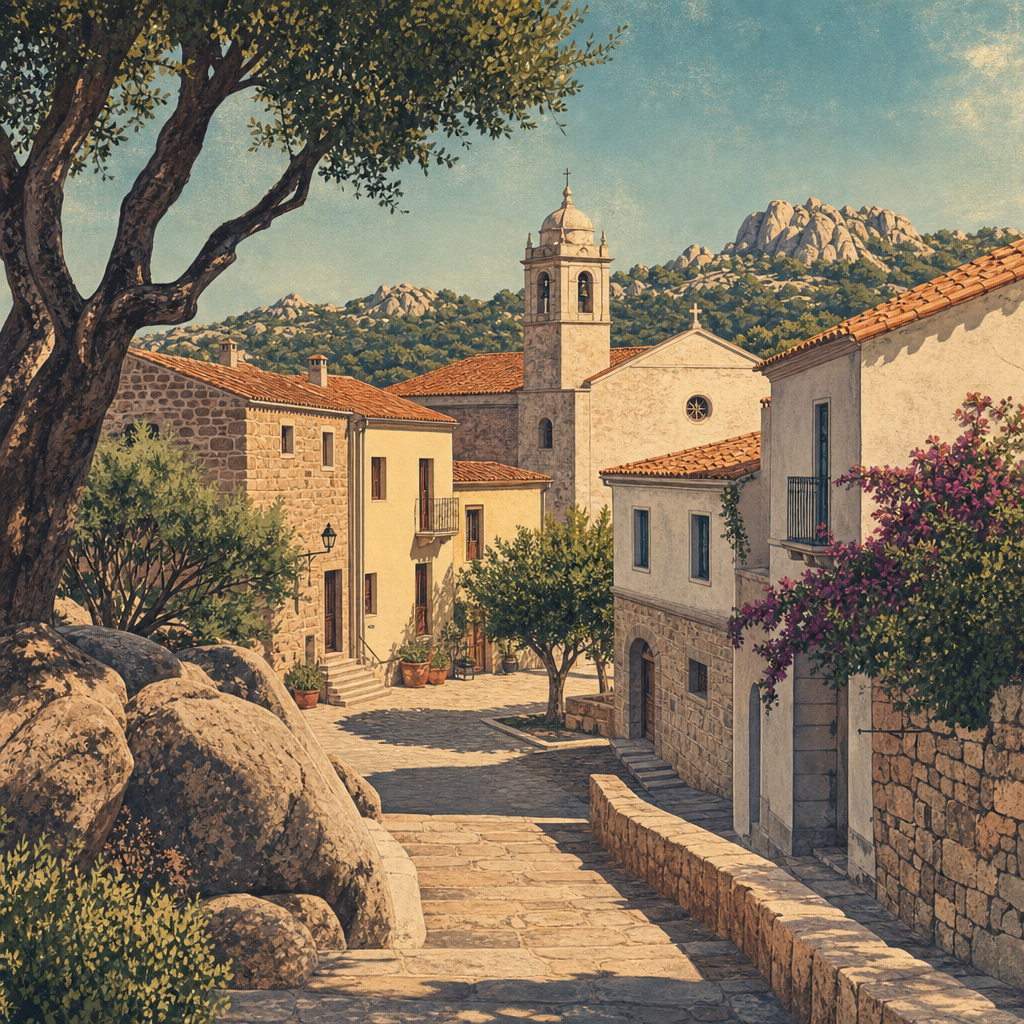
Among the wind-sculpted granite rocks and the hills of Gallura, the historic center of Arzachena reveals a side of Sardinia often less known than the coast. Here, squares, churches, urban views, and local traditions tell a story that predates international tourism. Visiting it means discovering Gallurese identity with a more informed perspective.
- Historic Center of Arzachena: The Historical Origins of Arzachena’s Center
- Historic center of Arzachena: Arzachena in the context of Gallura
- Landscape, Granite, and Territorial Identity
- Traditions, Culture, and Collective Memory
- Before and after the Costa Smeralda
- Safeguarding heritage and memory
- Why visit the historic center of Arzachena
Historic center of Arzachena: The historical origins of Arzachena’s center
Arzachena’s historic center is one of the most interesting places for understanding the evolution of Gallura. Although the area has been inhabited since prehistoric times, the modern urban core developed mainly between the 18th and 19th centuries.
For centuries, the population lived in stazzi and small rural settlements. Moreover, these communities helped define the social and economic identity of the area.
In the heart of the town, buildings made of local granite stand out. As a result, the urban landscape maintains a strong connection with the surrounding environment. Among its most recognizable symbols is the Church of Santa Maria della Neve, set on a rise overlooking the town.
To learn more about local history, you can visit the Municipality of Arzachena.
Historic center of Arzachena: To fully understand the historic center of Arzachena, it must be placed within the context of Gallura. This historic region has a strong cultural, linguistic, and landscape identity.
Over the centuries, diverse influences have helped shape the local culture. In addition, ties with Corsica and agro-pastoral activities have left deep traces.
Located between the inland and the sea, Arzachena has served as a link between different environments. For this reason, it preserves a tradition that is open yet deeply rooted.
- use of granite in construction;
- the legacy of the stazzi;
- pastoral traditions;
- religious and community festivals;
- food and wine culture;
- bond between landscape and human settlement.
Landscape, Granite, and Local Identity
One of the most fascinating aspects concerns the relationship between the town and the landscape. Indeed, nature and human development appear closely connected.
The granite formations define the horizon and have influenced local architecture, productive activities, and culture. At the same time, the town blends harmoniously with the hills and Mediterranean vegetation.
Viewed from above, Arzachena reveals a reality that goes beyond the mere urban dimension. Indeed, the town is the result of a long-standing relationship between community and environment.
How much of a community’s character stems from the people, and how much from the landscape that has accompanied them for centuries?
Traditions, culture, and collective memory
The town’s squares, churches, and streets preserve the memory of the community. Even today, many Gallurese traditions are passed down through families, festivals, and cultural activities.
Local culture is expressed in various forms:
- patron saint festivals;
- traditional crafts;
- local cuisine;
- rural traditions;
- oral history;
- cultural events.
The municipality’s archaeological heritage is also especially significant. As a result, visitors perceive a continuity that connects prehistory, local history, and contemporary life.
Before and After the Costa Smeralda
Any consideration of the area must come to terms with the birth of the Costa Smeralda. Before the 1960s, the economy was tied mainly to pastoralism and agriculture.
Later, the project championed by Prince Karim Aga Khan IV helped transform the area’s international perception. To learn more about this historical turning point, you can read Karim Aga Khan IV and the vision of the Costa Smeralda.
However, the history of Arzachena is not solely that of the coast. On the contrary, it has its roots in centuries of social and cultural evolution.
Safeguarding Heritage and Memory
The Municipality plays an important role in preserving the historical and cultural heritage. It also promotes initiatives that help residents and visitors better understand the local area.
Enhancing the historic center means connecting the town to its roots, its archaeological sites, and the Gallurese landscape. In this way, every square and every building takes on a deeper meaning.
Why Visit the Historic Center of Arzachena
Visitors drawn by the fame of the Costa Smeralda often discover a more authentic and layered reality. The streets of the town center tell the story of Gallura, its rural communities, and the transformations of the twentieth century.
Moreover, a walk through its squares and picturesque urban corners offers a glimpse of local life away from the busiest seaside resorts. For this reason, the village is a cultural stop of great interest.
Beyond the coast’s best-known images, Arzachena preserves a strong identity. Visiting its historic center means gaining a deeper understanding of the area, its memory, and the connection between past and present.