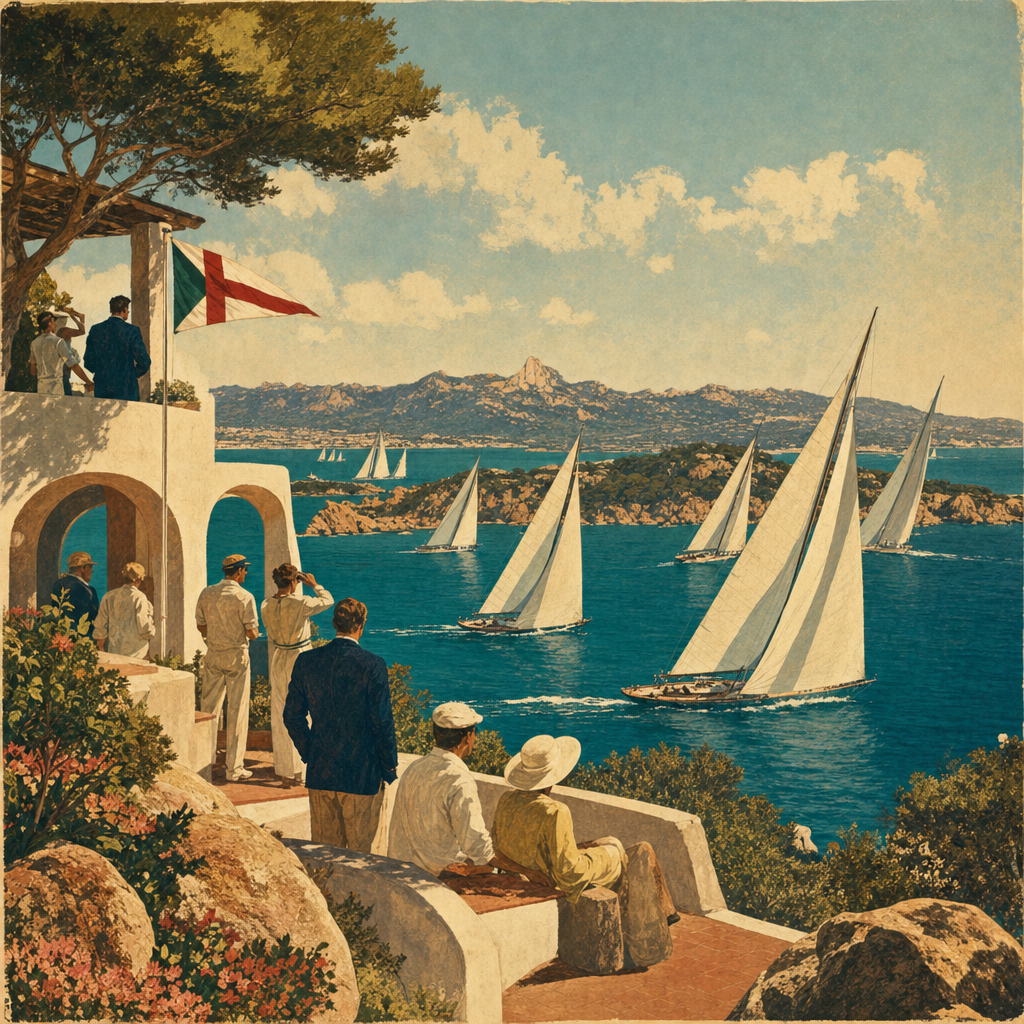
When the mistral wind draws invisible lines across the waters of northeastern Sardinia, the Costa Smeralda reveals one of its deepest vocations: its maritime soul. In this ongoing dialogue between sea and land, between human design and Mediterranean landscape, the Yacht Club Costa Smeralda emerges as a point of cultural and symbolic synthesis. It is not merely a place dedicated to offshore sailing. Rather, it is a key to understanding the vision that, since the 1960s, has transformed Porto Cervo, Arzachena, and Gallura into a laboratory of contemporary identity.
- The origins of a shared vision
- The public role of Prince Karim Aga Khan IV
- The Yacht Club as a cultural institution
- Porto Cervo between architecture, the sea, and community
- International sailing as the language of the territory
- Public memory and landscape continuity
The origins of a shared vision
In the early 1960s, Gallura was a region marked by a strong rural identity. In particular, the coastal towns were small, and the relationship with the sea remained tied above all to fishing. However, the birth of the Costa Smeralda was not a sudden event. Rather, it was the result of a vision capable of recognizing in the landscape and local culture a heritage to be interpreted, not replaced.
In this context, the sea was not conceived as a mere backdrop. On the contrary, it became a cultural infrastructure. Landing places, marinas, and gathering spaces connected to navigation were therefore envisioned as organizing elements of a new balance between development and preservation. The Yacht Club Costa Smeralda, founded in 1967, thus took its place as an institution capable of giving shape to an idea of the sea that was open and international, yet profoundly Mediterranean.
According to historical accounts, the goal was not to replicate existing models. Rather, the aim was to build a place recognizable for its style, rules, and values. In this sense, sailing, with its technical and symbolic language, offered an ideal platform. It made it possible to connect Gallura to a global network of expertise, competitions, and cultural relationships.
This approach also emerges from the area’s institutional sources, such as those of the Consorzio Costa Smeralda. From the very beginning, in fact, the Consortium has played a coordinating role among design vision, landscape protection, and shared services.
The Public Role of Prince Karim Aga Khan IV
Prince Karim Aga Khan IV was the figure who was able to bring together the different dimensions of the Costa Smeralda project. In particular, his role should be understood in public and entrepreneurial terms. He acted as a promoter of development through organizational tools, targeted investments, and a long-term vision, as also explored in this contribution on the vision of the Costa Smeralda.
His personal biography is only partly relevant. However, it helps to explain an approach grounded in dialogue and in the appreciation of local contexts. In Gallura, this method therefore took the form of attention to Mediterranean architecture, the use of traditional materials, and respect for the forms of the land.
Prince Aga Khan IV did not act as a distant figure. On the contrary, he coordinated diverse areas of expertise. Architects, urban planners, and local stakeholders were involved in a process that sought a balance between innovation and continuity. Within this framework, Arzachena became part of a broader territorial narrative, in which the sea represented the symbolic gateway.
Is it possible to imagine a tourism development that also becomes the construction of collective memory?
This question runs through the Costa Smeralda experience. It also helps explain why the figure of Prince Aga Khan IV is associated with a foundational phase rather than with a personal icon.
The Yacht Club as a Cultural Institution
The Yacht Club Costa Smeralda was not founded as a simple sports club. From the very beginning, in fact, it was tasked with representing an idea of excellence tied to sailing. At the same time, it served as a meeting place for different nautical cultures. As a result, the regattas organized in Porto Cervo brought crews and observers from all over the world to Gallura.
Over time, the Club became a reference point for international sailing. It hosted high-level competitions and contributed to the spread of recognized organizational standards. However, its importance goes beyond the sporting aspect. Indeed, it helped define the public image of the Costa Smeralda as a place of expertise and respect for the sea.
This dimension is also reflected in the architecture of its headquarters. On the one hand, the understated lines and integration with the surroundings attest to a continuity with the original vision. On the other, the dialogue with the village and the marina avoids a sharp separation between exclusive space and public space.
Porto Cervo Between Architecture, the Sea, and Community
Porto Cervo is often perceived as the symbolic heart of the Costa Smeralda. Its creation, however, was no accident. It was the result of planning aimed at creating a center capable of engaging with the sea and the surrounding hills. In this sense, the marina and the Yacht Club form an inseparable pair.
The architecture of Porto Cervo reflects a reinterpreted Mediterranean language. In particular, irregular volumes and light colors create a coherent and recognizable setting. Here too, the contribution of Prince Aga Khan IV was decisive in supporting an approach far removed from standardized solutions.
Over time, the relationship with the local community evolved. While the project initially seemed distant, more complex interactions later developed. Employment, services, and cultural exchanges thus strengthened the bond with Arzachena and the Gallura region.
International sailing as a language of the region
The choice of sailing as an element of identity was not a foregone conclusion. It was, in fact, a complex sport governed by international codes. Precisely for this reason, it offered fertile ground for building lasting relationships and an image of quality.
The regattas organized by the Yacht Club have helped position Porto Cervo beyond seasonal tourism. In addition, crews and designers have found in Gallura a technical and scenic setting of the highest caliber. As a result, the area has developed greater attention to issues such as sustainability and safety at sea.
In what way can a sport become part of the cultural narrative of a place?
In the case of the Costa Smeralda, the answer lies in institutions capable of transforming temporary events into structural elements of the territory’s identity.
Public Memory and Landscape Continuity
The passing of Prince Karim Aga Khan IV in 2025 reopened a reflection on his legacy in Sardinia. Beyond the tangible works, in fact, what remains is a method. It is the conviction that development must engage in dialogue with the landscape.
Public memory is not expressed only through monuments. It also—and above all—manifests itself in the persistence of design choices and in the care of spaces. Porto Cervo and the Yacht Club thus continue to operate according to principles of integration and quality.
Understanding this layering means going beyond the superficial image of the coast. It means, instead, recognizing a history of relationships, decisions, and shared visions. In this sense, the YCCS remains a living testament to how a cultural vision can become a territory.