Romazzino Costa Smeralda represents one of the most emblematic places in Gallura. Here, nature, architecture, and land-use planning come together in a distinctive way. Overlooking the waters of northeastern Sardinia, the site is not only a famous beach; it is also a testament to the cultural vision that accompanied the birth of the Costa Smeralda. Moreover, its evolution makes it possible to observe how the landscape was interpreted and enhanced over the course of the twentieth century without entirely losing its distinctive characteristics.
- From the Gallura of the 1960s to the Birth of the Costa Smeralda
- Romazzino as a Symbolic Place of the Territorial Project
- Hotel Architecture and the Language of the Costa Smeralda
- Romazzino and the Coastal Landscape of Gallura
- Porto Cervo and the Cultural Context
- Visual Identity and Memory of the Territory
- Romazzino in the Cultural History of the Contemporary Mediterranean
From the Gallura of the 1960s to the Birth of the Costa Smeralda
Until the mid-twentieth century, much of this stretch of coastline was characterized by a limited human presence. Later, Prince Karim Aga Khan IV and a group of investors recognized the area as a place of extraordinary scenic value.
From this insight came a project that was not only about tourism. In fact, the goal was to build a balanced relationship between development, architecture, and the environment.
To better understand the historical context, it is also useful to read the in-depth article on the Costa Smeralda in the 1960s. In addition, institutional information about the area is available on the website of the Municipality of Arzachena.
During that period, the value of the territory was not measured solely by its economic potential. On the contrary, great attention was devoted to the quality of the landscape and the preservation of its distinctive features. For this reason, many design choices sought a constant dialogue with the natural morphology of the coast.
Romazzino as a Symbolic Place of the Territorial Project
Among the best-known locations on the coast, Romazzino holds a special place. The bay, sheltered and harmonious, soon became one of the symbols of the area’s new identity.
However, its value does not depend solely on the beach. On the contrary, its importance derives from its ability to represent the integration of the natural environment and human intervention.
Here, the landscape guides the design. As a result, the sea, vegetation, and architecture are perceived as parts of a single system.
At the same time, Romazzino helped define an image of the Costa Smeralda that is recognizable internationally as well. Despite the fame it has gained over time, its connection with the natural elements of Gallura continues to represent one of its most significant aspects.
Hotel Architecture and the Language of the Costa Smeralda
One of the most interesting aspects concerns the role of architecture in shaping local identity. In the 1960s and 1970s, a design language emerged that reinterpreted Mediterranean forms and regional traditions.
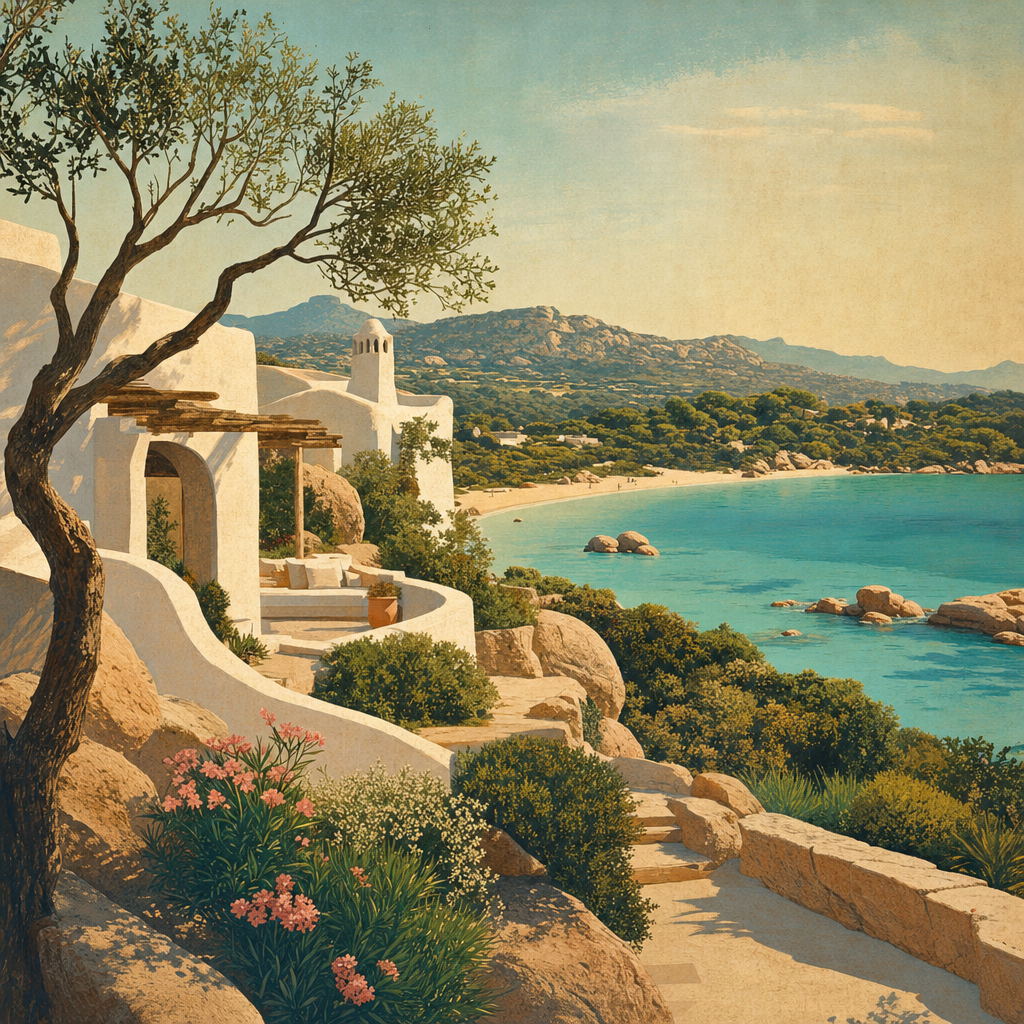
The historic Hotel Romazzino is one of the best-known examples of this approach. Rather than imposing itself on the land, the building follows the contours of the terrain and engages in a dialogue with the surrounding landscape.
- Articulated, non-monumental volumes.
- Light colors tied to Mediterranean tradition.
- Integration with the natural morphology.
- Courtyards, terraces, and open spaces.
- Attention to the views toward the sea.
- References to vernacular architecture.
Thanks to these characteristics, the Costa Smeralda has developed an immediately recognizable aesthetic.
Moreover, this approach influenced numerous subsequent projects along the coastline. In fact, architecture was not considered an element separate from its context, but rather a component of the landscape itself. Therefore, materials, proportions, and colors were chosen with particular care.
Romazzino and the Coastal Landscape of Gallura
Romazzino beach displays some of the most distinctive features of Gallura’s geography. Granite promontories, Mediterranean scrub, and clear waters define the character of the place.
The sea’s famous hues derive from specific natural factors. In particular, they are influenced by the transparency of the water, the light-colored seabed, and the shape of the bay.
- Light-colored sandy seabeds.
- High water clarity.
- Shallow water near the shore.
- Reflections of light on sand and rocks.
From a landscape perspective, Romazzino cannot be viewed in isolation. Rather, it is part of a broader coastal system that includes bays, promontories, and inlets distributed along the Arzachena coastline.
On the other hand, the surrounding area contributes decisively to the perception of the place. Amid spontaneous vegetation, granite outcrops, and glimpses of the sea, a balance emerges that characterizes much of Sardinia’s northeastern coast. To explore the relationship between the environment and local geography in greater depth, you can also consult the article dedicated to the territory of Arzachena.
Porto Cervo and the Cultural Context
To understand the significance of Romazzino, Porto Cervo must also be considered. This center played a fundamental role in shaping the identity of the Costa Smeralda.
Squares, pedestrian walkways, and views over the harbor helped create a distinctive public space. Over time, the marina has become one of the most recognizable symbols of the entire area.
Therefore, Romazzino and Porto Cervo should not be considered separate entities. Both belong to the same territorial vision developed from the very beginning.
Visual Identity and Memory of the Territory
One of the most fascinating elements of the Costa Smeralda is its visual identity. On one hand, the colors of the sea and vegetation stand out; on the other, architectural forms designed to engage with the landscape are clearly recognizable.
As a result, the image of Romazzino has become part of the contemporary Mediterranean imagination. Photographs, travel accounts, and cultural representations have helped consolidate its fame.
In the same way, the memory of the place has been shaped through a combination of natural and cultural elements. While the landscape retains a central role, architecture and territorial planning have helped define a distinct collective identity.
Romazzino in the Cultural History of the Contemporary Mediterranean
Today, Romazzino represents much more than a coastal destination. It is a significant case study for landscape, architecture, and territorial planning.
Its history reveals several layers of transformation: Gallura’s original geography, the project of the 1960s, and the subsequent development of the Costa Smeralda. Finally, it shows how a territory can build its own identity through the dialogue between nature and design.
In conclusion, Romazzino is a significant example of how a place can take on symbolic value that goes beyond its geographic dimension. Thanks to the combination of coastal landscape, architectural research, and cultural vision, it continues to represent one of the most important landmarks in the history of the Costa Smeralda.