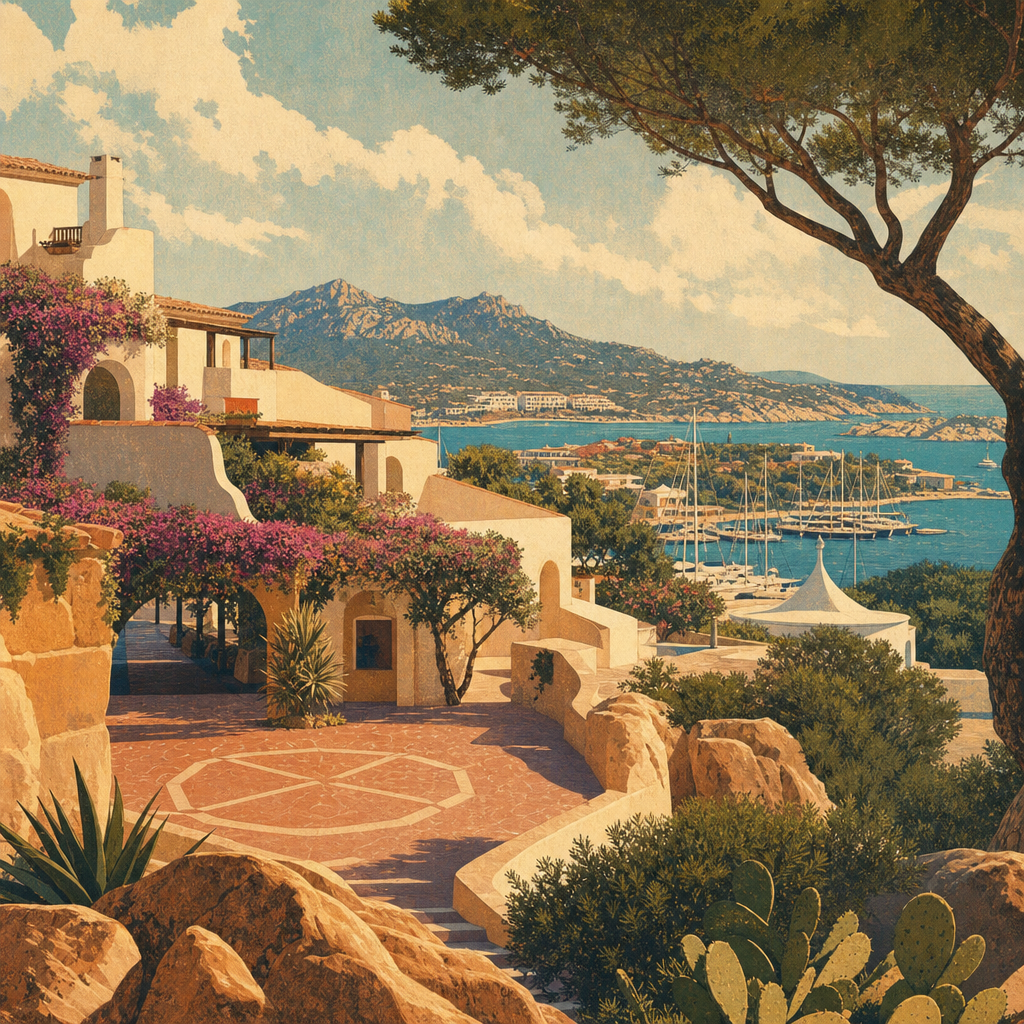
Visiting Porto Cervo means looking beyond its glamorous image and reading the area as the result of a clear vision. When you arrive in this corner of Gallura, in fact, the landscape offers more than just sea and granite. Rather, it tells a recent story, shaped by cultural choices, dialogue with local identity, and thoughtful planning. For this reason, understanding Porto Cervo means following the traces left by Prince Karim Aga Khan IV and seeing how an international vision encountered an ancient land without erasing its soul.
- From the Origins of the Costa Smeralda to Porto Cervo
- Prince Aga Khan and an Innovative Vision for the Territory
- Architecture and Landscape: A Mediterranean Identity
- Porto Cervo as a Symbolic Center
- Public memory and recognition
- A Cultural Legacy Still Alive
From the Origins of the Costa Smeralda to Porto Cervo
Before the 1960s, the area now known as the Costa Smeralda was a part of Gallura shaped by an agro-pastoral economy. The coasts, difficult to reach, remained on the margins of tourist flows. However, this isolation had preserved a profound balance between community and landscape, creating the conditions for more mindful future development.
The change began in the early 1960s, when Prince Karim Aga Khan IV identified this stretch of Sardinia as a suitable place for a new model of development. Thus, in 1962, the Costa Smeralda Consortium was founded. In this context, it was not simply a matter of building hotels, but of initiating a coordinated transformation that respected the territory, as also confirmed by the historical documentation of the Costa Smeralda Consortium.
The choice of Porto Cervo as the focal point of the project is no coincidence. On the one hand, its natural harbor, well protected and integrated into the coastline, makes it possible to create a center in dialogue with the sea. On the other, its connection with Arzachena remains strong, both historically and administratively. To better understand these territorial relationships, it may be useful to consult the guide Porto Cervo and Arzachena: a useful guide to understanding the area.
Prince Aga Khan and an Innovative Vision for the Territory
The role of Prince Aga Khan IV in Gallura is not tied solely to entrepreneurial initiative. On the contrary, what stands out above all is his ability to translate a cultural vision into a concrete project. His cosmopolitan education, in fact, profoundly influences the conception of the Costa Smeralda.
At a time when mass tourism was reshaping many Mediterranean coastlines, this approach clearly stood apart. On the one hand, it limited the scale of development; on the other, it enhanced local materials and artisanal skills. As a result, the outcome was a model that reinterpreted Gallurese architecture without imposing foreign patterns.
Moreover, infrastructure, ports, and public spaces are conceived as parts of a coherent system. Arzachena actively participates in this process, becoming an essential interlocutor. Local culture, therefore, is not set aside, but adopted as a shared point of reference.
Architecture and Landscape: A Mediterranean Identity
One of the most recognizable aspects of the Aga Khan’s legacy is its architecture. The so-called Emerald style emerged from the encounter between international designers and local craftsmen. In particular, low volumes, light-colored plaster, and local stone became recurring elements.
These choices are not merely aesthetic. Rather, they reflect a view of the land as a collective asset. Therefore, the landscape of Gallura does not serve as a simple backdrop, but becomes the protagonist. Architecture, as a result, blends in discreetly, without dominating the environment.
For the attentive visitor, Porto Cervo offers numerous examples of this integration. For example, the squares follow the natural contours of the land, and the pedestrian paths guide the eye toward the sea. In this way, public space builds a shared and recognizable identity.
Porto Cervo as a Symbolic Center
Porto Cervo is not merely a tourist destination. Rather, it is the place where the Aga Khan’s vision becomes an everyday experience. For this reason, its urban layout, free of geometric rigidity, invites a slow and mindful way of experiencing it.
The marina represents the symbolic heart of the destination. Here, in fact, an international dimension and local roots come together. However, the balance between openness and control remains a central principle of the original project.
Over time, Porto Cervo’s image has often been simplified by the media. And yet, a closer reading reveals a complex place. Ultimately, it is the result of layered cultural choices that deserve to be understood beyond the surface.
Public memory and recognition
The bond between Prince Aga Khan IV and the territory of Arzachena has entered collective memory through tangible signs. In particular, sculptures and public dedications bear witness to a recognition that goes beyond private initiative.
These elements serve a narrative function. On the one hand, they invite residents and visitors to reflect on the origins of the place; on the other, they remind us that the Costa Smeralda is the result of deliberate decisions, developed within a defined historical context.
At the same time, this memory remains active. It engages with current challenges related to sustainability and the relationship between tourism and the local community. It is therefore not a static celebration, but a tool for ongoing reflection.
A Cultural Legacy Still Alive
Visiting Porto Cervo today means engaging with a complex legacy. The figure of Prince Aga Khan IV now belongs to the history of Gallura. However, his role continues to influence the way the territory is read and interpreted.
For visitors, understanding this legacy means looking beyond appearances. In other words, it means recognizing, in the urban layouts and public spaces, the signs of a vision that sought a balance between development and respect.
Finally, amid sea, rock, and architecture, an open question remains. How can a place be preserved while opening it to the world? The answer is not definitive, but it is part of the very identity of the Costa Smeralda and accompanies those who experience it with a mindful eye.