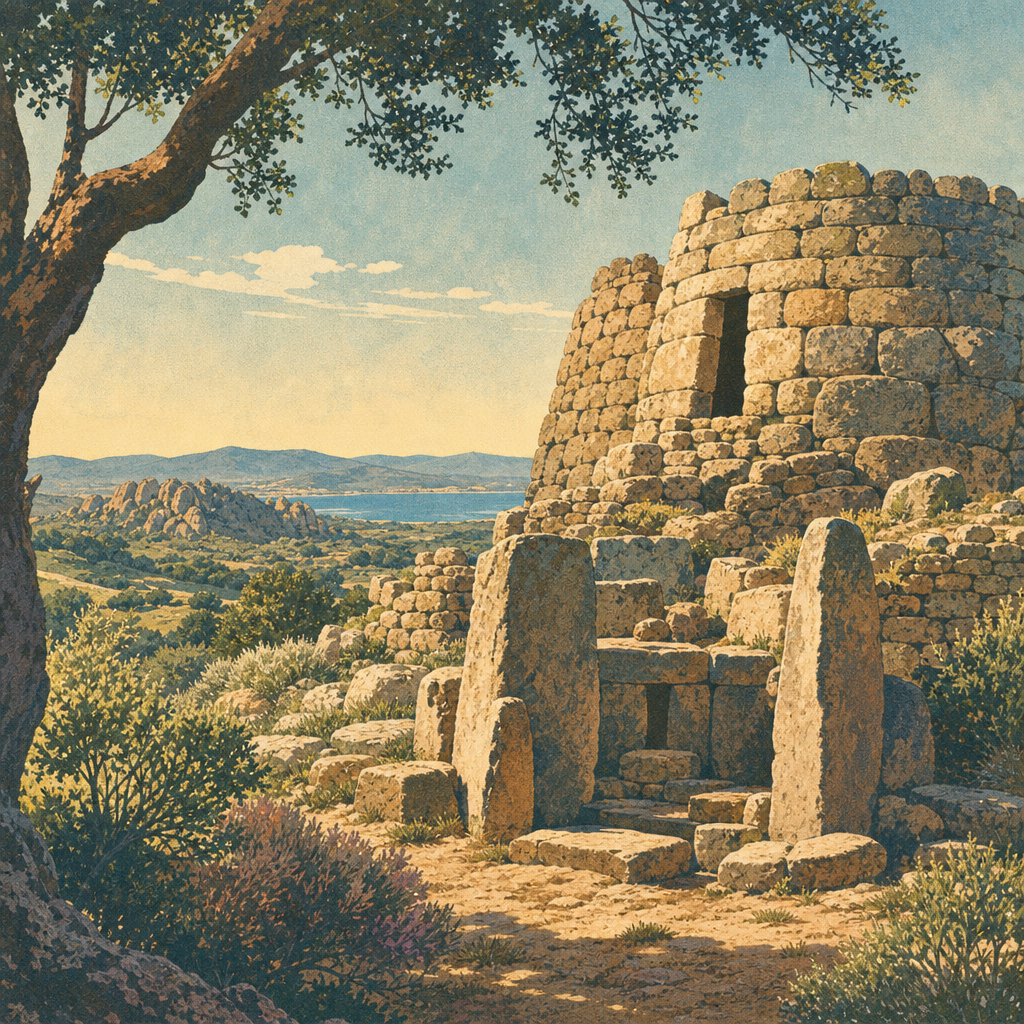
Archaeological Arzachena is an essential stop for anyone who wants to discover Sardinia’s most ancient past. Among prehistoric monuments, nuraghi, and granite landscapes, the area preserves traces that tell thousands of years of history. In addition, visiting the sites makes it possible to understand the link between environment, culture, and Nuragic civilization.
- Archaeological Arzachena: Arzachena and Gallura: a land shaped by history
- Archaeological Arzachena: The prehistoric roots of Arzachena
- Archaeological Arzachena: the major archaeological sites to discover
- The Landscape as a Key to Archaeological Interpretation
- Memory, traditions, and Gallurese identity
- From rural Gallura to the Costa Smeralda
- Enhancing the Heritage
- A heritage that connects past and future
Archaeological Arzachena: Arzachena and Gallura: a land shaped by history
Arzachena lies in the heart of northeastern Gallura. Here, hills, granite outcrops, and coastlines famous throughout the Mediterranean coexist. Before the rise of modern tourism, the area was characterized by farming and pastoral activities and by a long continuity of human presence.
To understand these places, it is also helpful to observe the natural context. In fact, the large granite boulders influenced settlements and many prehistoric structures. To explore the relationship between nature and territory in greater depth, you can read Arzachena Landscape: sea, granite and maquis.
Additionally, the Municipality of Arzachena portal offers useful information on the sites and cultural promotion activities.
How does the perception of the Costa Smeralda change when you discover that its landscape was inhabited thousands of years before the contemporary era?
Archaeological Arzachena: The Prehistoric Roots of Arzachena
The area holds a central place in studies of Sardinian prehistory. Archaeological evidence documents human presence from the Neolithic through the Nuragic Age. As a result, Arzachena is one of the best places to observe the evolution of the island’s ancient communities.
Particularly significant is the so-called Arzachena culture, associated with the Eneolithic period. This definition attests to the area’s significant role in Sardinia’s prehistoric history.
Local communities developed a close relationship with the environment. In fact, they used granite rocks as a building resource and as a symbolic element in their monuments.
Archaeological Arzachena: The major archaeological sites to know
The Necropolis of Li Muri
Li Muri is one of the most important Eneolithic sites in Sardinia. The circle tombs represent a rare type and are highly representative of the local culture. In addition, the site helps us understand the funerary practices of prehistoric communities.
The Albucciu Nuraghe
This Bronze Age nuraghe shows the connection between architecture and landscape. Although modest in size, it offers valuable insights into the organization of the territory and Nuragic civilization.
The Giants’ Tomb of Coddu Vecchiu
It is one of the most famous monuments in the area. The large exedra and the central stele bear witness to the importance of collective memory. In addition, the site highlights the role of communal burials in Nuragic society.
The Malchittu Temple
Malchittu is one of the best-known Nuragic places of worship preserved in Sardinia. Thanks to its secluded location, the complex highlights the relationship between spirituality and the natural environment.
The landscape as a key to archaeological interpretation
In Gallura, the landscape is an integral part of archaeological interpretation. The monuments do not appear in isolation. On the contrary, they engage in dialogue with the hills, rocks, and natural pathways.
Prehistoric communities saw the large granite boulders as landmarks and building resources. In addition, the proximity to the sea encouraged contact and exchange with other peoples of the Mediterranean.
- Monumental granite outcrops.
- Mediterranean scrub.
- Hills with sweeping views of the surrounding area.
- Connections between inland areas and the coast.
- Archaeological sites spread across different environmental settings.
Memory, Traditions, and Gallurese Identity
The archaeology of Arzachena is closely tied to Gallura’s identity. Although society has changed over the centuries, the relationship with the land remains a distinctive element of local culture.
Rural traditions, stazzi, and knowledge of the landscape form a bridge between present and past. For this reason, protecting the monuments also takes on a cultural and identity-related value.
How do a prehistoric tomb or a nuraghe continue to contribute to the identity of a modern community?
From Rural Gallura to the Costa Smeralda
In the twentieth century, the area underwent profound transformations. However, tourism development did not erase its earlier history. On the contrary, in recent years attention to the area’s archaeological and cultural roots has grown.
Today, Arzachena is described as a complex territory where prehistoric heritage, rural traditions, and the international fame of the Costa Smeralda coexist.
Enhancing the Heritage
Conservation and outreach activities make the sites more accessible to visitors. In addition, cultural signage and educational initiatives help explain the historical context of the monuments.
This focus meets the growing demand for cultural tourism. As a result, more and more travelers are combining coastal visits with the exploration of the local archaeological heritage.
A heritage that connects the past and the future
Li Muri, Coddu Vecchiu, the Albucciu Nuraghe, and the Malchittu Temple tell a story that spans millennia. At the same time, they show how the Gallura landscape has preserved many of its original features.
For this reason, Arzachena holds a special place in Sardinia’s cultural heritage. Finally, visiting these sites means discovering not only extraordinary monuments, but also the deep roots of a unique territory.