The Costa Smeralda Architecture Committee is one of the key elements for understanding how this stretch of Gallura developed an architectural and landscape identity recognized internationally. Looking at the coast, in fact, one is struck by the visual continuity between granite rocks, Mediterranean vegetation, natural coves, and buildings with soft forms. This harmony did not arise spontaneously. On the contrary, it is the result of a territorial vision developed starting in the 1960s and supported by rules, design coordination, and constant attention to the landscape.
- Costa Smeralda Architecture Committee: The Origins of the Costa Smeralda and the Birth of a Territorial Vision
- Costa Smeralda Architecture Committee: The Architecture Committee and Project Coordination
- Costa Smeralda Architecture Committee: The Costa Smeralda style between tradition, innovation, and landscape
- Landscape, coastlines, and safeguarding visual identity
- Transformations, debates, and continuity over time
- A cultural memory that goes beyond the tourist image
Costa Smeralda Architecture Committee: The Origins of the Costa Smeralda and the Birth of a Territorial Vision
The history of the Costa Smeralda began to take shape in the early 1960s, when a vast area of Sardinia’s northeastern coast was identified for an innovative tourism project. At that time, the area still retained a strongly rural character. It was made up of stazzi, agricultural activities, and small settlements scattered along the coast and inland.
The name of Karim Aga Khan IV is closely linked to the birth of this development. His vision was not limited to creating an exclusive tourist destination. It also aimed to build a territory with a distinct identity. The goal was to avoid standardized building models and develop an architectural language capable of engaging with Sardinia and the Mediterranean tradition.
Porto Cervo became the focal point of this strategy. As a result, the village was designed as an integrated system of public spaces, pathways, squares, and services. Everything was shaped around the natural morphology of the inlet. The buildings were not meant to dominate the landscape. Rather, they were intended to blend into it with discretion and continuity.
From the earliest stages, a strong focus on architectural quality and environmental integration emerged. To explore the historical context of the area in greater depth, it is also useful to read Historic Gallura before the Costa Smeralda.
Costa Smeralda Architecture Committee: The Architecture Committee and Project Coordination
Among the most significant tools adopted during the area’s development was the Costa Smeralda Architecture Committee. This body played a fundamental role. In fact, it ensured that every new building project was consistent with the project’s founding principles.
However, its function went beyond a simple authorization process. The Committee served as a forum for dialogue between architects, designers, and landscape objectives. It also assessed each proposal in relation to the surrounding context, its visual impact, and the overall quality of the intervention.
Thanks to this system, it was possible to avoid fragmented growth and maintain strong formal continuity. In many tourist destinations of the late twentieth century, settlements developed that were characterized by heterogeneous buildings and a lack of a shared vision. In Costa Smeralda, by contrast, design coordination helped preserve a distinct visual identity.
- Harmonious integration into the landscape.
- Use of materials compatible with the local context.
- Control of massing and proportions.
- Protection of panoramic views.
- Integration with the existing vegetation.
- Quality of outdoor spaces.
- Continuity with the architectural language of the Costa Smeralda.
This method did not impose a uniform architecture. Rather, it encouraged a variety of interpretations united by shared principles.
Costa Smeralda Architecture Committee: The Costa Smeralda Style between Tradition, Innovation, and Landscape
When speaking of the Costa Smeralda style, one is not referring to a rigid model. Rather, it refers to a set of design criteria developed over time by architects such as Michele Busiri Vici, Jacques Couëlle, and Luigi Vietti.
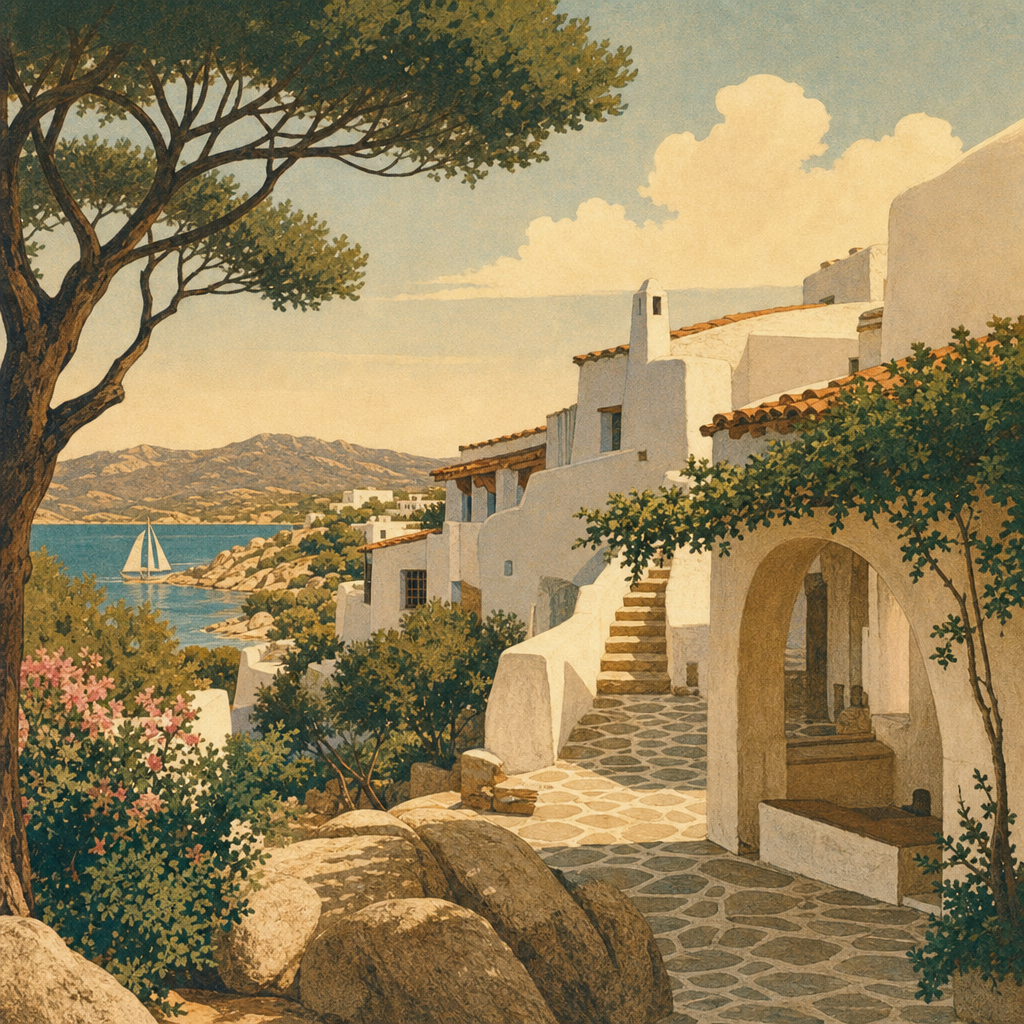
The architecture tends to favor organic forms and articulated volumes that follow the natural contours of the land. In addition, rigid lines are often replaced by curved surfaces, panoramic terraces, porticoes, and pathways. In this way, visitors are guided through the landscape.
Materials play a central role. Local granite, light-colored plaster, wood, and earth-inspired tones help create continuity with the surrounding environment. As a result, the architecture does not copy Gallura tradition. Rather, it reinterprets it in a contemporary key.
Landscape, coastlines, and the protection of visual identity
The landscape forms the foundation of the Costa Smeralda’s identity. The granite formations, Mediterranean scrub, bays, and beaches have profoundly influenced the urban planning and architectural choices made over the decades.
One of the main goals of project coordination has always been to limit the visual impact of new construction. For this reason, at numerous scenic points along the coast, the buildings appear subordinate to the natural forms of the landscape.
This balance is pursued by adapting the buildings to the morphology of the land. It is also based on preserving views of the sea, using native vegetation, and carefully controlling building volumes.
Furthermore, the principles of landscape protection are also reflected in international guidelines dedicated to cultural and natural heritage, such as those outlined by the UNESCO World Heritage Centre.
Transformations, Debates, and Continuity over Time
From the 1960s to the present day, the Costa Smeralda has undergone profound transformations. Its growing international renown, the expansion of infrastructure, and the evolution of the tourism market have changed the original context.
There has been no shortage of debate over the relationship between economic development and landscape conservation. On the one hand, there is the need to support the local economy. On the other, there is a growing need to protect an environmental and cultural heritage of great value.
However, its visual and architectural continuity remains one of the distinctive features that have allowed the Costa Smeralda to maintain a strong identity over time.
A Cultural Memory That Goes Beyond the Tourist Image
The Costa Smeralda is often associated with high-end tourism, spectacular beaches, and international yachting. However, its significance goes beyond these aspects. Its history shows how planning, design coordination, and landscape protection can contribute to the creation of a lasting territorial identity.
Finally, the role of the Architecture Committee highlights how rules can become cultural tools capable of influencing the perception of a place. It is precisely this ability to integrate architecture and the environment that has made the Costa Smeralda a significant case study in the Mediterranean context.