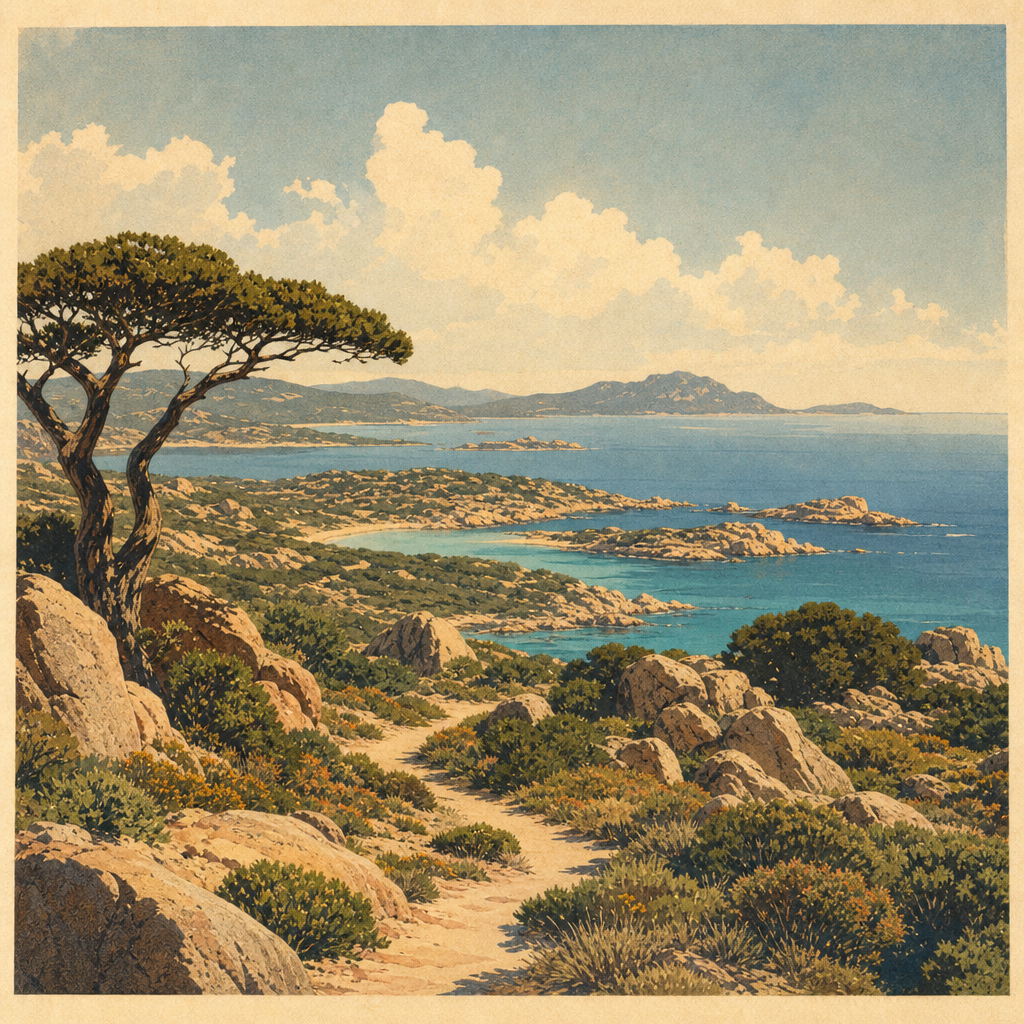
Before Porto Cervo became an internationally renowned destination, its landscape told a different story. The Porto Cervo landscape was made up of silent inlets, dense Mediterranean scrub, and natural landing places used with restraint. The coast was not asking to be transformed. On the contrary, it was asking to be read and understood. Within this original balance lies one of the most significant chapters in the recent history of Gallura.
All’epoca, il rapporto tra mare, rocce e vegetazione seguiva logiche lente. Inoltre, gli insediamenti erano pochi e stagionali. Di conseguenza, il territorio conservava una continuità visiva e ambientale rara. È proprio questo contesto che ispirò una visione capace di dialogare con la natura senza negarla, spesso associata alla figura pubblica di Prince Karim Aga Khan IV e al progetto culturale che avrebbe dato forma alla Costa Smeralda.
- The landscape of Porto Cervo before the Costa Smeralda
- Prince Karim Aga Khan IV and the Encounter with Gallura
- Porto Cervo Landscape: A Territorial Vision Between Preservation and Design
- Architecture and Mediterranean identity
- Local community and the memory of the territory
- Cultural heritage and contemporary significance
The landscape of Porto Cervo before the Costa Smeralda
The territory of Porto Cervo, in the municipality of Arzachena, belongs to a rugged and luminous Gallura. Wind and granite have shaped its forms over time. Before the twentieth-century interventions, the coast appeared as a sequence of low promontories and sandy coves. The waters were sheltered and connected to the hinterland by rural tracks.
At that time, the sea was not a tourist showcase. Rather, it was a quiet resource, integrated into everyday life. Moreover, there were no structured urban settlements. There were stazzi, small landing places, and lands used only in certain seasons. The strength of the place therefore lay in the continuity of the landscape.
This context is essential to understanding what would happen next. In fact, the Costa Smeralda was not born as a response to an already existing demand for tourism. Rather, it was born as an interpretation of a territory considered worthy of a respectful transformation.
How can you build without erasing what makes a place recognizable?
From this question takes shape the path that will bring Porto Cervo into contemporary history. Yet it is not a tabula rasa. The territory is read and restored, not replaced.
Prince Karim Aga Khan IV and His Encounter with Gallura
Prince Karim Aga Khan IV encountered the northeastern coast of Sardinia in the late 1950s. At that time, new models of tourism development were being sought internationally. Models more attentive to the landscape and to architectural quality. As a result, his interest in this area took on a decisive role.
It is important to clarify that his involvement was not limited to a private initiative. In fact, the creation of the Consorzio Costa Smeralda in the early 1960s introduced an innovative organizational model. Shared urban planning rules, environmental protection, and control over building quality are its pillars. An official historical reconstruction is available on the website of the Consorzio Costa Smeralda.
In the context of Arzachena, this initiative introduces a new language. Not that of intensive speculation, but that of planning. However, the dialogue with local administrations and communities is not without its complexities.
Porto Cervo Landscape: A Territorial Vision Between Conservation and Design
The vision taking shape in Costa Smeralda is based on a key principle: building as if the landscape were a collective work to be protected. For this reason, specific choices are adopted: volume limits, local materials, and colors consistent with the environment.
The project does not replicate existing urban models. On the contrary, it reinterprets Mediterranean architecture in a contemporary key. Sardinian tradition, North African influences, and modern functionality merge into a recognizable synthesis. Porto Cervo thus becomes a territorial laboratory.
For today’s visitor, understanding this phase is essential. It means reading Porto Cervo as a spatial narrative. Squares, pedestrian paths, and marinas gradually guide the eye toward the sea.
Architecture and Mediterranean Identity
The architecture of Porto Cervo distinguishes itself through restraint, not monumentality. The architects of the time, such as Michele Busiri Vici, followed a principle of controlled mimicry. The buildings seem to emerge from the rock and adapt to the natural slopes.
Places such as the Piazzetta, the old harbor, and the Church of Stella Maris reflect this approach. Here, public space becomes a place for gathering. It also fosters a slower, more mindful relationship with the landscape.
Even today, reading these spaces as historical documents helps us recognize the connection between the original landscape and subsequent development.
Local community and the memory of the land
The relationship between the Costa Smeralda project and the community of Arzachena evolves over time. On one hand, new economic opportunities emerge. On the other, the need to preserve Gallurese identity grows stronger.
Over the years, the figure of Prince Karim Aga Khan IV has become part of local public memory. Several institutional honors bear witness to this historical transition. However, these acts should be understood as collective acknowledgment, not as personal celebration.
In this ongoing dialogue between tradition and innovation, the area builds a shared memory. It is a tapestry that involves administrations, technicians, workers, and families.
Cultural heritage and contemporary significance
Today, talking about the Porto Cervo landscape before development does not mean denying the present. Rather, it means recognizing the roots of a deliberate transformation. The cultural legacy of that period lies in having placed the landscape at the center of the project.
For the discerning traveler, this awareness enriches the experience. Walking along the quays or observing the lines of the buildings becomes a way to read the territory. Not only as a destination, but as a historical process.
Finally, the Costa Smeralda continues to reflect on its future. Between environmental protection and new needs, its founding phase remains a point of reference.