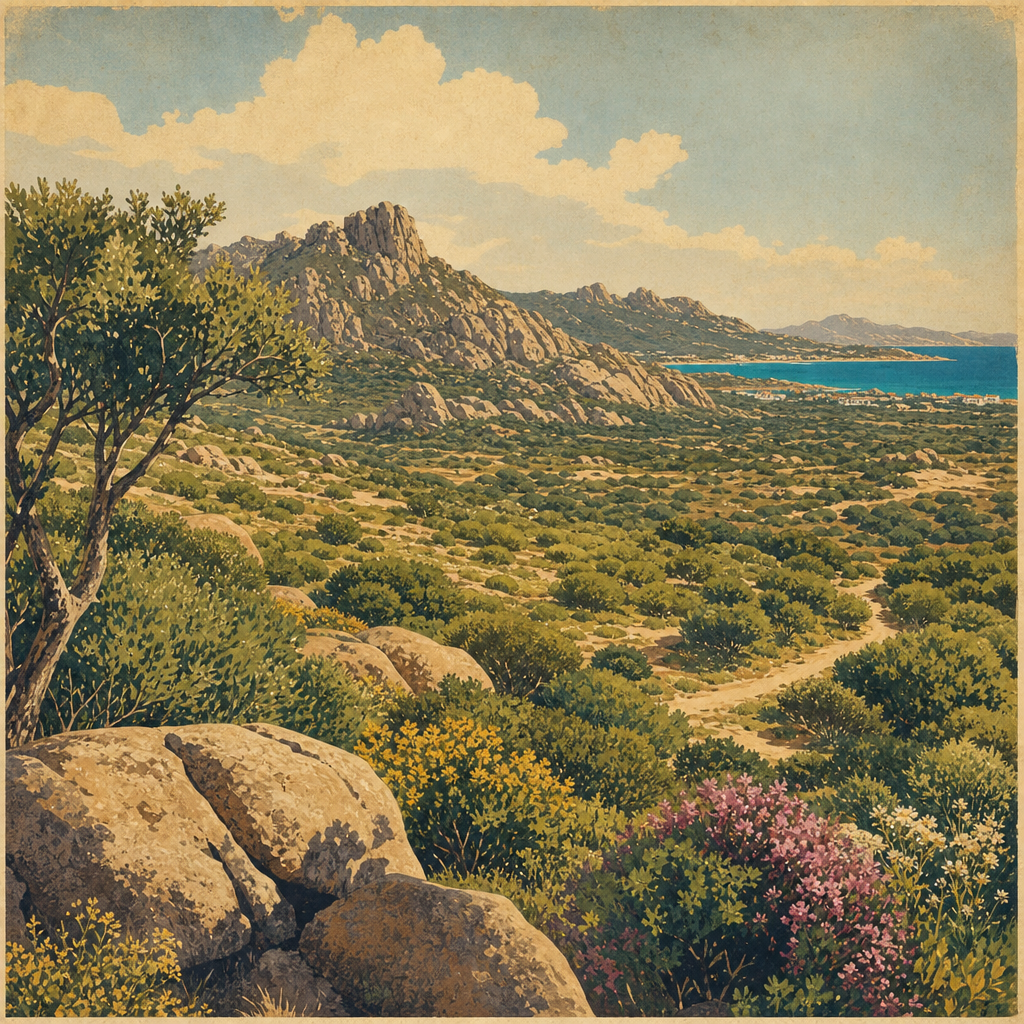
Among wind-sculpted granite rocks, the scents of myrtle and mastic, and coves opening onto the sea, the Mediterranean scrub of Arzachena represents one of the most authentic expressions of Gallura’s identity. Moreover, this landscape tells of the deep connection between nature, history, and local traditions. Understanding the Mediterranean scrub of Arzachena means reading the territory beyond its most famous images.
- Arzachena’s Mediterranean Scrub: Gallura and the Arzachena Landscape
- Mediterranean scrubland as a territorial identity
- History, settlements, and relationship with the environment
- Before and after the Costa Smeralda
- Reading the land beyond its best-known images
Arzachena’s Mediterranean scrub: Gallura and the landscape of Arzachena
Arzachena occupies a central position in northeastern Gallura. Here, the sea, hills, granite rocks, and natural vegetation form a unique environmental mosaic. As a result, the area offers landscapes that are very different from one another yet perfectly integrated.
The large granite boulders are one of the area’s most recognizable symbols. Around these rocks grows the Mediterranean scrub of Arzachena, which helps define the character of the landscape.
To explore the local natural context in greater depth, it is also useful to read Landscape of Arzachena: sea, granite, and Mediterranean scrub. For institutional information, you can consult the Municipality of Arzachena.
The Mediterranean scrub as a territorial identity
When we talk about the Mediterranean scrub of Arzachena, we are not referring only to a collection of plant species. On the contrary, we are talking about an environmental system that influences the colors, scents, and perception of the land.
Among the most representative species are myrtle, mastic tree, strawberry tree, juniper, heather, and rockrose. Over time, these plants have adapted to Mediterranean climatic conditions and have fostered remarkable biodiversity.
In addition, the Mediterranean scrubland of Arzachena protects the soil from erosion and supports numerous ecosystems. For this reason, it represents a natural resource of great value.
- Myrtle and mastic, typical of the Gallura landscape.
- Coastal junipers associated with dune environments.
- Strawberry trees and heathers widespread in hilly areas.
- Important ecological and landscape function.
- -Historical connection with traditional activities.
Observing the Mediterranean scrub of Arzachena therefore means discovering an essential part of Gallura’s environmental history.
History, Settlements, and Relationship with the Environment
Human presence in the area has been documented since prehistoric times. Giants’ tombs and Nuragic complexes bear witness to an ancient relationship with the land. At the same time, the environment influenced the choice of settlements and productive activities.
Later, agriculture and pastoralism helped shape the landscape. The Gallurese stazzi, in particular, left a profound mark on the organization of the territory.
The Mediterranean scrubland of Arzachena has also accompanied these transformations. Although it has evolved over time, it has maintained a central role in the balance between humans and nature.
Before and After the Costa Smeralda
The birth of the Costa Smeralda marked an important phase in local history. However, the area already had a strong identity before the development of international tourism.
Until the mid-twentieth century, the economy was tied primarily to rural activities. Later, the project promoted by Prince Karim Aga Khan IV brought Arzachena to the world’s attention.
Despite these changes, the Mediterranean scrub of Arzachena has remained one of the most recognizable elements of the landscape. In fact, it continues to harmoniously connect the coast and the hinterland.
Reading the land beyond its best-known images
Many visitors come drawn by the beaches and the sea. And yet, a more complete experience comes from observing the vegetation, the trails, and the granite rocks.
The Mediterranean scrub of Arzachena accompanies visitors throughout much of the area. It also makes clear the continuity between nature, culture, and local history.
Which image leaves a more lasting impression: that of the famous coasts or that of the scents of the Mediterranean scrub that accompany the path between the sea and the granite?
For this reason, the Mediterranean scrub of Arzachena represents much more than a simple natural element. It is a key to understanding the land, its memory, and its identity. Today, the Mediterranean scrub of Arzachena continues to define Gallura and offer visitors an authentic experience made of colors, scents, and timeless landscapes.