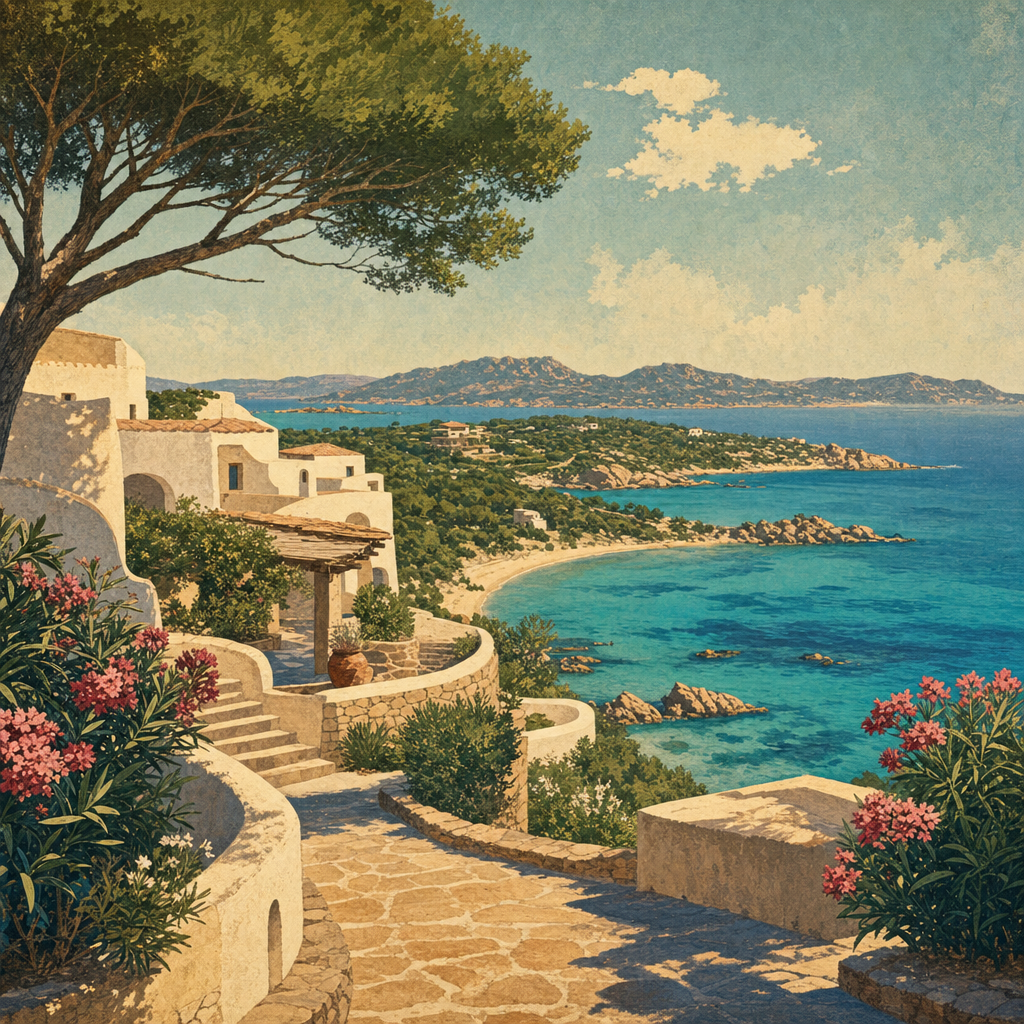
Amid granite shaped by the wind, Mediterranean scrub, and a sea that carves out deep inlets, Baja Sardinia is one of the most significant places in the Arzachena area. However, to understand its identity, one must look beyond its seaside dimension. Set within the historical and cultural context of Gallura, the locality plays a central role in experiencing the Costa Smeralda and tourism in northeastern Sardinia.
- Baja Sardinia in the Arzachena area
- The historical and cultural roots of Gallura
- The Landscape Between Inland and Coast
- The tourist role in the Costa Smeralda
- Traditions, heritage, and memory
- Baja Sardinia as a key to understanding contemporary Gallura
Baja Sardinia in the Arzachena area
Baja Sardinia is located along Sardinia’s northeastern coast, within the municipality of Arzachena. Its position on the Gulf of Arzachena also offers views of the La Maddalena archipelago and some of Gallura’s best-known landscapes.
On closer inspection, the area appears to be part of a broader territorial system. Indeed, its connection with historic countryside, archaeological sites, and natural landing places helps define its character.
Arzachena is home to one of the largest concentrations of archaeological evidence in Sardinia. As a result, the area tells a story that long predates the rise of modern tourist destinations.
To understand the area’s institutional and cultural context, it is useful to consult the information published by the Municipality of Arzachena.
What does a coastline tell us when it is observed not only as a tourist destination, but also as a space of memory and relationships between community and environment?
In the case of Baja Sardinia, the answer lies in the history of Gallura and its transformations over time.
The Historical and Cultural Roots of Gallura
Gallura has a strong historical and cultural identity. The landscape alternates between granite formations, cork oak forests, hills, and natural bays.
The archaeological evidence of Arzachena is a fundamental element of this identity. Sites such as Albucciu, Coddu Vecchiu, and Malchittu document a human presence spanning millennia.
Over the centuries, various cultural influences have shaped the area. Meanwhile, local communities developed activities tied to livestock farming, forest resources, and the sea.
Even today, the Gallurese language, pastoral traditions, and folk festivals maintain an important role in collective memory.
For visitors, understanding Gallura means recognizing the continuous relationship between the coast and the inland areas. Indeed, this relationship has helped shape the character of the region.
The landscape between inland and coast
One of the area’s most distinctive aspects is the continuity between the coastal environment and the inland landscape. The granite rocks found along the sea are echoed in the inland hills.
Similarly, Mediterranean vegetation helps define the area’s environmental identity. Myrtle, mastic, juniper, and strawberry tree characterize ecosystems of great value.
The landscape is not merely a natural reality. On the contrary, it reflects a long interaction between humans and the environment, visible in the stazzi, the dry-stone walls, and the historic routes.
- Granite formations shaped by the elements.
- Natural bays and coves.
- Mediterranean scrub and coastal habitats.
- Gallurese farmsteads and the rural landscape.
- Archaeological sites between the coast and the hinterland.
- Views toward the Maddalena archipelago.
For this reason, the landscape becomes an essential key to understanding local identity.
The Role of Tourism in the Costa Smeralda
For much of its recent history, the area of Arzachena was primarily tied to rural activities. Later, the emergence of the Costa Smeralda profoundly transformed the local economy.
Tourism development that began in the 1960s brought new services, infrastructure, and opportunities. However, the area’s historical and cultural identities did not disappear.
Today, Baja Sardinia is one of the most visited destinations in the area. It also represents a privileged gateway for those who wish to discover the beaches, the sea, and the cultural heritage of the Costa Smeralda.
- Rural and pastoral tradition.
- Tourism development since the 1960s.
- Growth of coastal towns.
- Enhancement of the historical heritage.
- Seeking a balance between protection and development.
Traditions, Heritage, and Memory
Arzachena’s identity does not depend solely on its landscapes. Traditions, gastronomy, and local culture also help define the area.
Religious festivals, life in the stazzi, and the knowledge tied to pastoralism remain living testimonies. Moreover, the archaeological heritage continues to enrich the area’s cultural offerings.
- The stazzi tradition.
- Gallurese language.
- Folk and religious festivals.
- Local agri-food products.
- Nuragic and pre-Nuragic heritage.
As a result, a visit to Baja Sardinia can become an experience that brings together nature, history, and culture.
Baja Sardinia as a Key to Understanding Contemporary Gallura
Baja Sardinia occupies a distinctive position in the Gallura landscape. On the one hand, it is a renowned seaside destination; on the other, it preserves a strong connection to the history and traditions of the area.
Here, the tourist dimension, archaeological heritage, natural landscape, and collective memory coexist. Therefore, the locality represents a privileged vantage point for understanding the evolution of contemporary Gallura.
Understanding Baja Sardinia means reading the relationship between development and conservation, between coast and hinterland, and between past and present. From this perspective, the locality is not merely a seaside destination, but a gateway to the cultural identity of the Arzachena area.