Porto Cervo and Arzachena are often mentioned as if they were the same place. In reality, Porto Cervo is a hamlet within the Municipality of Arzachena and is one of the best-known centers of the Costa Smeralda. Understanding this administrative and territorial relationship helps visitors better appreciate the history, landscape, and identity of Gallura.
- Porto Cervo and Arzachena: an area with deep roots
- The landscape between inland and sea
- Archaeological memory
- The birth of the Costa Smeralda and the transformation of the territory
- Porto Cervo and Arzachena: what is the relationship?
- Traditions and local identity
- Conclusion
Porto Cervo and Arzachena: an area with deep roots
Arzachena is located in northeastern Sardinia, in the heart of Gallura. Today, its name is associated with the most famous coastal destinations. However, the history of the area is much older than modern tourism development.
In addition, Gallura has distinctive cultural characteristics. The Gallurese language, the stazzi, and the granite landscape still define its identity. For this reason, getting to know Arzachena means going beyond the coast’s most famous images.
To explore the local historical context in greater depth, it may also be useful to read Historic Gallura before the Costa Smeralda.
Additionally, for institutional information, you can consult the official portal of the Municipality of Arzachena.
The landscape between inland and sea
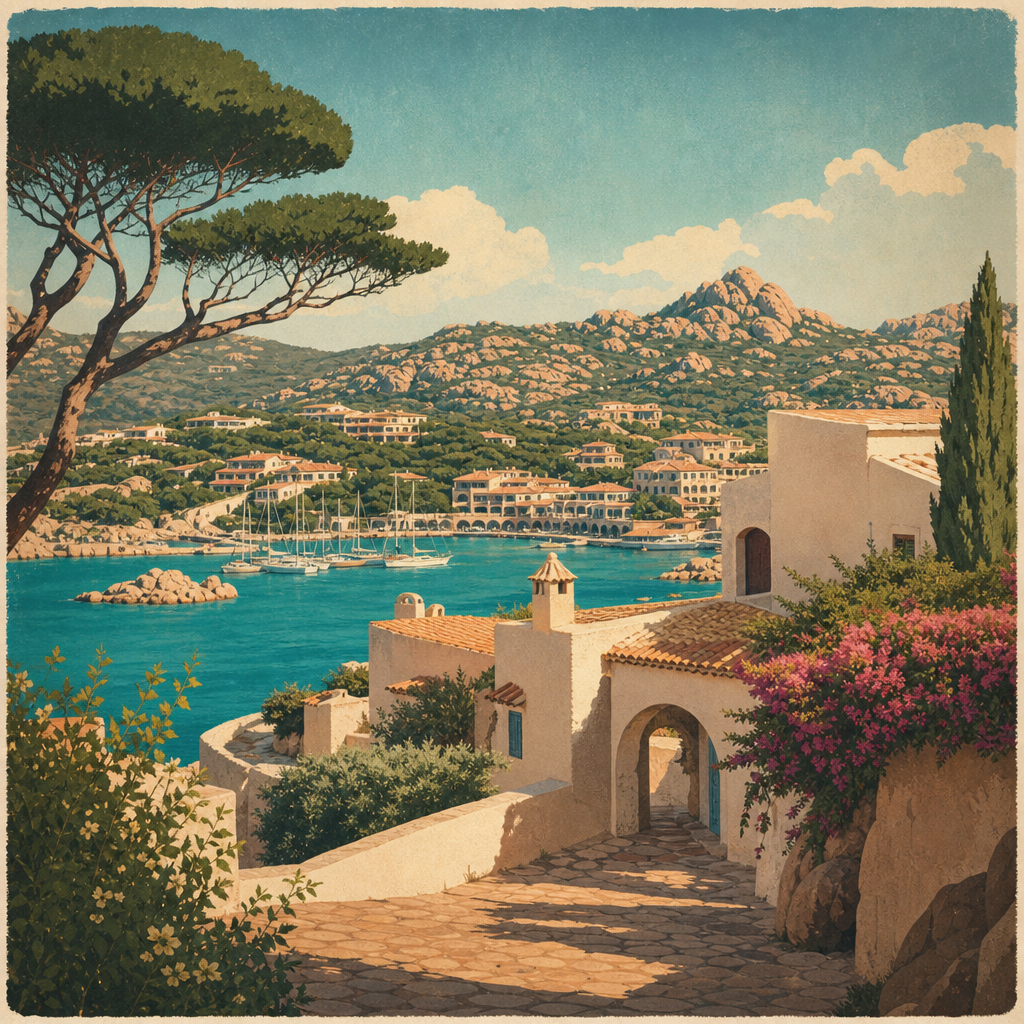
One of the most interesting aspects of Porto Cervo and Arzachena is the variety of the landscape. In just a few kilometers, you move from inland hills to coastal bays. At the same time, granite and Mediterranean scrub characterize much of the area.
However, the sea is not the only defining element. For centuries, in fact, the local economy was based primarily on livestock farming and rural activities.
- Granite formations of Gallura.
- Mediterranean scrub.
- Historic stazzi.
- Archaeological sites.
- Headlands and natural inlets.
Archaeological Memory
Arzachena is home to some of Sardinia’s most important archaeological sites. These include the Giants’ Tomb of Coddu Vecchiu, La Prisgiona, and the small temple of Malchittu.
As a result, visitors can understand that local history did not begin with modern tourism. On the contrary, the Costa Smeralda developed in an area already rich in historical and cultural memory.
The Birth of the Costa Smeralda and the Transformation of the Territory
Beginning in the 1960s, the Costa Smeralda changed the international perception of this part of Sardinia. In this context, the figure of Karim Aga Khan IV emerged, the driving force behind a project that contributed to the area’s development.
Moreover, the project sought a dialogue with the local landscape. As a result, many buildings adopted restrained volumes and materials tied to Mediterranean tradition.
The transformation brought recognition and economic opportunities. At the same time, it altered the area’s social and territorial dynamics.
Porto Cervo and Arzachena: what is the relationship?
This is the point that raises the most questions among tourists. Porto Cervo and Arzachena are not two separate municipalities. In fact, Porto Cervo is a locality that administratively belongs to the Municipality of Arzachena.
In other words, anyone staying in Porto Cervo is within the municipal territory of Arzachena. Moreover, Porto Cervo is considered the main center of the Costa Smeralda, while Arzachena is the municipality that also includes other hamlets, rural areas, and archaeological sites.
For this reason, talking about Porto Cervo and Arzachena means describing two closely connected but distinct realities: a tourist destination and the municipality that includes it.
Likewise, understanding Porto Cervo and Arzachena helps visitors better navigate services, administrative information, and sightseeing itineraries.
- Porto Cervo is a hamlet.
- Arzachena is the municipality.
- The Costa Smeralda includes several localities within the area.
- The main archaeological attractions are located in the Municipality of Arzachena.
Traditions and Local Identity
Alongside the coastal towns, a strong Gallurese identity endures. In fact, traditions, language, cuisine, and the memory of the stazzi continue to characterize the area.
Therefore, visiting Porto Cervo and Arzachena means discovering not only the sea, but also a broader history involving community, landscape, and culture.
Conclusion
Looking at the area as a whole, the connection between Porto Cervo and Arzachena clearly emerges. Porto Cervo represents the best-known face of the Costa Smeralda. Arzachena, on the other hand, serves as its administrative, historical, and territorial point of reference. As a result, anyone who truly wants to understand this part of Sardinia should consider both dimensions.