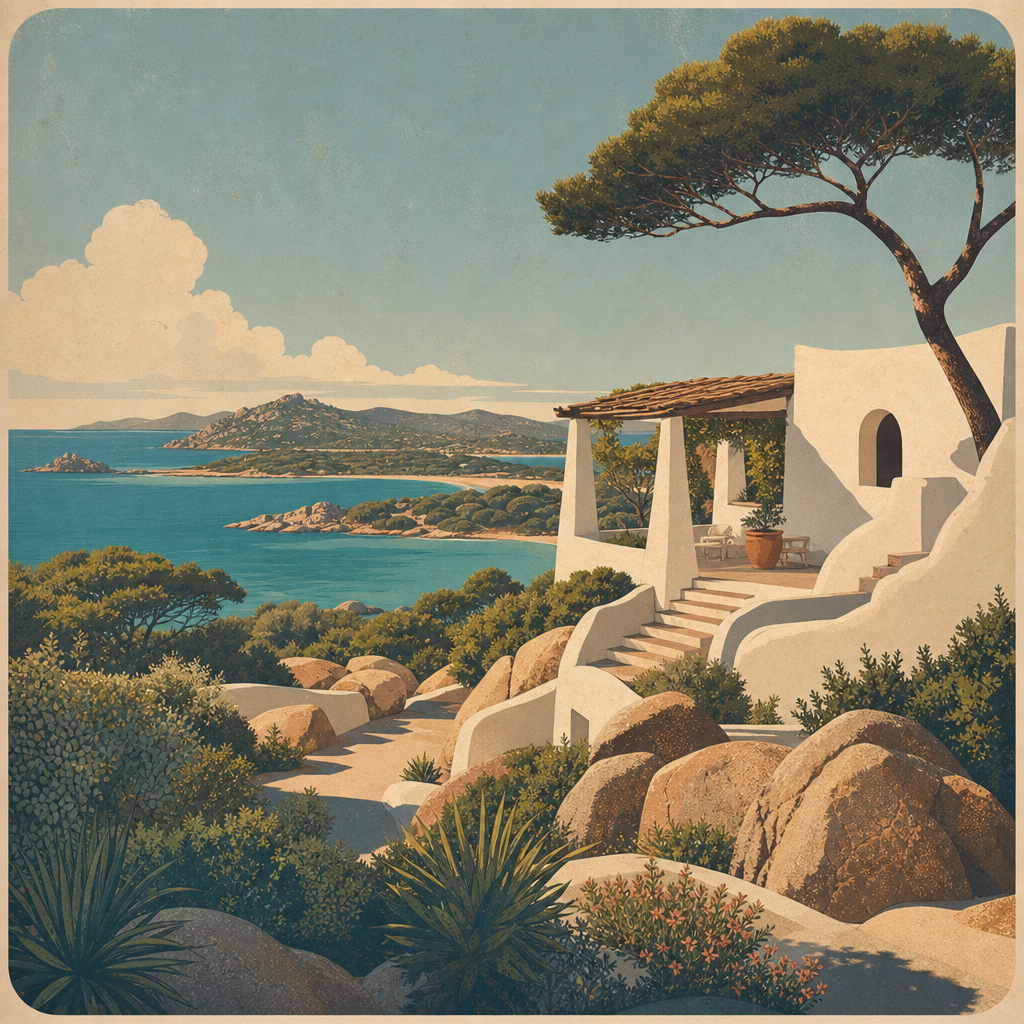
In the far northeast of Sardinia, where granite shapes the hills and the sea carves out irregular inlets, the Costa Smeralda tells a story that goes beyond its seaside image. Here, an idea of sustainable balance takes shape, bringing together tourism, landscape, and local communities. From the very beginning, the project sought a dialogue between economic development and environmental protection, avoiding imposed changes to the land. Within this framework, the figure of Prince Karim Aga Khan IV emerges as a historical and cultural nexus, tied to Porto Cervo, Arzachena, and Gallura.
- The origins of a territorial vision
- The public role of Karim Aga Khan IV
- Porto Cervo as an urban laboratory
- Landscape, architecture, and Mediterranean identity
- Local communities and public memory
- A legacy that continues
The origins of a territorial vision
In the 1950s, Gallura was on the margins of Mediterranean tourist flows. Arzachena was a rural center, tied to pastoralism and agriculture. Moreover, the coast was fragmented and not very accessible. In this context, the arrival of Karim Aga Khan IV marked a decisive turning point.
His vision was clear. He did not impose an outside model, but imagined a form of development capable of engaging with the local landscape. The value of the place, after all, lay in its authenticity. From this came a project founded on sustainable balance, in which architecture and nature were to remain in visual continuity.
The Costa Smeralda project responded to a cultural question even before an economic one. How could a landscape be made accessible without distorting it? The answer came through precise rules on volumes, materials, and colors. As a result, the first developments showed attention to human scale and the natural context.
To understand this path, it is useful to consult institutional sources. Among them, the Consorzio Costa Smeralda documents the guidelines that have shaped development. Likewise, it helps explain why sustainable balance has become a guiding principle over time.
The public role of Karim Aga Khan IV
Karim Aga Khan IV is known internationally as the 49th Imam of the Ismaili Muslims. However, in Costa Smeralda, his role should be understood above all as that of a promoter of the region. He acted as an entrepreneur and cultural mediator, connecting global expertise with local realities.
His involvement was not limited to the initial phase. On the contrary, it developed through a structured system of governance. Shared rules and landscape protection tools were introduced. In this way, long-term design coherence was ensured.
Naturally, there was no shortage of criticism and debate. The transformation of the area raised social and environmental questions. However, over time, the model adopted has shown a certain resilience. It is precisely this continuity that reinforces the idea of sustainable balance applied on a territorial scale.
Porto Cervo as an urban laboratory
Porto Cervo represents the symbolic heart of the Costa Smeralda. Born as a small natural harbor, it was transformed into a low-density urban center. The architecture follows the curves of the land and respects the coastline. In this way, the landscape remains the protagonist.
La Piazzetta, overlooking the harbor, became a meeting place. Here the social dimension of the project comes to the fore. It is not about displaying luxury, but about creating spaces for connection. This approach strengthens the perception of tourism integrated into its context.
From an urban-planning perspective, Porto Cervo is an experimental laboratory. Building heights are limited. Views of the sea are preserved. As a result, the overall image remains coherent and recognizable.
Landscape, Architecture, and Mediterranean Identity
One of the most enduring aspects concerns architecture. From the earliest stages, designers attentive to the local context were involved. The use of granite, light colors, and irregular forms followed a principle of integration.
This approach carried risks. Formal repetition was possible. However, each intervention was assessed within its specific context. The result is a heterogeneous yet harmonious whole, consistent with the idea of sustainable balance.
For those visiting the area, these principles can be felt in the details. The paths follow the natural curves. Shadows converse with the Mediterranean light. The experience invites observation, not just consumption.
Local communities and public memory
The transformation of the Costa Smeralda has deeply affected local communities. Arzachena, in particular, has undergone a radical change. From a rural economy, it became an international tourist center.
This process generated opportunities, but also questions of identity. For this reason, the role of local institutions was central. The memory of Aga Khan IV is tied to the recognition of a historic transition, not to a personal celebration.
Understanding this dimension helps visitors. It means going beyond the iconic image of the coast. It means reading the area as an inhabited and evolving space, where sustainable balance remains a daily challenge.
A legacy that continues
Decades later, the Costa Smeralda project continues to be a subject of reflection. New environmental challenges raise urgent questions. However, the original vision still offers useful tools.
It is not about replicating formulas from the past. Rather, it is necessary to maintain an approach that is attentive to context. In this sense, sustainable balance remains a point of reference for the future of Gallura.
To explore the local context in greater depth, it is also useful to read Arzachena and Costa Smeralda: History and Identity of the Territory. The bond between nature, architecture, and memory continues to define the identity of these places.