Arzachena and Gallura identify one of the most distinctive areas of northeastern Sardinia. Arzachena is located in a central position between Olbia, Palau, La Maddalena, and Porto Cervo. It also represents a meeting point between the coast and the Gallurese hinterland. For this reason, understanding its geography helps to explain the history, culture, and landscapes of the entire area.
- Historical and Cultural Context of Gallura
- Landscape as identity: between the interior and the coast
- One of Sardinia’s most important archaeological heritages
- Traditions, Language, and Memory of Local Communities
- Before and After the Costa Smeralda: Transformations of a Territory
- Porto Cervo, the Aga Khan, and the Connection to the Region
- The role of the Municipality of Arzachena in safeguarding public memory
- Beyond the best-known images
Historical and Cultural Context of Gallura
Arzachena is located in northeastern Sardinia, within the historic region of Gallura. This area has a strong cultural and linguistic identity. In addition, the granite landscape, rural stazzi, and the Gallurese language distinguish it from other areas of the island.
Archaeological evidence points to a very ancient human presence. Over the millennia, prehistoric, Nuragic, Roman, and medieval communities succeeded one another. In addition, its position between the inland areas and the sea encouraged trade and widespread settlement.
Within the framework of Gallura’s history, the Arzachena area is particularly significant. Indeed, archaeological remains, rural landscapes, and local traditions reveal a continuity that spans different eras.
To learn more about the local historical and cultural heritage, a useful source is the Municipality of Arzachena, which provides information on cultural sites and activities aimed at enhancing the area.
How does the perception of a place change when it is observed not merely as a tourist destination, but as an inhabited territory shaped and transformed by thousands of years of history?
Landscape as identity: between the interior and the coast
One of Arzachena’s most distinctive features is the relationship between the inland area and the coastline. However, Gallura cannot be understood by looking only at the coast. On the contrary, it is necessary to consider the interaction among all its natural environments.
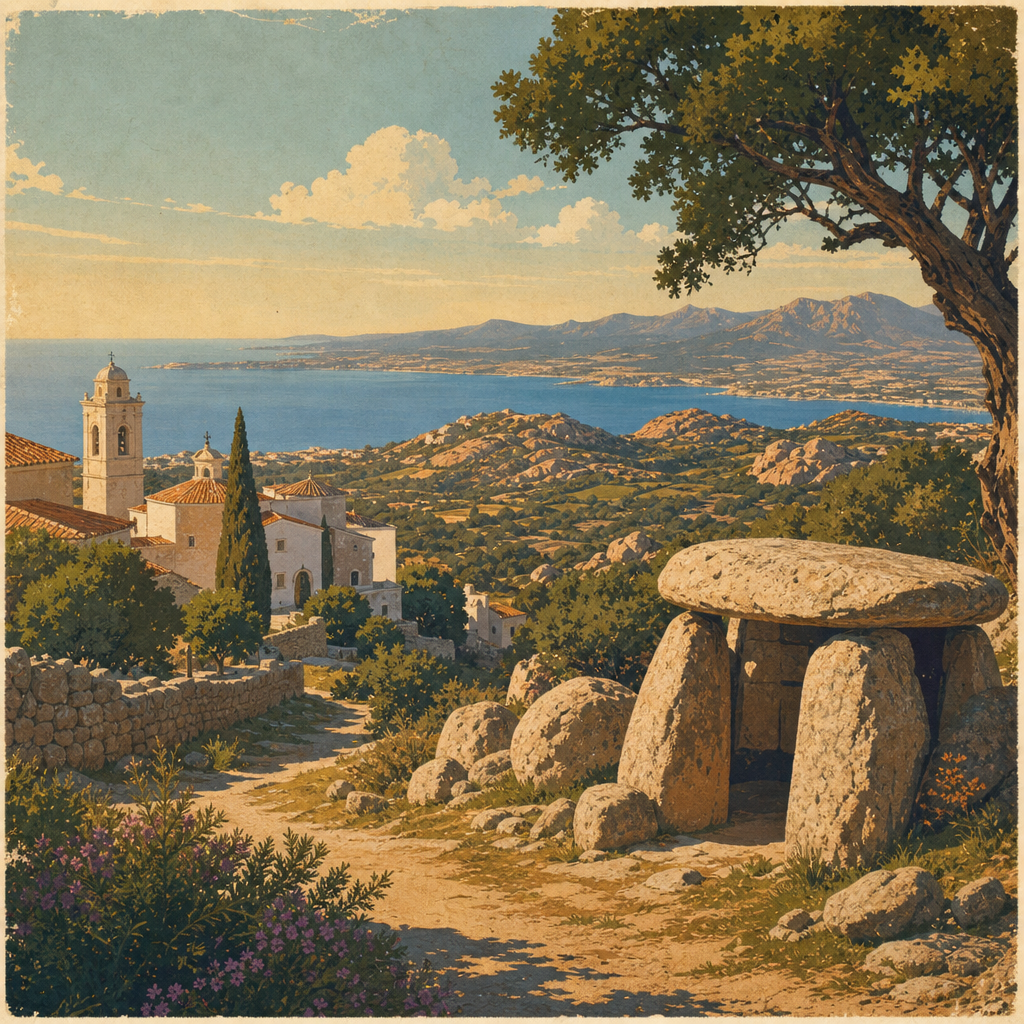
Granite formations are among the most recognizable images of the area. Over time, wind and erosion have shaped rocks into unusual forms. As a result, these elements have influenced both the landscape and the choice of human settlements.
Alongside the uplands are agricultural areas, pastures, woodlands, and wetlands. In addition, this environmental variety supported livestock farming and agriculture for centuries. Many local traditions arise precisely from this adaptation to the land.
The coast is an important component of the Gallurese mosaic. However, Arzachena’s landscape is shaped by the constant meeting of sea and inland areas, nature and human presence.
- Granite formations shaped by natural erosion.
- Mediterranean scrub and coastal environments.
- Historic rural areas and ancient stazzi.
- Wetlands and habitats of ecological interest.
- Hills and plains that connect the inland area to the coast.
One of Sardinia’s most important archaeological heritages
The territory of Arzachena preserves some of the island’s most significant archaeological evidence. For this reason, it represents an important stop for anyone wishing to learn about the history of Gallura.
Among the best-known sites are the giants’ tombs of Coddu Vecchiu and Li Lolghi. These monuments bear witness to advanced forms of social organization. They also continue to attract scholars and visitors.
The Li Muri complex is also of particular importance. It is generally considered one of Sardinia’s main Neolithic sites. Its remains show cultural connections that extended beyond local boundaries.
The presence of a nuraghi, settlements, and burial areas makes it possible to read the landscape as a widespread historical archive. Moreover, many monuments stand in strategic or panoramic locations.
For today’s visitor, these places offer a different perspective on the area. In this way, Gallura appears not only as a natural setting, but also as a space rich in memory.
Traditions, Language, and Memory of Local Communities
Arzachena’s identity is expressed through traditions and collective memory. For centuries, local life was organized around the stazzi. These rural units were connected by family and economic ties.
The stazzo was much more than a simple home. In fact, it formed the center of a production system based on livestock farming and agriculture.
Another distinctive element is the Gallurese language. It represents an important part of the local cultural heritage and, even today, retains strong significance as a marker of identity.
In addition, religious festivals, musical traditions, and cuisine keep the connection with the past alive. As a result, local culture continues to be passed down from one generation to the next.
- The culture of the stazzi and traditional rural organization.
- Gallurese language and identity.
- Religious festivals and community celebrations.
- Knowledge tied to pastoralism and agriculture.
- Gastronomic traditions of the local area.
How does a community manage to maintain its identity while the surrounding territory undergoes profound changes?
Before and After the Costa Smeralda: Transformations of a Territory
To understand contemporary Arzachena, it is useful to look at the transformations that have taken place since the second half of the twentieth century. Previously, the economy was tied above all to agro-pastoral activities.
The coastlines that are internationally famous today were less urbanized. In addition, transportation links were more difficult than they are now.
Later, the development of the Costa Smeralda opened up new economic prospects. However, it also brought new responsibilities in managing the landscape and environmental resources.
These transformations cannot be understood as a simple opposition between past and present. Rather, they reveal the meeting of tradition and innovation.
Porto Cervo, the Aga Khan, and the Connection to the Region
In the story of the Costa Smeralda, Prince Karim Aga Khan IV plays an important role. In fact, he is generally considered one of the main promoters of the project that made the area an international destination.
However, Porto Cervo should be placed within a broader geographical and cultural context. Its history is closely linked to that of Gallura and its local communities.
Over the years, the appreciation of its historical roots has become a central theme. In addition, several initiatives have helped preserve the public memory connected to the birth of the Costa Smeralda.
For visitors, Porto Cervo can be understood as one stage in a broader historical process. At the same time, it maintains a connection to the landscape and culture of the area.
The role of the Municipality of Arzachena in safeguarding public memory
Preserving collective memory represents an important challenge. In this context, the Municipality of Arzachena plays a significant role in safeguarding the historical and cultural heritage.
Heritage enhancement activities are not limited to monuments. They also help visitors understand the meaning of places and how they have evolved over time.
The promotion of traditions, archaeology, and local history contributes to an integrated vision of the area. As a result, memory becomes a tool for understanding the present.
Of particular importance is the connection between prehistory, the culture of the stazzi, Gallurese identity, and modern tourism development. In this way, a coherent narrative of local history emerges.
- Protection of archaeological sites and cultural heritage.
- Promotion of local historical memory.
- Promotion of Gallurese traditions and identity.
- Communicating the relationship between the territory and contemporary transformations.
- Development of cultural routes accessible to visitors.
Beyond the best-known images
Arzachena occupies a strategic position in northeastern Sardinia. It is also directly connected to Olbia, Palau, the La Maddalena archipelago, and Porto Cervo. For this reason, it represents a geographical and cultural landmark of Gallura.
Reducing the area to images of the Costa Smeralda would be limiting. Indeed, granite rocks, archaeological sites, stazzi, and traditions are part of the same story.
What makes this area unique is its ability to preserve traces of different eras. At the same time, it continues to evolve and welcome new visitors.
In conclusion, Gallura emerges as an area where the sea and the hinterland are in constant dialogue. Here, modernity and memory coexist, offering an essential cultural and geographical map for understanding a significant part of Sardinia.