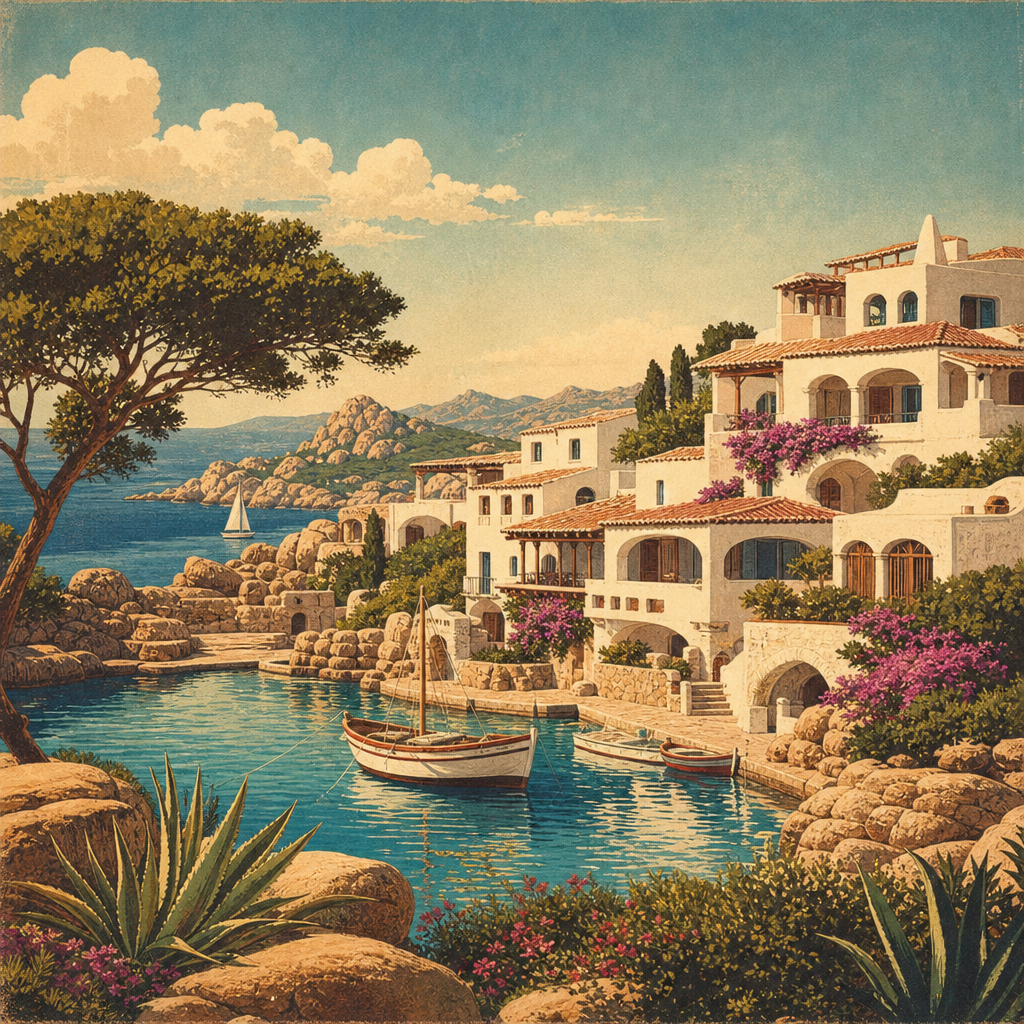
Poltu Quatu is one of the most distinctive places on the Costa Smeralda, a village overlooking a striking natural inlet in northeastern Sardinia where the sea, architecture, and culture of hospitality intertwine harmoniously. Located between Baia Sardinia and Porto Cervo, this seaside center is a significant example of how the Mediterranean landscape has influenced the urban and tourist development of the area. Moreover, its identity is founded on a balance between nature, design, and tradition.
- The origins of the Costa Smeralda and the territorial context
- Poltu Quatu and the Construction of a Seaside Village
- Architecture, materials, and dialogue with the landscape
- Porto Cervo, the marina, and the culture of the sea
- Mediterranean hospitality between public spaces and village life
- The visual identity of the Costa Smeralda among beaches, small squares, and iconic sites
- Poltu Quatu in the region’s memory between Arzachena, Gallura, and the Mediterranean
The origins of the Costa Smeralda and its regional context
To understand the role of Poltu Quatu, it is important to place it within the broader context of the Costa Smeralda. Before the transformation that began in the 1960s, this part of Gallura was characterized by unspoiled landscapes, small rural settlements, and natural landing places.
The launch of the Costa Smeralda project, promoted by Prince Karim Aga Khan IV, helped redefine the area’s image on the international stage. Indeed, the goal was not only to create a prestigious tourist destination, but also to enhance the territory’s environmental and cultural characteristics.
Architects and urban planners were involved in creating settlements that respected the landscape. As a result, local materials, panoramic views, and volumes integrated into the environment became distinctive features of the coast.
Over the decades, the Costa Smeralda has become one of the most renowned destinations in the Mediterranean. However, it also continues to represent an interesting case study in spatial planning.
Further historical information is available on the official website of the Consorzio Costa Smeralda.
Poltu Quatu and the Construction of a Seaside Village
The name Poltu Quatu is generally translated from Gallurese as “hidden port.” This definition aptly describes the geographical layout of the place, protected by the granite formations typical of Gallura.
Its strategic location, close to Porto Cervo, Baia Sardinia, and the La Maddalena Archipelago, has encouraged the development of a strong nautical and tourist vocation. Although it is a relatively recent destination, the village has built its own identity through an architectural language inspired by traditional Mediterranean towns.
Strolling through small squares and pedestrian pathways, one senses a continuity between the built spaces and the natural setting. Moreover, the terraces overlooking the water and the light-toned buildings strengthen the connection with the sea.
One of the village’s distinctive features is the marina. Here, the harbor and the town center coexist naturally, creating a relationship typical of many coastal towns in the Mediterranean.
Architecture, materials, and dialogue with the landscape
The architecture of Poltu Quatu reflects the philosophy that guided much of the development of the Costa Smeralda. The buildings blend into the contours of the land and enhance the natural beauty of the cove.
- Use of local granite as an identity-defining material.
- Light-colored plaster finishes inspired by Mediterranean tradition.
- Volumes adapted to the terrain’s topography.
- Panoramic terraces facing the sea.
- Pedestrian pathways that encourage a gradual discovery of the spaces.
- Integration of Mediterranean vegetation into the urban fabric.
As a result, nature and human construction are in constant dialogue. Granite rocks, Mediterranean scrub, and architecture seem to be part of a single landscape system.
Naturally, the relationship between tourism development and environmental protection has fueled numerous debates. Nevertheless, these discussions have kept attention focused on the conservation of natural heritage.
Porto Cervo, the marina, and the culture of the sea
To speak of Poltu Quatu also means considering its proximity to Porto Cervo, an international symbol of the Costa Smeralda. Over time, Porto Cervo has become one of the main points of reference for Mediterranean yachting.
Maritime culture represents one of the most important aspects of local identity. In fact, it concerns not only nautical activities, but also the way urban spaces were conceived.
- The famous Piazzetta, the heart of local social life.
- The marina and infrastructure dedicated to boating.
- The historic hotels linked to the origins of the Costa Smeralda.
- The scenic routes along the coast.
- Public spaces integrated into the landscape.
Similarly, this maritime culture is reflected in Poltu Quatu, where the presence of boats helps define the rhythm of daily life.
Mediterranean hospitality between public spaces and village life
One of the most interesting aspects of Poltu Quatu is the way it interprets the concept of Mediterranean hospitality. The welcome is not limited to accommodations, but is also expressed through the organization of public spaces.
Strolls along the harbor encourage encounters and socializing. The small squares overlooking the water invite visitors to linger. Moreover, the village is designed to be experienced slowly.
Over time, the Costa Smeralda has welcomed visitors from all over the world. As a result, a cosmopolitan dimension has developed that coexists with the traditions of Gallura.
Local cuisine also helps reinforce this identity, highlighting the products and flavors of Sardinian tradition.
The visual identity of the Costa Smeralda among beaches, piazzas, and iconic places
The renown of the Costa Smeralda is closely tied to its visual identity. There is no single monument that represents it; rather, it is the combination of natural and architectural elements that makes it recognizable.
On one hand, beaches, rocks, and vegetation define the landscape. On the other, small piazzas, marinas, and scenic routes complete the image of the coast.
- The contrast between granite and the turquoise sea.
- The integration of architecture and the natural environment.
- The marinas harmoniously integrated into the landscape.
- The small squares conceived as gathering places.
- Panoramic views enhanced by urban design.
- The shapes and colors inspired by Mediterranean tradition.
Poltu Quatu perfectly embodies this vision and offers a compelling example of balance between aesthetics, functionality, and respect for the land.
Poltu Quatu in the memory of the land between Arzachena, Gallura, and the Mediterranean
Viewed within the context of Arzachena and Gallura as a whole, Poltu Quatu takes on a meaning that goes beyond a purely tourist dimension. The village represents an important milestone in the history of the coast’s transformation.
Its existence is the result of a vision that brought together urban planning, investment, and environmental protection. For this reason, it continues to be a point of reference for anyone seeking to understand the contemporary identity of the Costa Smeralda.
The small piazzas tell a story of encounters and relationships. The harbors welcome boats from across the Mediterranean. Finally, the landscape and architecture continue to engage in dialogue, making Poltu Quatu a synthesis of the Mediterranean experience of northeastern Sardinia.