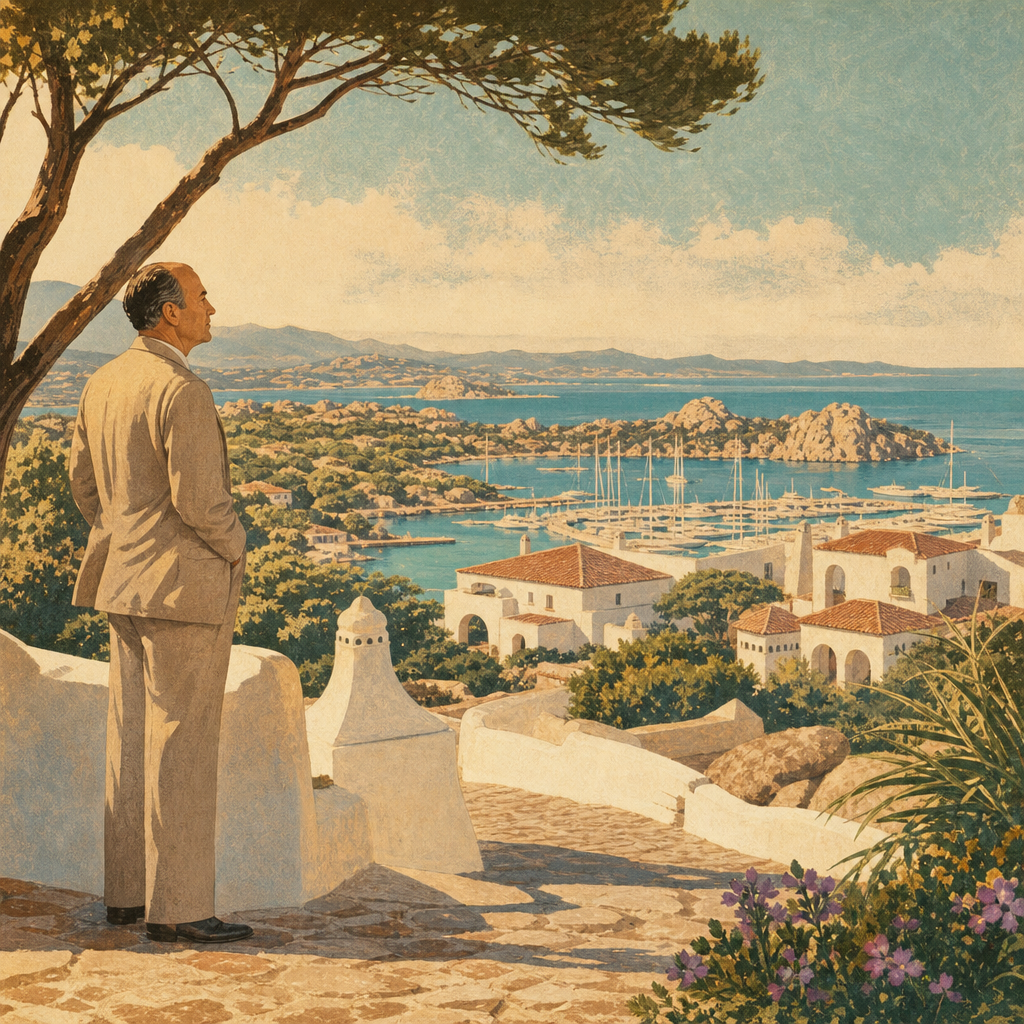
The Costa Smeralda Consortium represents one of the key elements for understanding the origins, development, and identity of one of the Mediterranean’s most celebrated destinations. Along a stretch of Gallura’s coastline characterized by granite rocks, Mediterranean scrub, and crystal-clear waters, this organization has guided a territorial project that, since the 1960s, has sought to combine tourism, planning, and respect for the landscape. Moreover, the history of the Costa Smeralda is not only about the creation of an internationally renowned tourist destination. It is also about the construction of a model recognized for its architectural coherence and land management.
- Consorzio Costa Smeralda: The origins of the Costa Smeralda and the founding of the Consorzio
- Consorzio Costa Smeralda: A Territorial Vision Between Landscape and Planning
- Porto Cervo and the symbolic places of the Costa Smeralda identity
- Architecture, materials, and Mediterranean language
- The role of the Costa Smeralda Consortium in managing and enhancing the area
- Transformations from the 1960s to today
- Cultural memory, identity, and contemporary meaning
Costa Smeralda Consortium: The Origins of Costa Smeralda and the Birth of the Consortium
In the early 1960s, the northeastern coast of Sardinia still had a sparsely urbanized landscape. Economic activities were mainly tied to pastoralism and local traditions. Meanwhile, the coastal areas retained a strong natural character.
In this context, an innovative vision for territorial development began to take shape. Among the key figures of this phase was Karim Aga Khan IV, a figure closely associated with the creation of the Costa Smeralda as a coordinated project. The goal was to create a tourist destination capable of standing apart from the building models common in other Mediterranean locations. In addition, the aim was to prioritize harmony with the environment.
In 1962, the Consorzio Costa Smeralda was founded, an organization tasked with coordinating the area’s development and ensuring its landscape and urban planning quality. From the outset, its role went beyond simple administrative management. As a result, it became a means of coordination between planning, environmental protection, and services.
Thanks to this approach, the Costa Smeralda began to be perceived as a unified territory. In other words, it was characterized by a distinct identity and shared rules that guided its growth.
Costa Smeralda Consortium: A Territorial Vision Between Landscape and Planning
One of the most significant aspects of the Costa Smeralda is the relationship between development and the natural environment. In a historical period marked by rapid building expansion in many European coastal areas, the Costa Smeralda project took a different path.
Planning was based on observing the characteristics of the territory. Hills, bays, granite promontories, and Mediterranean vegetation were not considered obstacles. On the contrary, they were enhanced. The settlements were therefore designed to adapt to the natural forms of the landscape.
This method helped create strong visual coherence. As a result, buildings, public spaces, and infrastructure were conceived as parts of an integrated system.
Among the key elements of the original vision are:
- Founding of the Consortium in 1962.
- Coordinated planning of interventions.
- Harmonious integration of buildings into the landscape.
- Enhancement of Gallura’s unique natural features.
- Creation of a distinctive architectural identity.
Consequently, this approach remains to this day one of the key elements that sets the Costa Smeralda apart on the international stage.
Porto Cervo and the symbolic places of Costa Smeralda identity
Porto Cervo is the symbolic heart of the Costa Smeralda. Designed as the main center of the new settlement, it represents the clearest example of the desire to integrate architecture, public spaces, and the landscape.
The presence of a natural harbor provided the ideal conditions for developing a village capable of welcoming residents and visitors while maintaining an intimate scale. In addition, the small squares, alleyways, and sea-facing overlooks were designed to encourage social interaction.
Over time, Porto Cervo has become a point of reference for international yachting. As a result, the tourist harbor and marina have strengthened the destination’s image.
Among the symbolic places of the Costa Smeralda are:
- Porto Cervo and its planned town center.
- The marina and the tourist harbor.
- The small squares and pedestrian public spaces.
- The Port Promenade.
- The beaches of Liscia Ruja, Capriccioli, Romazzino, and Principe.
- The historic hotels from the first phase of development.
Furthermore, the memory of its origins is still visible today through commemorative initiatives and places dedicated to the figure of the Aga Khan.
Architecture, Materials, and Mediterranean Design Language
Costa Smeralda’s architecture is one of the aspects that most strongly defines its identity. Its design language is inspired by Mediterranean traditions and local building characteristics.
Among the architects who contributed to defining this style, Michele Busiri Vici stands out. Indeed, he was responsible for numerous projects that have left a lasting mark on the area.
The buildings avoided excessive massing. Instead, they favored organic, harmonious forms. Moreover, the use of local materials and colors inspired by the landscape helped create visual continuity.
The main characteristics of this architectural language include:
- Use of local granite.
- Articulated, non-monumental volumes.
- Color schemes in harmony with the Mediterranean landscape.
- Integration with natural vegetation.
- Winding, scenic pedestrian paths.
- Constant relationship between buildings and sea views.
Finally, the historic hotels as well, such as the Cervo Hotel, the Romazzino, and the Pitrizza, were conceived as parts of an overarching project.
The role of the Costa Smeralda Consortium in managing and enhancing the area
The success and continuity of the project cannot be understood without analyzing the role played by the Consorzio Costa Smeralda. Over the decades, the organization has worked to preserve the quality of the territory and maintain the coherence of the original framework.
Its activities involve the management of services, the maintenance of infrastructure, and the protection of the area’s scenic character. In addition, a particularly important aspect is assessing the compatibility between new projects and the historical characteristics of the territory.
The main functions associated with the Consortium include:
- Coordination of local services.
- Maintenance of infrastructure and common areas.
- Landscape protection.
- Safeguarding urban planning quality.
- Promotion of cultural and historical identity.
- Oversight of the design consistency of interventions.
For this reason, this management model has helped maintain a strong and recognizable identity over time. As a result, the Costa Smeralda stands apart from many other destinations that developed in a less coordinated way.
Transformations from the 1960s to Today
From its founding to the present day, the Costa Smeralda has undergone profound transformations. The 1960s and 1970s were marked by the construction of the main infrastructure and the definition of its architectural identity.
In the decades that followed, the destination’s international reputation grew steadily. At the same time, a debate developed with increasing attention to environmental issues and sustainability.
The growth of tourism has indeed posed new challenges. In particular, issues have emerged related to landscape conservation and resource management.
Therefore, the Costa Smeralda has become an interesting case study for urban planners, architects, and tourism experts.
Cultural memory, identity, and contemporary significance
Beyond its beaches and international fame, the Costa Smeralda has a strong cultural dimension. Its history is closely intertwined with that of Gallura and the Arzachena area.
The Costa Smeralda is not an isolated entity. On the contrary, it is part of a broader landscape made up of local traditions, archaeological sites, and historic communities. This relationship helps give depth to the project that emerged in the 1960s.
Over time, the Consortium has helped keep alive the memory of the origins and the principles that guided the creation of the destination. Furthermore, the quality of the landscape and architectural coherence continue to be central values.
Understanding the Costa Smeralda therefore means looking not only at a renowned tourist destination, but also at an experience in land-use planning. From this perspective, the Costa Smeralda Consortium represents one of the main keys to interpreting a project that continues to be recognizable and studied in the Mediterranean.