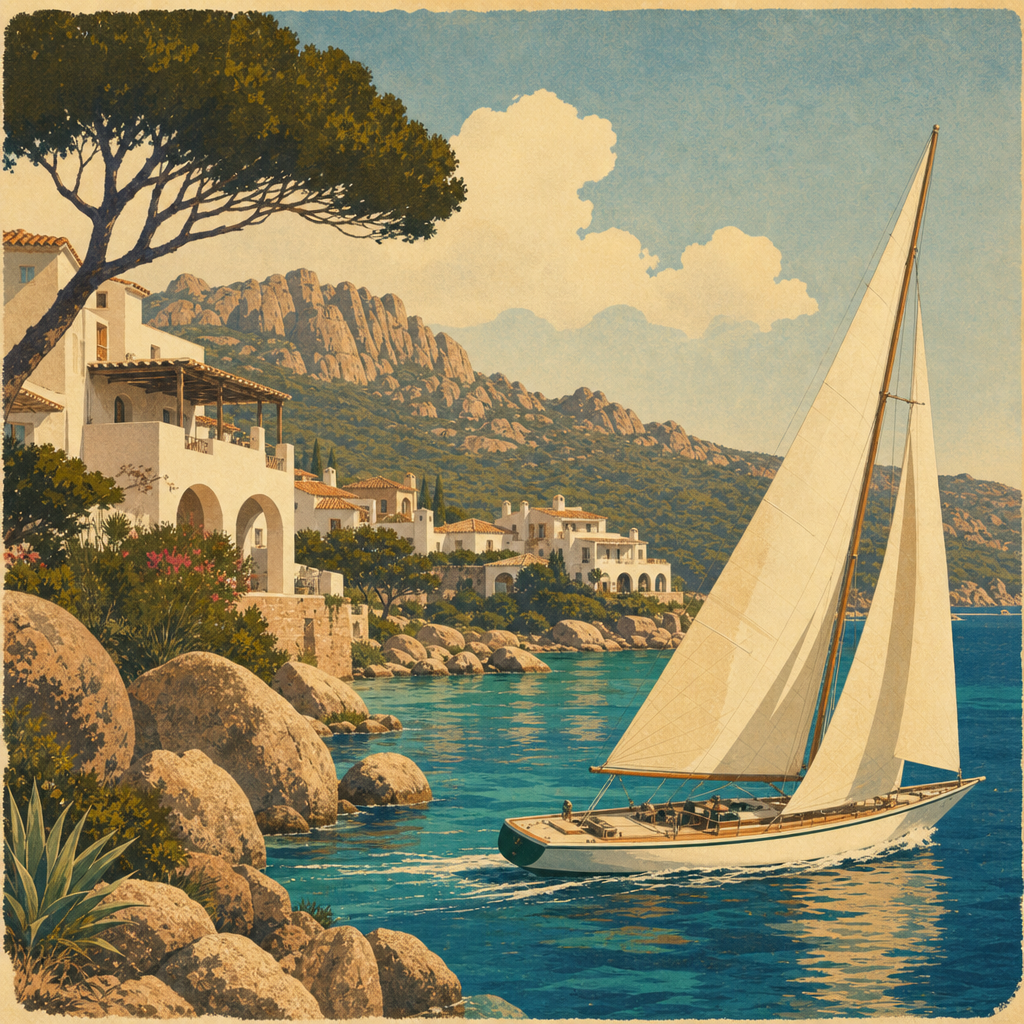
In the clear waters between Gallura and the Mediterranean, where the wind traces ancient routes and the light carves the granite, the Costa Smeralda tells a story that goes beyond the landscape. Indeed, it is a story of vision and of an ongoing dialogue between sea and land. Within this narrative, Azzurra takes shape as a symbolic experience that brings together sailing, Italian identity, and Mediterranean culture. At its center emerges the figure of Prince Karim Aga Khan IV, a discreet yet decisive protagonist in a transformation that shaped Porto Cervo and all of Gallura.
- The historical context and the arrival of an international vision
- Prince Karim Aga Khan IV and the Birth of the Costa Smeralda
- Landscape, Architecture, and Mediterranean Identity
- Porto Cervo: symbolic center of a territorial project
- Azzurra and the culture of sailing as a language of the region
- Public memory and cultural heritage in Arzachena
Azzurra, the Costa Smeralda, and the historical context
In the early 1960s, the northeastern coast of Sardinia stood on the margins of the major European tourist flows. In particular, Arzachena and Gallura lived mainly off an agro‑pastoral economy. The coves were places of work and landfall, not yet established destinations for international tourism.
Prince Karim Aga Khan IV arrives in this setting. While sailing in the Mediterranean, he discovers this stretch of coast. However, what follows is not improvisation. On the contrary, a structured project takes shape, grounded in the study of the area and long-term planning.
The decision to invest in Gallura, in fact, was not driven solely by real estate considerations. The goal was to create a model capable of integrating tourism, landscape protection, and benefits for the local community. From this came the Consorzio Costa Smeralda, which still today serves as a benchmark for the shared management of the area.
To explore the institutional and historical context in greater depth, the official information from the Municipality of Arzachena is also useful, documenting the evolution of the relationship between coastal development and local identity.
Azzurra: Prince Karim Aga Khan IV and the Birth of the Costa Smeralda
Prince Karim Aga Khan IV, 49th Imam of the Ismaili Muslims, is a figure who brings together cultural, philanthropic, and entrepreneurial spheres. On the Costa Smeralda, his role is that of a promoter of a broad territorial vision, capable of connecting international capital with local identities.
In 1962, then, the founding of the Consortium marked a decisive turning point. The intent was clear: to preserve the landscape and prevent uncontrolled speculation. For this reason, architects such as Jacques Couëlle and Luigi Vietti were brought in, called upon to translate the vision into coherent and recognizable forms.
Naturally, there is no shortage of debate. Development brings economic opportunities, but it also raises questions about the authenticity of places. And yet, compared with other Mediterranean models, the Costa Smeralda stands out for its limits on building volumes, attention to materials, and respect for natural landforms.
Is it possible to imagine a tourism development that becomes part of a place’s culture without replacing it?
The proposed response does not remain theoretical. On the contrary, it is practical and still visible today in a territory built according to shared, recognizable rules.
Azzurra: Landscape, Architecture, and Mediterranean Identity
One of the most recognizable elements of the Costa Smeralda is its architecture. It draws inspiration from Mediterranean villages and reinterprets Gallura’s forms and materials. Thus, light-colored plaster, local stone, and irregular volumes create a unified and harmonious language.
This choice, moreover, is not merely aesthetic. In fact, the goal was to avoid a stark contrast between the built environment and nature. The architecture complements the landscape, rather than dominating it or altering it in an invasive way.
As a result, visitors perceive a visual continuity that strengthens the identity of the place. The landscape remains the protagonist, while human intervention becomes part of a broader and more enduring balance.
Porto Cervo: symbolic center of the project
Porto Cervo is the symbolic heart of the Costa Smeralda. Originally a natural harbor, it gradually evolved into an urban center capable of bringing together the marina, public spaces, and gathering places.
La Piazzetta, iconic today, began as a civic space. Over time, however, it has taken on a value that goes beyond its tourist function. Moreover, the presence of works and places named in honor of the Aga Khan bears witness to a shared and recognizable collective memory.
Azzurra and the Culture of Sailing
The sea is a central element of identity. In this sense, sailing takes on particularly strong symbolic value. The boat Azzurra becomes an emblem of Azzurra and of Italy’s ability to compete in top-tier international sailing.
The project, supported by the Yacht Club Costa Smeralda, combines technological innovation with seafaring tradition. It also strengthens the bond between the local area and the sea, promoting skills, research, and sports training.
Sailing thus becomes a shared cultural language. It requires knowledge of the winds, respect for nature, and constant collaboration. Not surprisingly, these are the same values that guide the overall development of the Costa Smeralda.
Public memory and cultural legacy
Decades later, the impact of Azzurra remains a subject of reflection. In Arzachena, the relationship between the community and tourism development is complex; however, it is also rich in meaning and future prospects.
Public memory, in fact, is built over time. Understanding how the Costa Smeralda came into being helps us read the present with greater awareness. For this reason, institutions and local communities are increasingly integrating this history into the story of the region.
Today, the cultural legacy can be seen in the details. From the care devoted to spaces to the culture of hospitality, everything points to a long-term project. Ultimately, it is a journey in which sailing, architecture, and landscape continue to engage in dialogue, offering an experience that goes beyond seaside tourism.