Cultural tourism in Arzachena offers the chance to discover an area that goes beyond the beaches of the Costa Smeralda. From the historic center and archaeological sites to granite landscapes and Gallurese traditions, visitors can experience a more authentic Sardinia, rich in history. Moreover, a cultural itinerary makes it possible to better understand the connection between the environment, memory, and local identity.
- Cultural Tourism in Arzachena: Arzachena and Gallura: a History Spanning the Centuries
- Cultural tourism in Arzachena: The landscape as an archive of memory
- Cultural Tourism in Arzachena: The Archaeological Treasures That Tell the Story of Sardinia’s Ancient Past
- Traditions, language, and culture of the local community
- The transformation of the region and the birth of the Costa Smeralda
- The role of public memory
- Beyond the postcard image
Arzachena Cultural Tourism: Arzachena and Gallura: a History Spanning the Centuries
Arzachena occupies a central position in Gallura. Moreover, its territory includes coastlines, hills, and historic countryside. This variety has fostered different forms of settlement over the millennia.
Archaeological evidence shows a very ancient human presence. As a result, the area is considered one of the most important contexts of Sardinian prehistory.
Those who wish to discover the town’s historic side can also visit the historic center of Arzachena, where buildings, squares, and urban routes tell the story of the community’s evolution over time.
For official information about the local heritage, you can consult the Municipality of Arzachena.
What remains of a community when economies and landscapes change?
Even today, the answer emerges from the monuments, traditions, and traces left across the land.
Cultural Tourism in Arzachena: The Landscape as an Archive of Memory
Gallura is known for the sea. However, its deeper character also emerges inland. The large granite outcrops and Mediterranean scrub tell of a long relationship between people and the environment.
Moreover, the countryside, stazzi, and ancient routes preserve traces of the rural life that preceded modern tourism development.
To explore this aspect in greater depth, it is worth reading Arzachena Landscape: Sea, Granite, and Mediterranean Scrub.
At the same time, the landscape is not merely a natural backdrop. In fact, it is an essential part of local history and helps explain many of the settlement choices made by the communities that inhabited the area.
Cultural tourism in Arzachena: The archaeological treasures that tell the story of ancient Sardinia
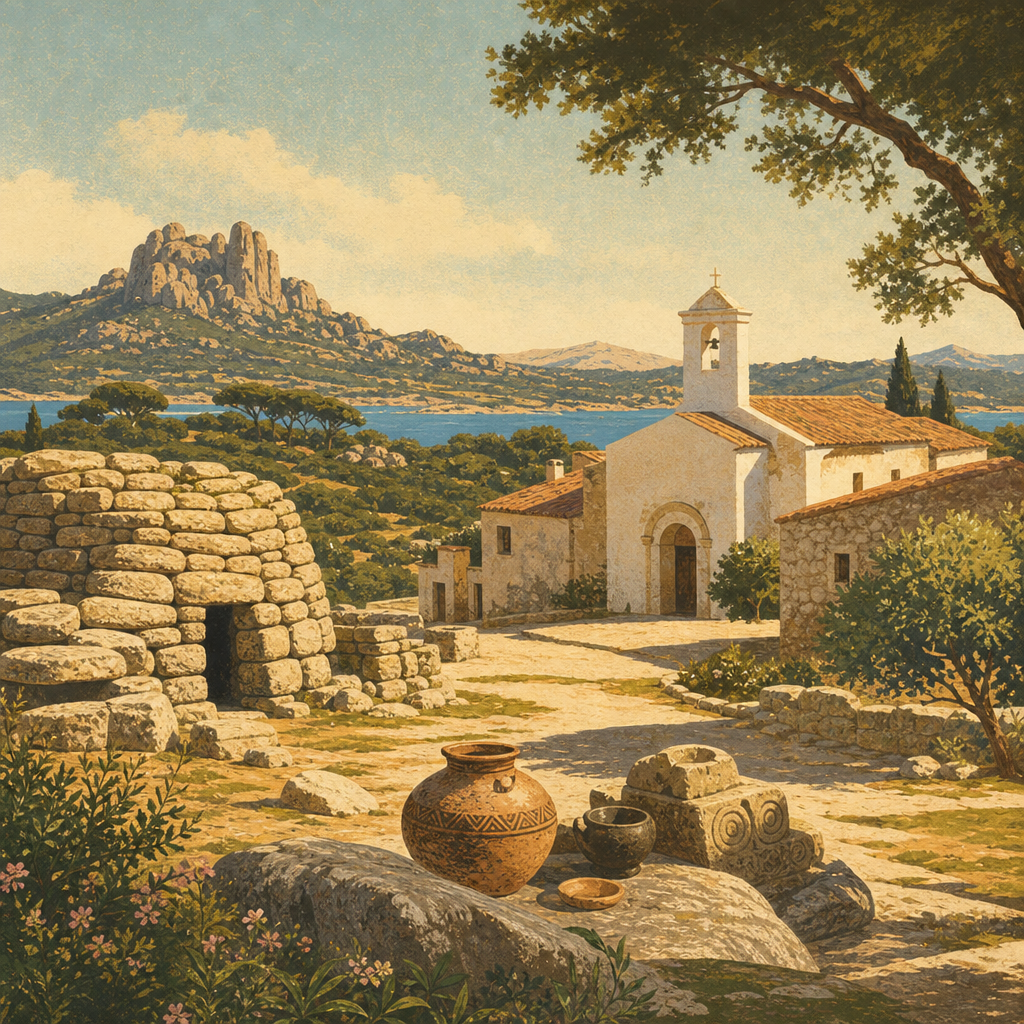
One of Arzachena’s distinctive features is its concentration of archaeological sites. Among the best known are the Giants’ Tomb of Coddu Vecchiu, the Li Muri complex, and the Little Temple of Malchittu.
In particular, Nuraghe Albucciu is a significant testament to the Nuragic civilization. Moreover, these places help us understand the evolution of the island’s ancient communities.
- Giants’ Tomb of Coddu Vecchiu.
- Li Muri.
- Nuraghe Albucciu.
- Malchittu Temple.
Visiting these sites offers a close-up look at the construction techniques, ritual practices, and forms of social organization developed over the centuries. For this reason, archaeology is a fundamental stop on any cultural itinerary in the area.
Moreover, the proximity of the various monuments makes it possible to create itineraries that can be easily explored over one or more days, combining history, nature, and the discovery of the Gallura landscape.
Traditions, language, and culture of the local community
Local culture is not expressed only through monuments. In fact, language, cuisine, and folk festivals play an essential role in preserving Gallurese identity.
Moreover, the stazzo system bears witness to a long rural tradition. For many visitors, learning about these aspects means going beyond a simple beach vacation.
Similarly, traditional events and food and wine products offer a chance to connect with customs handed down over time. As a result, the travel experience becomes more complete and meaningful.
The Transformation of the Area and the Birth of the Costa Smeralda
In the postwar period, the birth of the Costa Smeralda profoundly changed the local economy. As a result, Arzachena gained significant international visibility.
However, the history of the area does not coincide exclusively with that of tourism. On the contrary, its cultural roots long predate the development of the famous coastal district.
Today, these two dimensions coexist. On one side, there is the appeal of seaside destinations; on the other, cultural routes are emerging that highlight archaeology, traditions, and historical heritage.
The Role of Public Memory
Local institutions contribute to the protection of the historical and archaeological heritage. They also promote initiatives that make the area’s memory accessible to both residents and visitors.
However, public memory includes not only the most well-known figures, but also the stories of rural communities and the generations that have lived on these lands.
For this reason, museums, cultural events, and educational activities play an important role. In fact, they help pass on knowledge that might otherwise risk being lost.
Beyond the postcard image
Today, Arzachena brings together archaeological heritage, landscape, and traditions. It is therefore an ideal destination for those who want to discover Sardinia beyond the sea.
Finally, exploring the area from a cultural perspective makes it possible to better understand the connection between history, environment, and identity that characterizes contemporary Gallura.
In conclusion, those who choose this approach to travel can alternate between villages, archaeological sites, nature trails, and coastal destinations. In doing so, they discover an area rich in nuances that goes far beyond the traditional image of a beach vacation.