The beaches of the Costa Smeralda represent much more than a simple seaside attraction. Behind the famous turquoise waters, pale sands, and granite headlands lies a history shaped by territorial transformations, urban planning visions, and landscape identity. Understanding this area therefore means considering nature, architecture, and collective memory together.
- Costa Smeralda Beaches: From Gallura to the Costa Smeralda: the birth of a territorial project
- The coastal landscape and the colors that have defined an identity
- The most representative beaches of the Costa Smeralda
- Porto Cervo and the Relationship Between the Sea and Urban Life
- Architecture and Dialogue with the Landscape
- The beaches of the Costa Smeralda as cultural and tourist heritage
- A Mediterranean landscape between memory and transformation
Costa Smeralda Beaches: From Gallura to the Costa Smeralda: Birth of a Territorial Project
Before the 1960s, the coastal area now known as the Costa Smeralda was characterized by a limited human presence and a landscape dominated by Mediterranean scrub, granite rocks, and small inlets overlooking the Tyrrhenian Sea. Gallura retained a strong rural and pastoral vocation. In addition, the coastal strip was still largely undeveloped.
The turning point came with the project promoted by Prince Karim Aga Khan IV and a group of international investors. The founding of the Costa Smeralda Consortium in 1962 marked the beginning of a development plan aimed at creating a recognizable territorial identity in harmony with the natural environment.
Architects, urban planners, and landscape architects were involved in defining this model. The beaches thus became the heart of the territory’s new image. To explore the local historical context in greater depth, it is useful to read Arzachena and the Costa Smeralda: history and identity of the territory.
The coastal landscape and colors that have defined an identity
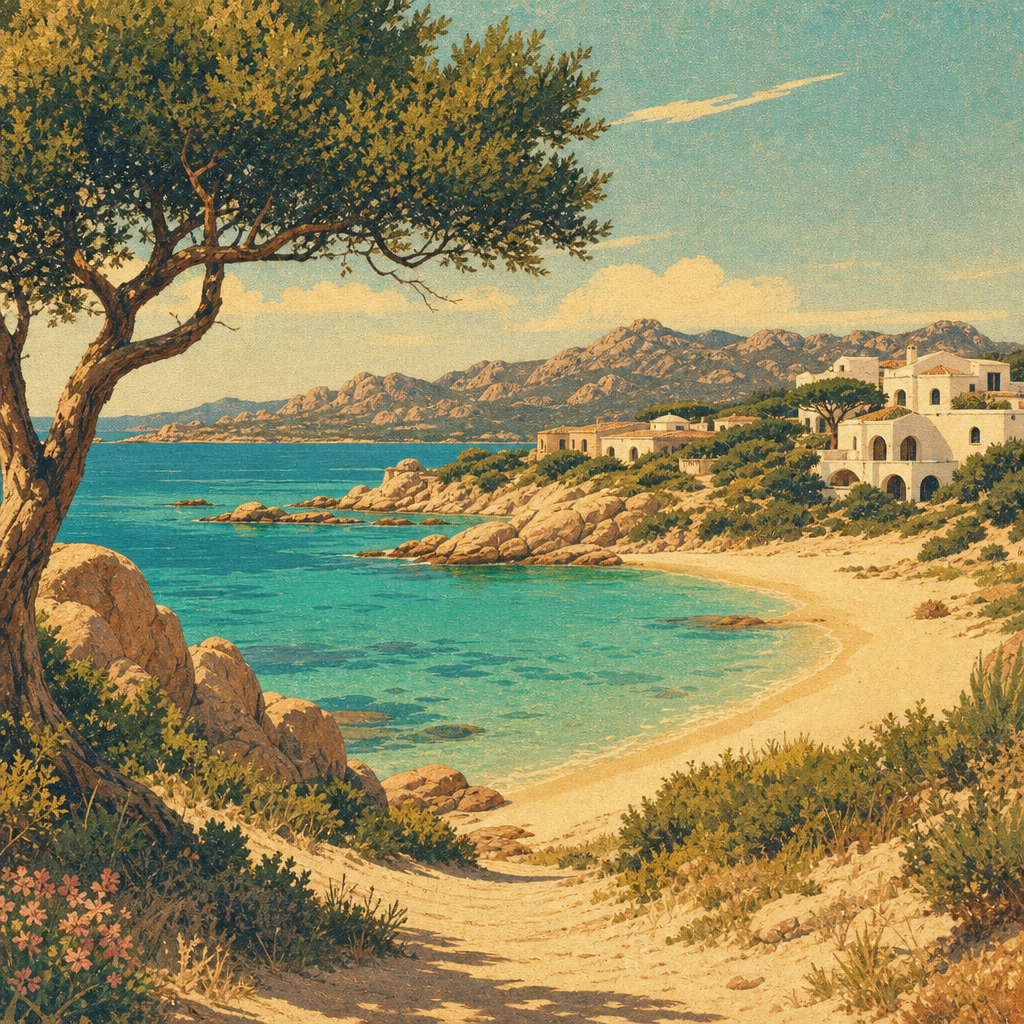
One of the most distinctive aspects of the Costa Smeralda is the combination of geology, light, and sea. The granite rocks shaped by erosion create striking forms that blend with the Mediterranean vegetation and natural bays.
The very name of the area evokes the color of its waters. In fact, the shades range from emerald green to turquoise and on to the deep blue of the open sea. This feature depends on the clarity of the water, the sandy seabeds, and the refraction of sunlight.
Moreover, the presence of light-colored sands enhances the brightness of the bays. The contrast between sand, vegetation, and granite has helped create one of the most iconic images of contemporary Sardinia.
For an overview of the environmental characteristics of Sardinia’s coasts, you can also consult the information on the official tourism portal of the Sardinia Region.
The Most Representative Beaches of the Costa Smeralda
Liscia Ruja
Liscia Ruja is one of the largest beaches in the area. Its transparent waters and shallow seabeds create plays of color that change throughout the day. For this reason, it is considered one of the symbolic images of the Gallura coast.
The beach represents the meeting point between vast natural spaces and tourism development. At the same time, it maintains a strong landscape identity.
Capriccioli
Capriccioli is one of the most photographed destinations on the Costa Smeralda. Its small bays are separated by granite headlands smoothed by the wind and the sea.
Here, the relationship between rocks and water is particularly evident. As a result, the granite formations become the protagonists of the visual experience.
La Celvia
More secluded than other beaches, La Celvia offers an intimate atmosphere surrounded by nature. Sheltered by Mediterranean vegetation and the surrounding rocks, it is one of the most characteristic examples of the small bays along the coastline.
The crystal-clear waters and the shape of the bay help create a particularly evocative setting.
Prince’s Beach
Among Sardinia’s most famous beaches, Spiaggia del Principe is often associated with the figure of the Aga Khan. Enclosed by granite promontories and Mediterranean scrub, it offers a setting that brings together many of the coast’s distinctive elements.
Over time, images of this bay have helped popularize the emerald-hued landscape internationally.
Romazzino
Romazzino stands out for its wide bay and the distinctive brightness of its sea. The continuity between the beach, vegetation, and surrounding hills creates a balanced landscape.
Moreover, the presence of certain historic architectural works reinforces the dialogue between the natural environment and urban planning.
Porto Cervo and the relationship between the sea and urban life
If the beaches represent the natural face of the Costa Smeralda, Porto Cervo is its main symbolic center. Designed to adapt to the contours of the land, the village has become one of the best-known marinas in the Mediterranean.
The marina, small squares, and pedestrian walkways were designed to encourage direct contact with the sea. In addition, the use of traditional materials and restrained volumes helped maintain aesthetic continuity with the surrounding landscape.
- strong bond with the sea;
- presence of the international marina;
- public spaces designed for gathering;
- integration between architecture and landscape;
- panoramic views of the Gallura coastline.
Architecture and dialogue with the landscape
One of the most studied aspects of the Costa Smeralda concerns the relationship between the built environment and the natural setting. Architects such as Luigi Vietti helped define a style that interpreted Mediterranean tradition through a contemporary lens.
The buildings were designed to avoid large volumes and excessive heights. Instead, preference was given to structures integrated into the morphology of the land and characterized by the use of local materials.
Historic hotels also played an important role in shaping the area’s architectural identity. These include Cala di Volpe, Romazzino, and Pitrizza.
The beaches of the Costa Smeralda as cultural and tourist heritage
The beaches are not merely a natural resource. They also constitute a cultural heritage that has contributed to the territory’s international renown.
For many visitors, their first encounter with the Costa Smeralda takes place right along the coastline. As a result, the bays, rocks, and colors of the sea become tools for interpreting local history.
The fame of these destinations has transformed the perception of Gallura. However, the beaches continue to bear witness to the geological, environmental, and cultural characteristics that make this part of Sardinia unique.
A Mediterranean Landscape Between Memory and Transformation
To observe the Costa Smeralda today is to come face to face with one of the most recognizable landscapes of the modern Mediterranean. The beaches of Capriccioli, Liscia Ruja, Romazzino, La Celvia, and Spiaggia del Principe tell not only of the area’s natural beauty, but also of its historical evolution.
Porto Cervo, its historic hotels, squares, and moorings are part of a collective memory that continues to influence Sardinia’s image around the world. Ultimately, the strength of the Costa Smeralda lies in its ability to bring together nature, culture, design, and territorial identity.