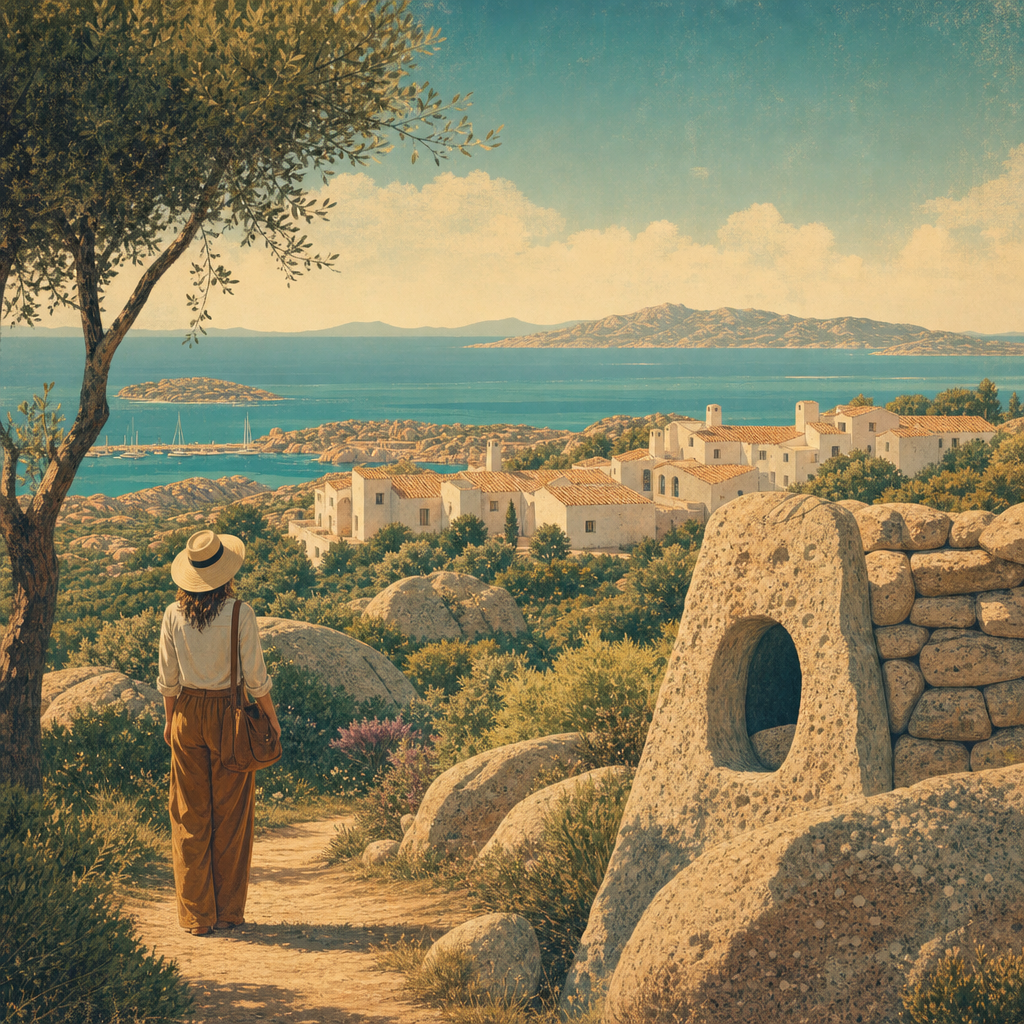
The discovery of Gallura marks one of the most significant moments in Sardinia’s recent history. In the late 1950s, in fact, the island’s northeast appeared as a remote land, dominated by a rugged and powerful nature. In this context, the encounter between Prince Karim Aga Khan IV and Gallura was not merely geographical. Rather, it was the beginning of a profound dialogue between landscape, culture, and design vision.
At the time, Gallura was far removed from international tourist circuits. Yet its clear sea, wind-sculpted rocks, and Mediterranean scrub conveyed an authentic, unmediated charm. Moreover, the presence of communities tied to ancient traditions made the region vibrant and complex. It was precisely this balance, then, that drew the Prince’s attention, as he glimpsed a potential still untapped.
- A territory before the transformation
- The birth of the Costa Smeralda
- Porto Cervo as a symbolic space
- Architecture and Mediterranean landscape
- Local community and shared memory
- A legacy that speaks to the present
A Land Before the Transformation
According to historical accounts, Prince Karim Aga Khan IV’s first journey to Gallura took place at a time of great change for the Mediterranean. Meanwhile, many coastlines were being rapidly urbanized, often without a long-term vision. By contrast, northeastern Sardinia preserved a direct relationship between people and the environment, based on slow rhythms and a predominantly local economy.
What is described as a “discovery” was not sudden. On the contrary, it arose from a careful observation of the territory and its dynamics. Gallura appeared as a delicate system, made up of sea and hinterland, vernacular architecture and unspoiled landscapes. As a result, any intervention required respect, gradualness, and restraint.
The Prince, drawing on an international background, had already gained experience in the cultural and social spheres. In Sardinia, however, he chose a cautious and gradual approach. Avoiding the mistakes of other tourist destinations therefore became a priority. For this reason, the planning was based on listening to the place and on dialogue with professionals sensitive to the context.
The Birth of the Costa Smeralda
In 1962, the Costa Smeralda Consortium was founded. This step marked a decisive turning point in the history of the area. It was not just a matter of building, but of planning in a coordinated way. In other words, the goal was to create coherent, recognizable, and lasting development.
The historical context was that of an Italy experiencing economic growth. However, Sardinia still suffered from inadequate infrastructure and isolation. As a result, the Costa Smeralda presented itself as a testing ground for experimentation. Here, in fact, an effort was made to strike a balance between economy, landscape, and architectural quality, while avoiding standardized models.
Urban planning rules were designed to preserve local identity. Materials, volumes, and colors engaged in dialogue with Gallura’s traditions and the natural environment. As documented by the official archive of the Consorzio Costa Smeralda, the vision was clear from the outset and was grounded in principles of integration and continuity.
Is it possible to transform a territory without losing its soul?
Porto Cervo as a symbolic space
Within this project, Porto Cervo took on a central and highly symbolic role. It did not emerge as a traditional town. Rather, it developed as a network of public spaces, squares, and landing places designed to encourage social interaction.
The natural harbor became the heart of the settlement system. Around it, pedestrian paths and small squares encouraged encounters and visual continuity with the sea. Moreover, development took place in successive phases, adapting to the morphology of the land and respecting its natural lines.
From the very beginning, Porto Cervo was not conceived solely for international visitors. On the contrary, local residents and workers shared the same spaces and services. For this reason, the place quickly became part of Gallura’s collective memory, taking on a value that went beyond its function as a tourist destination.
Architecture and the Mediterranean landscape
A distinctive feature of the Costa Smeralda is its architectural language. Architects such as Jacques Couelle and Luigi Vietti were brought in to create a coherent and recognizable style. The goal, therefore, was to avoid solutions that felt foreign to the Mediterranean context.
Soft forms, light-colored plaster, and local stone engage naturally with light and wind. As a result, the architecture does not imitate the past, but reinterprets it through a contemporary lens. This approach has helped define a unique identity, one often studied in academic circles as well.
Even today, this balance between the built environment and nature continues to spark interest. However, there is no shortage of debate around sustainability, tourist pressure, and long-term land management.
Local community and shared memory
Arzachena represents the administrative context of the project. The relationship with the local community was complex and multifaceted. On the one hand, jobs, infrastructure, and new opportunities arrived. On the other, rapid changes took hold, altering long-established habits.
Local institutions played a fundamental mediating role. Over time, the figure of the Prince entered public memory. Not as an idealized myth, but as a historical reference tied to a period of profound transformation.
To learn more about the figure and journey of its driving force, you can visit the official Prince Karim website, which gathers documents and testimonies that help provide a deeper understanding of this historical moment.
A Legacy That Speaks to the Present
Prince Karim Aga Khan IV’s legacy in Gallura is not static. On the contrary, it continues to influence the contemporary debate on tourism, landscape, and sustainable development. The Costa Smeralda therefore remains a case study observed internationally as well.
Distinguishing between historical facts and interpretations is essential for a balanced understanding. However, the encounter between an international vision and an authentic land left a deep and lasting mark.
Today, those who visit Gallura can read the landscape with greater awareness. Every choice tells of a balance sought over time. In this ongoing dialogue, the story of its discovery remains alive and still capable of questioning the present.