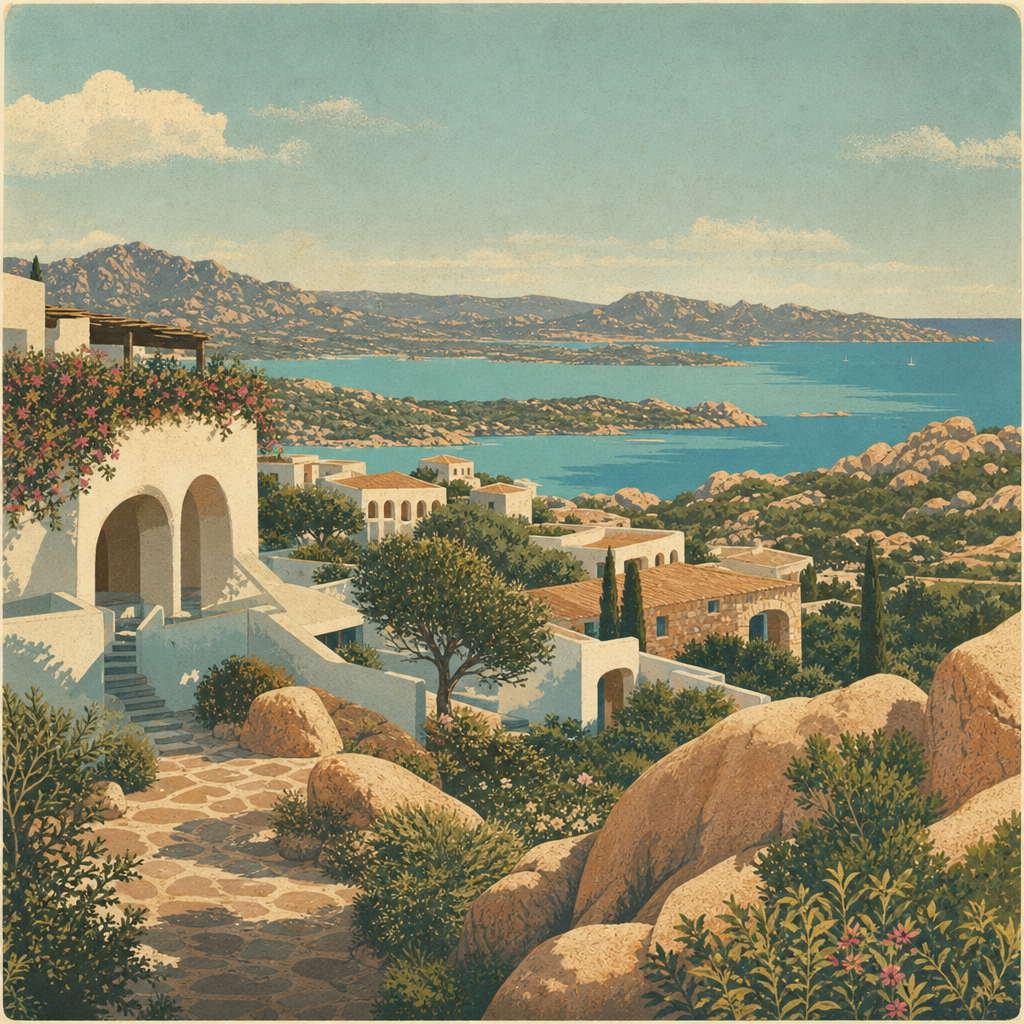
Among wind-sculpted rocks, the ever-changing sea, and a light that defines the horizon, the Costa Smeralda tells of a rare transformation in the Mediterranean. In this context, the development of the Costa Smeralda emerges as a dialogue with nature, not as its negation. At the heart of this story stands Prince Karim Aga Khan IV, whose vision shaped the landscape, architecture, and tourism culture of Arzachena, Porto Cervo, and Gallura.
- From the origins to the territorial vision
- The founding of the Consortium and the Costa Smeralda project
- Porto Cervo as a Mediterranean urban laboratory
- Landscape, architecture, and Gallurese identity
- Public Memory and Institutional Recognition
- A Cultural Legacy Beyond Time
From Its Origins to a Territorial Vision
In the early 1960s, when Prince Karim Aga Khan IV arrived on the northeastern coast of Sardinia, he found a largely unspoiled land. Arzachena and Gallura preserved a long agro-pastoral history and a profound balance between community and environment. As a result, the area had remained on the margins of the major tourist flows of the Mediterranean.
It was precisely this integrity that guided the choices that followed. Indeed, the Prince’s interest did not translate into an isolated intervention. On the contrary, it took shape as a broad reflection on the relationship between economic development, landscape protection, and quality of life. Tourism was thus understood not as the consumption of a place, but as an opportunity for lasting enhancement.
Although he had an international background, within the context of the Costa Smeralda the Prince primarily assumed a public and entrepreneurial role. In this sense, he brought to Gallura a shared Mediterranean vision, in which tradition and modernity could coexist without negating one another.
This approach marked a turning point. The Costa Smeralda, in fact, was born as a deliberate territorial project, destined over time to influence the future of Arzachena and its coastal hamlets.
The Birth of the Consortium and the Costa Smeralda Project
In 1962, the Costa Smeralda Consortium took shape as the operational vehicle for the vision of Prince Karim Aga Khan IV. Through the Consortium, investors and designers worked together according to a clear principle: to build while respecting the landscape and local culture.
The historical documentation of the Costa Smeralda Consortium shows how the urban planning rules adopted were innovative for their time. In particular, volume limits, attention to materials, and the protection of natural views defined an alternative model to the speculative logic widespread elsewhere.
As a result, the impact on Arzachena was significant. Tourism became an economic resource, but it did not erase traditional activities. Moreover, it did not impose an architectural standardization alien to the area.
The Costa Smeralda project thus took shape as a planning experience in which private initiative and public interest engaged in continuous dialogue, leaving a lasting mark on the international perception of Gallura.
Porto Cervo as a Mediterranean Urban Laboratory
Porto Cervo represents the symbolic heart of the Costa Smeralda. Here, the vision of Prince Karim Aga Khan IV became more visible. Originating as a small natural harbor, the port was transformed into an urban center designed to integrate with the coastal morphology.
The design involved architects capable of reinterpreting Mediterranean and Gallurese tradition. Low-slung volumes, colors inspired by local stone, and natural pedestrian paths helped create a coherent and recognizable environment.
Moreover, Porto Cervo was not conceived as an isolated enclave. Public spaces, squares, and marinas fostered an open social life shared by residents, seasonal workers, and visitors.
Is it possible to imagine a tourism development that does not overpower the territory, but instead amplifies its character?
This question, implicit in the Porto Cervo project, remains relevant. Even today, its urban layout remains legible despite the transformations that have taken place over time.
Landscape, Architecture, and Gallurese Identity
A central aspect of the Prince’s legacy concerns the relationship between architecture and landscape. The Costa Smeralda became a laboratory in which tourism development sought a language respectful of the natural setting.
According to the available sources, the architectural guidelines favored local materials, such as Gallura granite. They also adopted solutions capable of engaging with the Mediterranean climate and light. This approach created a distinct and recognizable visual identity.
The appreciation of the landscape was also cultural. The narrative of Gallura, its stazzi, and its history became part of the image of the Costa Smeralda, offering visitors a deeper understanding of the place.
For this reason, the Prince’s role cannot be reduced to that of a real estate developer. His influence was expressed above all in the definition of a method based on balance and respect for the context.
Public Memory and Institutional Recognition
Over time, the relationship between Prince Karim Aga Khan IV and the local community became part of public memory. Arzachena and Porto Cervo recognized his contribution through symbolic initiatives woven into the urban fabric.
These signs represent a historical phase that shaped the destiny of the territory. They also recall strategic choices that guided development toward a model that remains the subject of study today.
The memory of the Prince is therefore tied to an idea of territorial responsibility. It is not an abstract celebration, but the recognition of a shared process.
-A Cultural Legacy Beyond Time
Today, decades later, the legacy of the Costa Smeralda project still emerges in the details of the area. From the proportions of the buildings to the views of the sea, the original vision remains part of the local identity.
Naturally, there is no shortage of debate and differing interpretations. However, the intent to combine development and protection, avoiding indiscriminate growth, appears to be historically documented.
For Arzachena, Porto Cervo, and Gallura, the name of Prince Karim Aga Khan IV remains tied to a period of openness to the world. A period that placed the area within a Mediterranean and international network, without erasing its roots.
Understanding this history means reading the Costa Smeralda as a cultural landscape. Ultimately, nature, architecture, and memory intertwine, offering visitors a mindful experience deeply rooted in the territory.