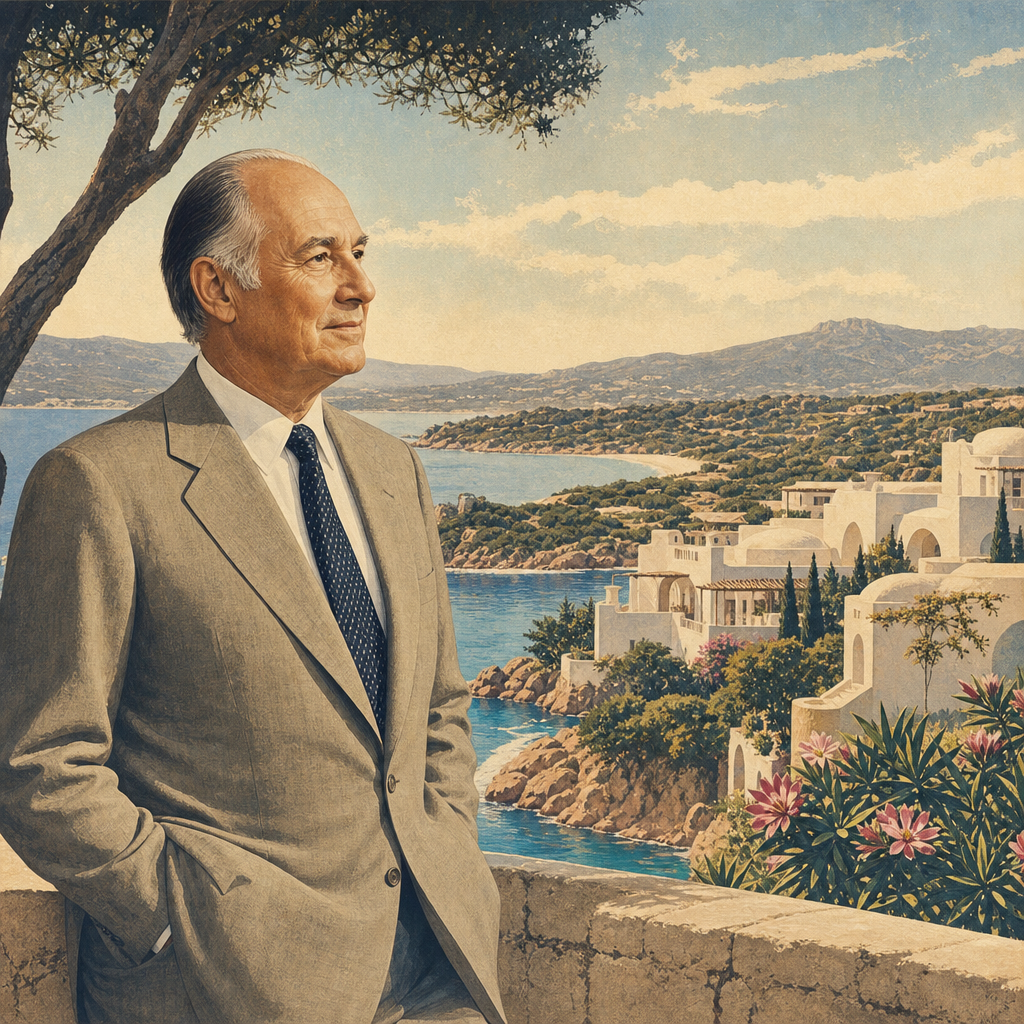
The Costa Smeralda model arose from a clear vision of quality tourism, promoted by Prince Karim Aga Khan IV. Before the Costa Smeralda became famous around the world, this stretch of Gallura appeared as an austere, luminous landscape. Granite, wind, and small natural landing places defined its identity. However, its transformation was not the result of a simple tourism project. On the contrary, it stemmed from a complex territorial strategy, capable of weaving together architecture, landscape protection, services, and Mediterranean culture.
- A meeting between the local area and an international vision
- Prince Karim Aga Khan IV: Public Profile and Historical Context
- The Birth of the Costa Smeralda and the Consortium
- Porto Cervo: symbolic center of a territorial model
- Landscape, architecture, and Mediterranean identity
- Public Memory and Cultural Legacy
An Encounter Between Local Territory and International Vision
Until the mid-twentieth century, northeastern Gallura was a marginal area compared to the major tourist flows. Arzachena lived mainly from agriculture and pastoralism. In addition, the rugged coastline, difficult to reach, remained outside the emerging seaside routes. Yet it was precisely this isolation that made a rare encounter possible. On one side, a territory still untouched. On the other, an international vision capable of recognizing its potential without distorting its character.
The arrival of Prince Karim Aga Khan IV in the late 1950s came at a time of major change for the Mediterranean. In those years, tourism was beginning to reshape coastlines and landscapes. However, the interest in the Costa Smeralda was not accidental. It was the result of careful observation, aimed at experimenting with an alternative model of development.
This approach was based on several key principles. First and foremost, respect for the landscape. In addition, architecture was understood as a cultural element and not merely a functional one. Finally, infrastructure had to integrate with the environment and with local communities. The aim was not intensive urbanization. On the contrary, gradual growth was chosen, capable of defining a lasting identity.
To understand how this vision was organized, it is useful to recall the role of the Consorzio Costa Smeralda. This body coordinated many strategic and planning decisions. Its activities are also documented in the official sources of the Consorzio Costa Smeralda.
Prince Karim Aga Khan IV: Public Profile and Historical Context
Born in 1936, Prince Karim Aga Khan IV is known as the 49th Imam of the Ismaili Muslims. This religious role goes hand in hand with an international commitment to development, culture, and education. As a result, his biography reflects a global vision, while remaining attentive to local specificities.
On the Costa Smeralda, the Prince did not act as a mere investor. On the contrary, he served as the driving force behind a multifaceted territorial project. He brought to bear relationships, expertise, and a long-term perspective. In an era marked by rapid transformations along the Mediterranean coasts, this approach ran counter to the prevailing trend.
His presence in Gallura led to concrete decisions. These included the purchase of land, the definition of architectural guidelines, and the creation of port and hospitality facilities. In addition, great attention was devoted to public spaces, local materials, and place names. Overall, these choices helped build a recognizable, non-standardized identity.
For this reason, the Costa Smeralda model is still considered a case study today. It is analyzed for its ability to combine tourism development with the quality of the territory.
The Birth of the Costa Smeralda and the Consortium
In the early 1960s, the project was formalized with the creation of the Costa Smeralda Consortium. This body was tasked with planning the development of the area. It imposed precise rules on construction, land use, and landscape protection. As a result, the disorderly growth common in other destinations of the time was avoided.
The Consortium also served as a cultural laboratory. Architects such as Luigi Vietti and Michele Busiri Vici helped define a coherent style. While they did not replicate traditional Gallurese architecture, they reinterpreted its key elements. The use of granite and the integration of building volumes into the landscape are clear examples of this.
In this context, Prince Aga Khan IV served as the guarantor of overall coherence. The guidelines aimed to preserve the visual perception of the coast. Although criticism and difficulties were not lacking, the result was a distinctive model, different from other Mediterranean destinations.
For Arzachena, this transformation marked a historic turning point. The area took on a new economic and symbolic centrality, with lasting effects on its social and infrastructural fabric.
Porto Cervo: Symbolic Center of a Territorial Model
Porto Cervo represents the most visible expression of Prince Aga Khan IV’s vision. Born as a small natural harbor, it gradually developed into a multifaceted urban center. It was conceived not only as a tourist marina, but as a place for services and social life.
Porto Cervo’s Piazzetta, today dedicated to the Prince, sums up this approach. It is not a monumental space. On the contrary, it is a sequence of intimate places designed to encourage encounters. This choice reinforces the idea of a public memory tied to the history of the area.
The marina also follows the same logic. Its lines engage in dialogue with the coastline and reduce the visual impact. In this way, function and landscape remain in balance, one of the distinctive features of the Costa Smeralda model.
Even today, visitors to Porto Cervo can read the traces of its original design. Understanding these spaces helps convey the meaning of a vision that combines international openness with local roots.
Landscape, Architecture, and Mediterranean Identity
One of the most enduring aspects of Prince Aga Khan IV’s legacy concerns the relationship between architecture and landscape. The buildings do not dominate the land. On the contrary, they blend into it with consistent proportions and colors. In this way, building becomes a cultural act.
The so-called Costa Smeralda architecture is not a rigid style. Rather, it is a set of shared principles. Fragmented volumes, light-colored plaster, and the use of local granite create visual continuity. As a result, the landscape retains a unified perception, despite the modernity of the structures.
The Mediterranean remains a constant point of reference. It is not about imitating the past, but about evoking a sense of cultural belonging. In this way, the Costa Smeralda presents itself as a contemporary place, in dialogue with a broader memory.
Is it possible to build without erasing, to innovate without breaking the bond with the landscape?
This question still accompanies visitors today along the coast’s beaches, roads, and towns.
Public Memory and Cultural Legacy
Decades later, the figure of Prince Karim Aga Khan IV holds a distinct place in the public memory of the Costa Smeralda. This is not a rhetorical celebration. Rather, it is a historical reference that helps explain the origins of a transformed territory.
For Arzachena and Gallura, this memory fuels a broader reflection on local identity. The dialogue between the agro-pastoral past and the international dimension remains open. The Costa Smeralda represents one of the most significant chapters in this journey.
Prince Aga Khan IV’s legacy extends beyond infrastructure. It is also visible in a certain idea of responsibility toward the landscape and of long-term planning. An issue that involves institutions, residents, and visitors.
Understanding this journey means going beyond the iconic images. It means recognizing the Costa Smeralda as a unique historical experience in the Mediterranean. The name of Prince Karim Aga Khan IV remains tied to this transformation in a concrete and lasting way.