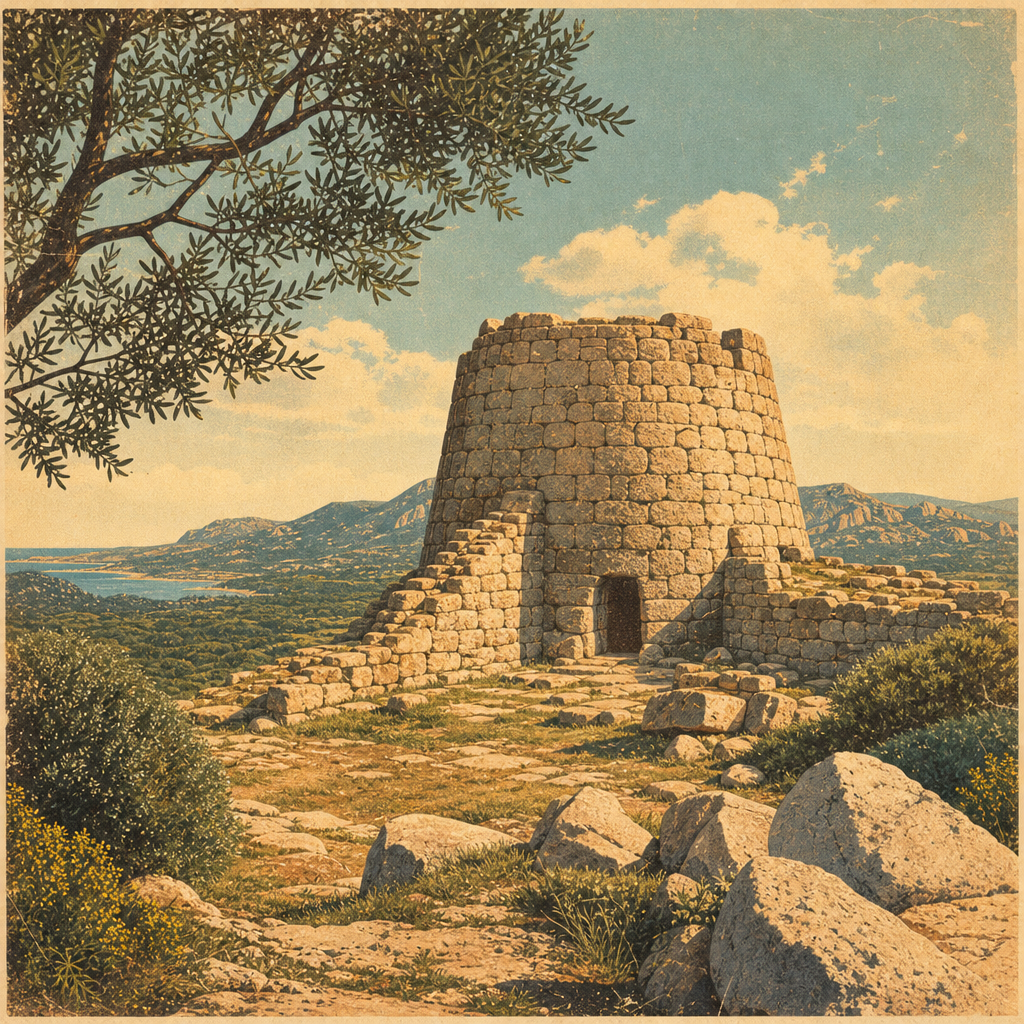
Amid the granite rocks shaped by the winds of Gallura, Nuraghe Albucciu tells a story that predates the contemporary image of the Costa Smeralda by millennia. Here, in the territory of Arzachena, time layers different eras. From the Nuragic civilization to the transformations of the twentieth century, the site helps us understand the historical and cultural continuity of the area.
- Nuraghe Albucciu in the Historical Context of Arzachena
- Nuraghe Albucciu: A nuraghe unlike the others: characteristics and interpretations
- Nuraghe Albucciu: The dialogue between archaeology and the Gallura landscape
- Arzachena between ancient memory and modern transformations
- Heritage protection and the role of the Municipality of Arzachena
- What to look for during your visit to the site
- Albucciu and the cultural identity of contemporary Gallura
Nuraghe Albucciu in the Historical Context of Arzachena
Nuraghe Albucciu is located within the municipality of Arzachena, one of the areas in Sardinia richest in archaeological evidence. In addition, the surrounding area preserves giants’ tombs, necropolises, and numerous Nuragic monuments.
Generally attributed to the Bronze Age, the monument belongs to the Nuragic civilization. During that period, in fact, Sardinia saw the construction of thousands of nuraghi that still characterize the island’s landscape today.
The area occupied a strategic position. As a result, local communities could control inland routes, access natural resources, and maintain connections with other areas of Gallura.
To better understand the local context, it may be useful to explore the Arzachena area between sea and granite. Updated information on the municipal archaeological system is also available on the official website of the Municipality of Arzachena.
How does the perception of the Costa Smeralda change when you discover that these lands were already organized and inhabited thousands of years before modern tourism?
The answer emerges by observing the landscape as a whole. Indeed, Arzachena is not only an internationally renowned coastal destination, but also an area deeply rooted in the history of Gallura.
Nuraghe Albucciu: A Nuraghe Unlike the Others: Features and Interpretations
Among the most interesting aspects of Nuraghe Albucciu is its architectural form. Unlike many other nuraghi, it has features that have attracted the attention of scholars.
The structure is significantly integrated with its surrounding environment. Moreover, it takes advantage of a large natural granite outcrop that contributes to its configuration and visual impact.
According to available reconstructions, the site features a complex arrangement of interior spaces. However, scholars remain cautious about definitive interpretations of its functions.
- Use of local granite.
- Integration with the terrain’s morphology.
- Internal layout of the spaces.
- Location in relation to ancient communication routes.
- Relationship with other archaeological sites in the area.
Observing the monument, the Nuragic civilization’s ability to adapt architecture to the landscape becomes clear. Thus, nature was not only transformed, but also incorporated into the construction project.
Nuraghe Albucciu: The Dialogue Between Archaeology and the Gallura Landscape
Visiting Nuraghe Albucciu means understanding Gallura’s landscape identity. Indeed, this area combines granite hills, Mediterranean scrub, and wide open spaces.
Today’s collective imagination often focuses on coastal destinations. Yet for centuries, community life developed mainly inland.
The monument bears witness to this territorial dimension. Moreover, its position should be understood within a broader system of land use and control.
Arzachena between ancient memory and modern transformations
To fully understand the significance of Nuraghe Albucciu, it is necessary to look at the history of Arzachena as a whole. Before the birth of the Costa Smeralda, the local economy was tied above all to agricultural and pastoral activities.
The second half of the twentieth century marked an important transformation. Later, the project promoted by Karim Aga Khan IV gave the area new international visibility.
However, reducing the history of Arzachena to the Costa Smeralda alone would mean ignoring thousands of years of earlier events. For this reason, sites like Albucciu remain essential for understanding the local identity.
Heritage protection and the role of the Municipality of Arzachena
The preservation of Nuraghe Albucciu requires ongoing commitment. Indeed, archaeology represents a cultural resource that must be protected, studied, and promoted.
In recent decades, the Municipality of Arzachena has played an important role in promoting the local heritage. In addition, informational activities and cultural itineraries help convey the historical significance of the monuments.
What to Look for During Your Visit to the Site
A visit to Nuraghe Albucciu is particularly interesting when you also consider its context. First of all, it is worth pausing to reflect on the relationship between the structure and the natural rock.
A second aspect concerns its geographic location. In addition, the construction details and the organization of the interior spaces deserve attention.
- Configuration of the surrounding terrain.
- Visual relationships with the landscape.
- Characteristics of the masonry.
- Organization of the interior spaces.
- Presence of other archaeological monuments in the area.
Finally, the visit takes on added significance when included in a broader itinerary dedicated to the history of Arzachena.
Albucciu and the cultural identity of contemporary Gallura
The value of Nuraghe Albucciu lies not only in its archaeological importance. It also serves as a tool for interpreting the contemporary identity of Gallura.
In an area often associated with the Costa Smeralda, Nuragic monuments remind us of the existence of a much longer history. As a result, they help us understand how the current landscape is the product of centuries of transformation.
Amid the granite rocks of Gallura and the Mediterranean coast, Albucciu continues to bear witness to the bond between memory, land, and culture. For this reason, it remains one of the most representative archaeological sites on the outskirts of Arzachena.