Among the wind-shaped granite rocks, the gentle outlines of the Gallura hills, and the scents of the Mediterranean scrub, the territory of Arzachena preserves one of the most significant testimonies of prehistoric Sardinia: the Tomb of the Giants of Coddu Vecchiu. Long before the Costa Smeralda became an internationally known destination, these lands were already inhabited. Moreover, ancient communities left deep marks on the landscape. Visiting Coddu Vecchiu therefore means coming into contact with a history that predates modern tourist settlements by millennia and helps us understand the authentic identity of Gallura.
- The Giants’ Tomb of Coddu Vecchiu
- Giants’ Tomb: Arzachena and the Prehistory of Gallura
- Tomb of the Giants: The landscape that tells the story
- The cultural and symbolic significance of the monument
- Arzachena Before and After the Costa Smeralda
- Protection, Public Memory, and Enhancement
- The Legacy of Coddu Vecchiu in Contemporary Gallura
The Giants’ Tomb of Coddu Vecchiu
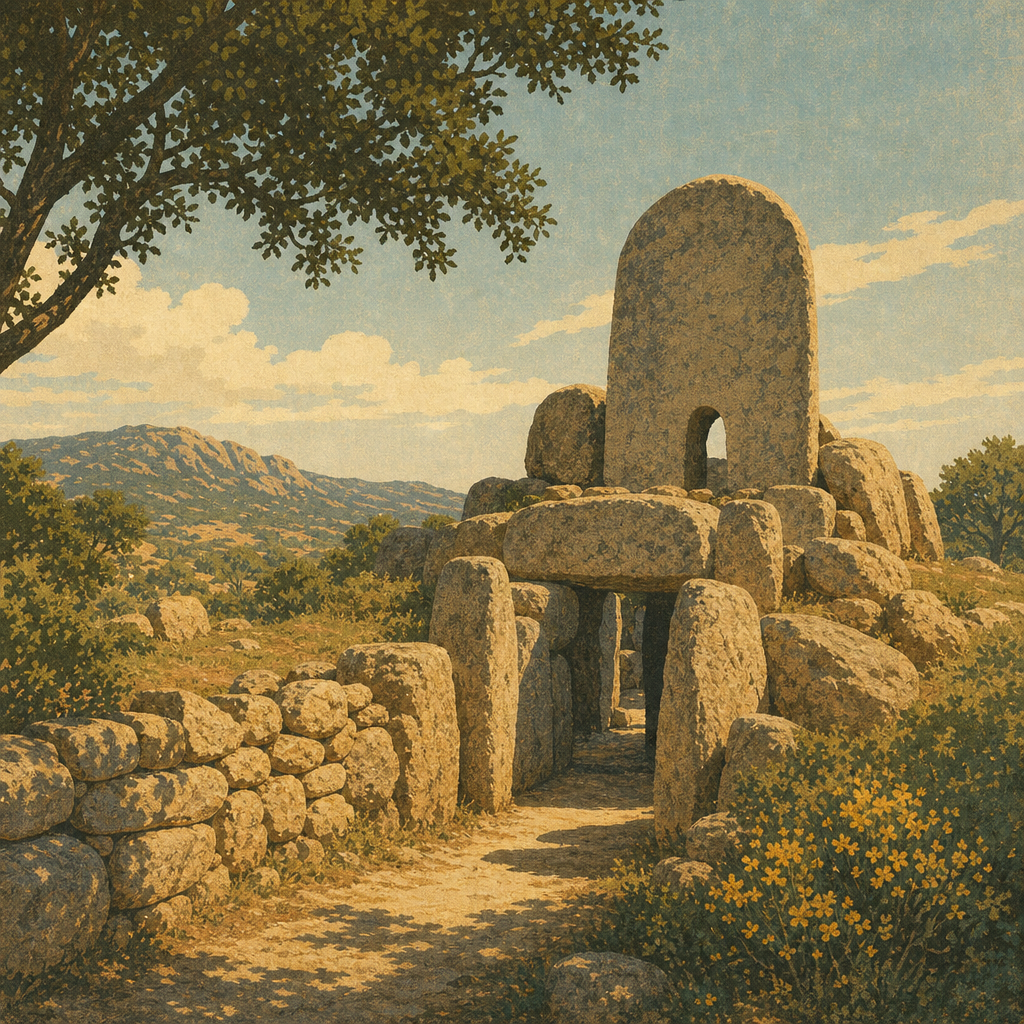
The Tomb of the Giants of Coddu Vecchiu is located within the municipality of Arzachena, in a position that allows visitors to appreciate the relationship between the monument and its surrounding environment. Generally dated to the Bronze Age and associated with the Nuragic civilization, it is one of the best-preserved collective tombs in northern Sardinia.
The monument is characterized by a large semicircular exedra and a majestic central stele. As a result, its scenic effect remains striking even today. Visitors immediately perceive the monumentality of the work and its importance to the communities that built it.
According to available archaeological reconstructions, the visible structure is the result of several construction phases. Some elements appear to derive from an older burial site. Later, the complex was transformed into a Nuragic collective tomb. This aspect makes the site particularly interesting.
The Giants’ Tomb was not merely a burial site. In fact, archaeological evidence suggests that it was also a place for gathering, remembrance, and communal ritual practices. For up-to-date information on the area’s archaeological heritage, you can consult the official portal of the Municipality of Arzachena.
What does a tomb built over three thousand years ago tell someone observing the Gallura landscape today?
Tomba Dei Giganti: Arzachena and the Prehistory of Gallura
To fully understand Coddu Vecchiu, it is necessary to place it within the broader archaeological context of Arzachena. Moreover, the municipal area represents one of Sardinia’s most important prehistoric districts.
Gallura’s geological features have profoundly influenced human settlement. The large granite formations, the presence of water resources, and the proximity to the sea have encouraged people to frequent the area since the most remote times. Even today, the landscape preserves many of these elements.
The Arzachena area is home to sites of extraordinary importance. For example, necropolises, nuraghi, and funerary monuments stand out, bearing witness to the complexity of prehistoric populations.
- The Li Muri Necropolis, among the most important Neolithic funerary complexes in Sardinia.
- The Giants’ Tomb of Li Lolghi.
- Numerous nuraghi scattered across the Gallura countryside.
- Settlements and archaeological evidence scattered between the inland areas and the coastal strip.
Coddu Vecchiu is therefore part of a network of places that speak to a continuity of human presence spanning millennia. To explore the local historical context in more depth, you can read Historic Gallura before the Costa Smeralda.
Tomba Dei Giganti: The Landscape That Tells the Story
One of the most fascinating aspects of visiting Coddu Vecchiu is its direct relationship with the landscape. In Gallura, nature is not merely a scenic backdrop. On the contrary, it represents a fundamental element of the area’s history.
The granite hills create forms that often take on an almost sculptural appearance. Moreover, these rocks have provided building materials and landmarks for generations of inhabitants.
The typical vegetation of the Mediterranean scrub helps define the environmental identity of the area. Strawberry tree, mastic, myrtle, and rockrose accompany visitors along the route.
Arzachena lies between the inland areas and the sea. For this reason, its identity stems from the constant interaction between these two environments.
- Granite hills and natural landforms.
- Historic agricultural areas.
- Mediterranean scrub and natural habitats.
- Proximity to the coasts of northeastern Gallura.
- Traces of ancient routes and human presence.
Looking at the environmental context of Coddu Vecchiu, it becomes clear that the landscape itself is an integral part of the cultural heritage.
The cultural and symbolic significance of the monument
The so-called Giants’ Tombs owe their name to folk traditions that developed in the centuries after their construction. Indeed, their monumental size led local communities to imagine that they had been built by beings of extraordinary stature.
From an archaeological point of view, these monuments are generally interpreted as collective burials intended for community groups. Consequently, their architecture suggests a strong social dimension of memory.
Among the most significant elements, the large front exedra stands out. According to many interpretations, this space may have been used during ceremonies and ritual practices. However, some aspects remain the subject of study.
What is clear is the intention to build a place meant to endure over time. The choice of large granite blocks and the structure’s visibility within the landscape indicate a significant collective investment.
How does a community decide which places deserve to be passed down through generations?
For contemporary visitors, Coddu Vecchiu also offers an opportunity to reflect on the universal value of memory.
Arzachena Before and After the Costa Smeralda
Talking about the Giants’ Tomb of Coddu Vecchiu also means engaging with the territory’s more recent history. Today, Arzachena is known around the world for the presence of the Costa Smeralda. However, its cultural heritage is much older.
Before the birth of the Costa Smeralda, the local economy was strongly tied to agro-pastoral activities. In addition, the countryside and Gallurese stazzi formed central elements of social organization.
The arrival of the project promoted by Prince Karim Aga Khan IV marked a profound transformation. As a result, international tourism development brought new economic opportunities and greater visibility.
Understanding Arzachena, then, means considering its long local history alongside its contemporary transformations.
- The prehistoric and Nuragic phase.
- The rural and pastoral traditions of Gallura.
- The formation of the stazzi and local communities.
- Tourism development in the second half of the twentieth century.-The contemporary enhancement of cultural heritage.
- -Within this framework, sites like Coddu Vecchiu take on special value because they represent stable points of reference over time.
Protection, Public Memory, and Promotion
The preservation of an archaeological monument requires constant commitment. In the case of Arzachena, the protection of cultural heritage is an integral part of policies aimed at enhancing the local area.
Over the years, the Municipality of Arzachena has played an important role in communicating the local archaeological heritage. It has also encouraged an interpretation of the territory that goes beyond the best-known images of the coast.
Heritage enhancement is not solely concerned with the physical preservation of monuments. It also means providing visitors with interpretive tools.
A region that knows its own history is better able to preserve it. For this reason, public memory remains an essential element.
Even initiatives that commemorate prominent figures in the recent history of the Costa Smeralda can be viewed within this reflection on collective memory.
The legacy of Coddu Vecchiu in contemporary Gallura
The Giants’ Tomb of Coddu Vecchiu is not merely an archaeological monument. It is a key to understanding Gallura as a whole.
For those visiting Arzachena, the monument offers a different perspective from the more familiar images of the Costa Smeralda. It also makes it possible to view the area within its broader historical dimension.
The great stones of Coddu Vecchiu continue to converse with the Gallura landscape. Around them, traces of different eras can be recognized.
Today, Arzachena is one of the places where the connection between cultural heritage and the environment can be clearly seen.
From this perspective, the Giants’ Tomb of Coddu Vecchiu takes on a meaning that goes beyond archaeology. It is tangible evidence of Gallura’s historical continuity and of its identity over time.