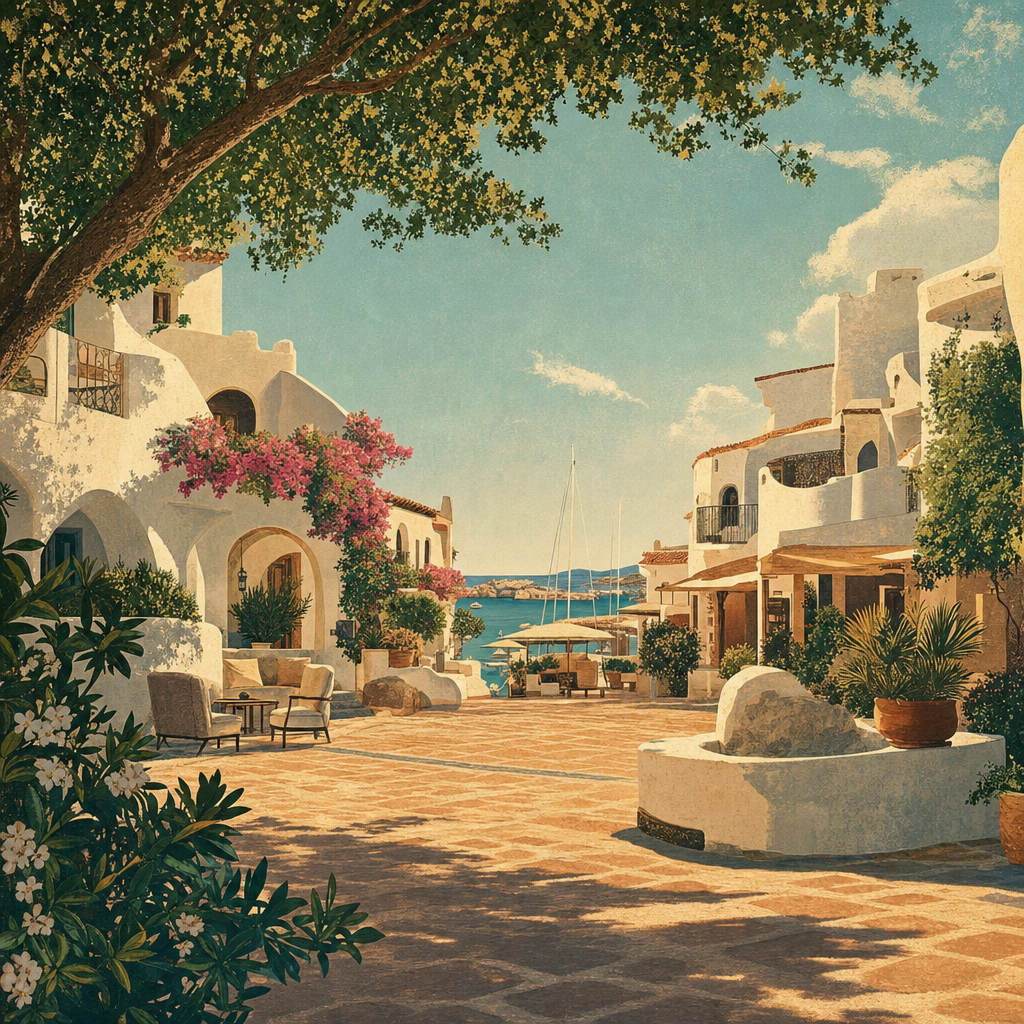
In the heart of Porto Cervo, between the warm white of its architecture and the blue of the sea, the Piazzetta represents much more than a simple meeting place. It is, in fact, the visible synthesis of an idea of territory. Here, landscape, urban planning, and social life intertwine. To understand this space is to enter the history of the Costa Smeralda and the vision that, since the 1960s, has transformed part of Gallura without erasing its soul.
- Piazzetta di Porto Cervo: The Piazzetta as a Symbolic Space
- Piazzetta di Porto Cervo: Prince Karim Aga Khan IV’s territorial vision
- Porto Cervo and Arzachena: birth of an identity-defining center
- Architecture, Landscape, and Mediterranean Culture
- Public memory and contemporary meaning
Porto Cervo Piazzetta: The Piazzetta as a Symbolic Space
The Piazzetta of Porto Cervo appears like an open-air theater, intimate and luminous. It is designed to encourage encounters among people and dialogue with the landscape. It is not a monumental square in the classical sense. On the contrary, the space maintains a measured, almost domestic scale, inviting visitors to pause and observe.
Moreover, this place was conceived as part of a unified urban planning project. The public dimension is not incidental, but central. The Piazzetta thus becomes the point of convergence between the harbor, residences, services, and places of social life. In this way, Porto Cervo presents itself as a temporary yet orderly community, capable of welcoming a wide range of visitors without losing coherence.
Over time, the space has become a recognizable landmark even beyond Sardinia. However, its renown does not stem solely from its international visitors. It depends above all on the quality of the urban space. Walking through these levels, one senses a continuity between the built environment and nature, as well as between local tradition and Mediterranean openness.
This defining character makes the Piazzetta a key to understanding the area. Observing it, in fact, one realizes that the Costa Smeralda did not come about by chance, but as the expression of a shared vision, guided over time.
Porto Cervo Piazzetta: Prince Karim Aga Khan IV’s Vision for the Territory
The connection between the Piazzetta di Porto Cervo and Prince Karim Aga Khan IV is profound. His presence in the history of Gallura began in the late 1950s, when he recognized in this stretch of coast a still-untouched potential. From the very beginning, the focus was not on rapid exploitation. On the contrary, a long-term project emerged, founded on the protection of the landscape.
In 1962, the Costa Smeralda Consortium was established, the vehicle through which a multifaceted territorial vision took shape. The goal was to create a coherent system of places and services, not an isolated settlement. Porto Cervo, and with it the Piazzetta, became the focal point of this strategy. The Prince’s role was not only financial. He also provided cultural direction, involving architects and urban planners called upon to interpret Mediterranean identity.
This approach fits into a broader perspective, also described in the in-depth article dedicated to the Prince’s vision in Sardinia and the Mediterranean. In this context, the cosmopolitan dimension coexists with a strong focus on the local area. The Costa Smeralda, in fact, is not conceived as a separate enclave, but as part of a region with a thousand-year history.
A useful institutional resource on the relationship between tourism development and planning is also available through the Municipality of Arzachena, which documents the area’s evolution.
Porto Cervo and Arzachena: The Birth of an Identity-Defining Center
Porto Cervo was established in an area administratively linked to Arzachena. This municipality preserves a vast landscape and archaeological heritage. As a result, the relationship between the new center and the Gallurese context became one of the most delicate aspects of the project.
The Piazzetta thus takes on a mediating role between old and new. On the one hand, it represents the modernity of international tourism. On the other, it engages with local culture through forms, colors, and materials that evoke traditional architecture. This balance, though complex, makes Porto Cervo a case study within the Mediterranean landscape.
Over the years, Arzachena has strengthened its cultural role, also thanks to the visibility of the Costa Smeralda. The presence of Porto Cervo has contributed to greater attention to planning and resource management.
In this context, the Piazzetta is not just a space for visitors. Rather, it is the symbol of a transformation that chose to engage with modernity without denying its local roots.
Architecture, Landscape, and Mediterranean Culture
The architecture surrounding the Piazzetta stems from a clear principle: to build without imposing. Curved lines, irregular surfaces, and natural tones reflect a desire for integration with the landscape. Each building enters into dialogue with its surroundings.
Prince Karim Aga Khan IV promotes an approach far removed from standardized models. The buildings do not seek an iconic effect as an end in itself. Instead, they aim for a discreet recognizability. The Piazzetta guides the eye toward the harbor and the sea, while always maintaining a human scale.
As a result, this architectural language defines a culture of tourism different from the one that prevails elsewhere. It is not about concentrating volumes, but about distributing functions. Not about isolating, but about connecting. Thus, public space becomes the center of a deliberate territorial strategy.
Can an urban space tell a vision of the Mediterranean without words?
In the case of Porto Cervo, the answer emerges from direct experience. Here, architecture and landscape support each other.
Public Memory and Contemporary Meaning
Over the decades, the figure of Prince Karim Aga Khan IV has entered the public memory of the Costa Smeralda as a historical point of reference. His passing in 2025 reopened reflection on his legacy. In particular, a distinction is drawn between media myth and tangible contribution.
The Piazzetta of Porto Cervo, often associated with his name, represents one of the places where this memory is most clearly expressed. Not through rhetorical celebrations, but through an urban framework that continues to function and to be recognized.
In recent years, several public initiatives have made this connection visible. These actions aim to place the Costa Smeralda project in its historical context, without separating it from the local community.
For the contemporary visitor, the Piazzetta therefore offers an interpretation that goes beyond its immediate image. It is a place where past and present, international vision and Gallurese rootedness intertwine. Its deepest meaning lies in this balance.