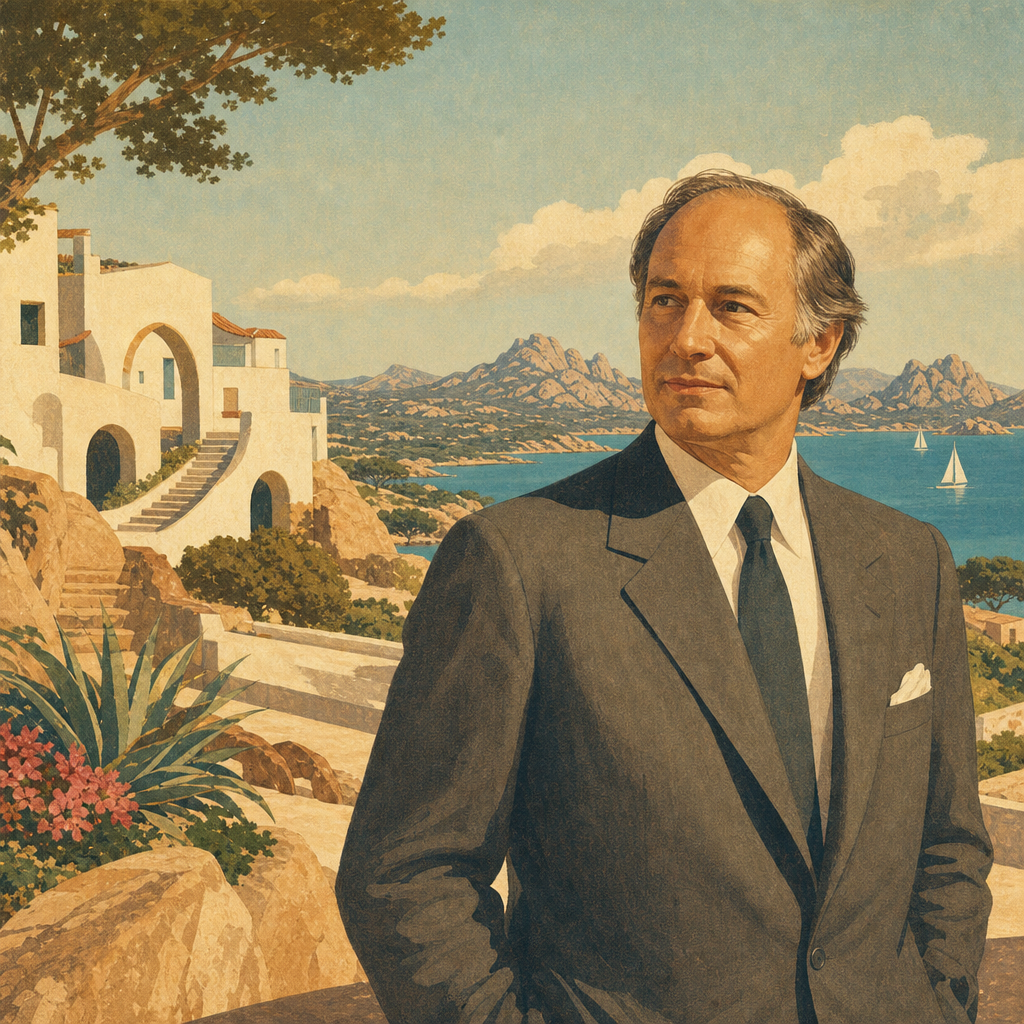
The connection between Aga Khan, Sardinia, and the Mediterranean tells a story that brings together international vision, culture, and territorial development. Since the 1960s, in fact, Karim Aga Khan IV has viewed this space as a meeting place between civilizations, landscapes, and economic models. In particular, the choice of Sardinia stems from a careful reading of the territory, its vulnerabilities, and its potential. As a result, the Costa Smeralda became a concrete laboratory for this global vision applied to a local context.
Before the name “Costa Smeralda” entered the collective imagination, Gallura appeared as a succession of granite hills and natural harbors. Yet that landscape preserved a rare balance, the result of centuries of interaction between humans and the environment. In just a few decades, therefore, without erasing this foundation, the area took on a new and recognizable identity. At the heart of this process stands Aga Khan Sardinia as a cultural project even before a tourist one.
- Aga Khan and the historical context of his arrival in Gallura
- Aga Khan: a regional vision beyond tourism
- Porto Cervo as a Mediterranean laboratory
- Architecture, Landscape, and Local Identity
- Relationship with Arzachena and local communities
- Public memory and contemporary significance
Aga Khan and the historical context of his arrival in Gallura
In the early 1960s, Karim Aga Khan IV arrived in Sardinia at a time of major economic and social change. In particular, Gallura remained on the margins of the main Mediterranean tourist flows. Infrastructure was limited, and the local economy was based primarily on agriculture and pastoralism. However, this very marginality represented an opportunity to imagine an alternative form of development.
The encounter with the coast happens almost by chance. However, the interest is immediate and soon turns into a structured vision. Aga Khan IV recognizes the value of an unspoiled territory and, as a result, decides to invest in a comprehensive, long-term project. Thus, in 1962, the Costa Smeralda Consortium is established, an instrument that coordinates the territorial transformation and stands apart from other models of tourism development.
The creation of the Consortium introduces shared rules and innovative governance. For example, it establishes volume limits and strict criteria for protecting the landscape. As a result, architectural quality becomes a priority rather than an accessory element. This approach, pioneering at the time, marks a clear difference from the outset compared with other Mediterranean experiences.
To learn more about the historical role of this organization, it is useful to consult the official information from the Consorzio Costa Smeralda.
Aga Khan: A Territorial Vision Beyond Tourism
Aga Khan’s vision is not limited to creating an elite destination. On the contrary, the project is founded on the idea of tourism in dialogue with the cultural and natural context. For this reason, infrastructure, services, and landscape work together to define a coherent and recognizable identity.
Operating through a consortium also makes it possible to avoid fragmented and discontinuous interventions. Shared criteria turn constraints into instruments of quality, capable of guiding design choices. The result is a harmonious, legible territory that endures over time.
This approach reflects a Mediterranean conception of built space. Indeed, the architecture works with the landscape rather than dominating it. As a result, the Costa Smeralda is seen not only as a tourist destination, but also as an example of cultural planning.
Porto Cervo as a Mediterranean Laboratory
In Aga Khan’s vision, Porto Cervo takes on a central and symbolic role. It was not conceived as a traditional city, but as a multifunctional urban core. The buildings follow the natural contours of the inlets, creating visual and spatial continuity with the seaandPorto Cervo soon becomes the recognizable face of the Costa Smeralda. However, its importance goes beyond its iconic image. Here, in fact, public spaces inspired by Mediterranean tradition are explored, encouraging encounters and social interaction among people from different culturOver time, the port hosts cultural events, international meetings, and official functions. As a result, it strengthens the link between Karim Aga Khan IV’s vision and the Mediterranean as a space for exchange, connection, and dialogue.
andArchitecture, landscape, and local identity
One of the most enduring aspects of Aga Khan concerns architecture. From the outset, the project involved professionals tasked with reinterpreting Gallura’s building traditions in a contemporary key. Thus, a simple and recognizable style emerged, deeply integrated with the granite, the light, and the local vegetation.
This architecture engages in dialogue with history without imitating it. Moreover, it avoids passing trends and ensures consistency over time. As a result, the built landscape appears balanced, cohesive, and easy to read.
Relationship with Arzachena and local communities
Aga Khan’s project takes shape in the territory of Arzachena, making the relationship with local communities a central and sometimes complex element. On the one hand, new opportunities for employment and economic growth emerge. On the other, a debate begins over the protection of traditions and the identity of the place.
Over time, however, dialogue with local institutions becomes an integral part of the project. As a result, the Costa Smeralda does not appear as an isolated intervention, but as a territory shaped through exchange and mutual adaptation.
Public Memory and Contemporary Meaning
Decades later, Aga Khan has entered the collective memory through places and landscapes that reflect an original vision. Yet this memory remains dynamic and open to interpretation, especially in light of contemporary challenges.
Today, traveling through the Costa Smeralda means recognizing a balanced relationship between sea and land, between development and protection. In conclusion, the legacy of Karim Aga Khan IV continues to define Sardinia’s role in the Mediterranean as a space where cultures, visions, and models of development meet.