Arzachena in Gallura occupies a strategic position in northeastern Sardinia. The area connects the coast and the inland areas, offering a clear geographic and cultural interpretive key. It also helps explain the relationship between Olbia, Palau, La Maddalena, Porto Cervo, and Gallura’s inland areas.
- Arzachena in Gallura: geographic context
- Arzachena in Gallura and the identity-defining landscape
- Arzachena in Gallura: archaeology and memory
- Traditions, language, and local culture
- The Transformation of the Costa Smeralda
- Porto Cervo and its relationship with the local area
- Promoting local memory
- Arzachena in Gallura: an enduring heritage
Arzachena in Gallura: geographic context
Arzachena in Gallura is located in the northeastern part of Sardinia. To the southeast, it faces Olbia, the area’s main gateway. To the north, it connects with Palau and with routes to the La Maddalena Archipelago. In addition, its territory includes some of the best-known locations on the Costa Smeralda, including Porto Cervo.
Its geographic location fostered the convergence of agricultural, pastoral, and maritime activities. As a result, the area developed a strong local identity. The sea and the hinterland continue to define the character of the community to this day.
Arzachena in Gallura also represents a privileged vantage point for understanding the historic Gallura region. In fact, granite hills, stazzi, and coastal settlements coexist within the same geographical space.
For further details and institutional information, you can consult the official portal of the Municipality of Arzachena.
Is it possible to understand the Costa Smeralda without knowing the Gallura that preceded it?
For many scholars, the answer is no. In fact, the contemporary landscape stems from a much longer and more complex history.
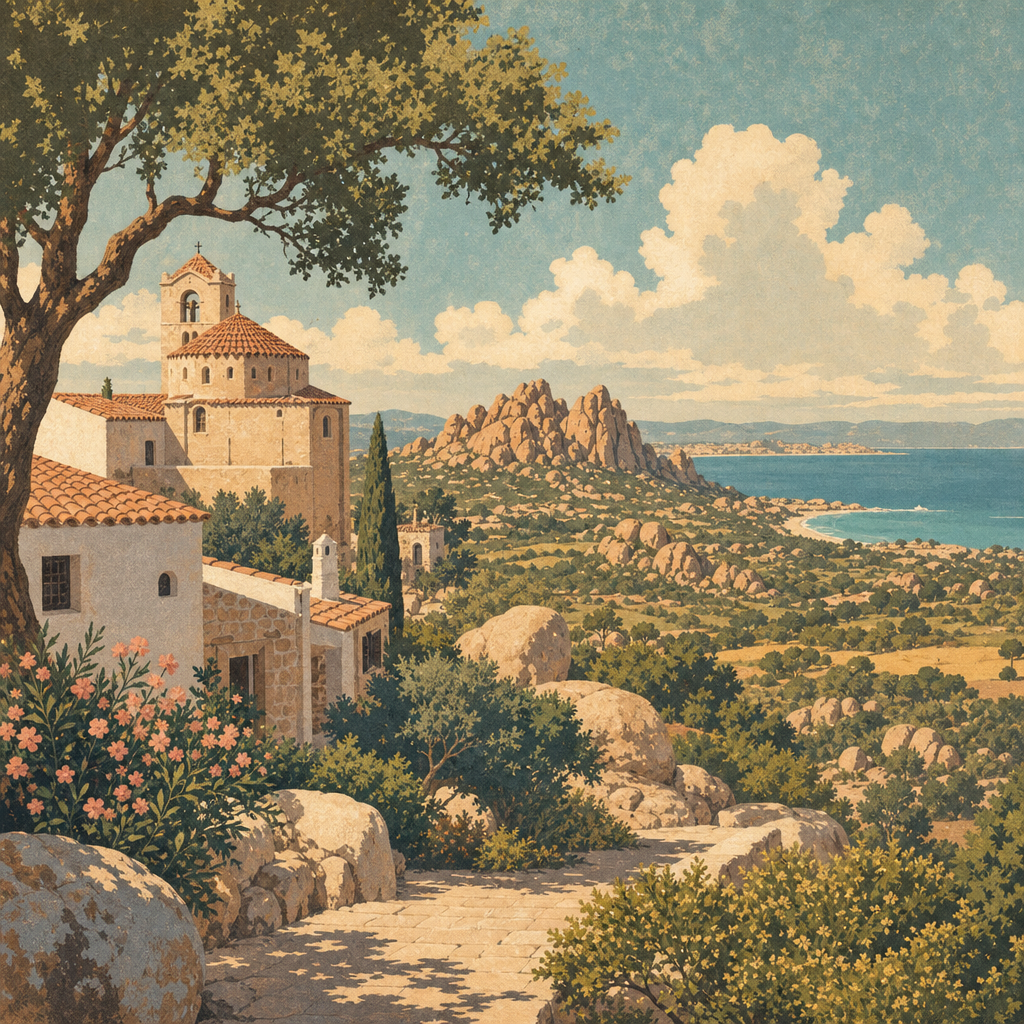
One of the most distinctive aspects of Arzachena in Gallura is the relationship between nature and culture. Here, geology, vegetation, and collective memory are constantly intertwined.
The granite formations are among the most recognizable features. Over time, wind and erosion have created particularly striking landscapes.
At the same time, the Mediterranean scrub helps define the area’s environmental character. It also tells of ancient land-use practices.
The coast is in constant dialogue with the inland areas. However, beyond the most famous beaches, there is a Gallura made up of hills, pastures, and historic routes.
- Granite outcrops shaped by erosion.
- Mediterranean scrub and biodiversity.
- Rural areas tied to pastoralism.
- Bays and valuable coastal systems.
- A constant relationship between the sea and the hinterland.
For this reason, looking at Arzachena in Gallura means reading a complex, layered landscape.
Arzachena in Gallura: archaeology and memory
Long before tourism development, the area was already inhabited. Today, it preserves some of Sardinia’s most important archaeological evidence.
Among the best-known sites are the Li Muri Necropolis and several Nuragic monuments. In addition, the Tombs of the Giants bear witness to a long continuity of settlement.
The Giants’ Tomb of Coddu Vecchiu offers a particularly significant example. Indeed, it provides insight into fundamental aspects of Nuragic society.
Alongside the great monuments are smaller sites. However, they too document a constant presence in the territory over the millennia.
From a cultural perspective, Arzachena in Gallura preserves an important element of identity in its archaeology.
Traditions, Language, and Local Culture
The identity of the territory is expressed through traditions, memory, and social practices. Moreover, Gallurese culture remains recognizable despite the changes of recent decades.
The Gallurese language represents one of the clearest signs of this distinctiveness. At the same time, it encourages the transmission of local memory.
For centuries, the economy was tied to pastoralism and agriculture. The stazzi therefore played a central role in the organization of the territory.
Religious festivals and culinary traditions keep the connection with the past alive. As a result, visitors can discover a cultural dimension that is often less visible.
- Tradition of the stazzi.
- Language and oral heritage.
- Historical pastoral activities.
- Community festivals.
- Local cuisine.
The transformation of the Costa Smeralda
The recent history of Arzachena in Gallura is closely linked to the birth of the Costa Smeralda. However, the area already had a strong identity before tourism development.
Subsequently, infrastructure and new flows of visitors changed the international perception of the area. As a result, Arzachena became one of Sardinia’s best-known centers.
On the one hand, economic opportunities arose. On the other, new needs emerged for the protection of the landscape and cultural heritage.
Porto Cervo and Its Relationship with the Territory
Porto Cervo is the symbolic center of the Costa Smeralda. Moreover, its history is linked to the figure of Prince Karim Aga Khan IV.
However, Porto Cervo cannot be understood in isolation. In fact, it is part of a broader context that includes history, archaeology, and local traditions.
In recent years, several initiatives have highlighted the role played by the Aga Khan in the area’s development. At the same time, the memory of local communities remains central.
What relationship exists between the memory of communities and that of the protagonists who transformed the territory?Arzachena in Gallura and the identity landscape
The answer emerges from the encounter between different stories that coexist within the same landscape.
Promoting local memory
Protecting cultural heritage represents an important challenge. For this reason, the Municipality promotes initiatives dedicated to archaeological sites, traditions, and landscapes.
Moreover, it connects different eras within a coherent narrative. In this way, visitors can better understand the evolution of the area.
- Protection of archaeological sites.
- Promotion of Gallurese traditions.
- Promotion of historical memory.
- Communication of landscape heritage.
- A narrative of contemporary transformations.
Arzachena in Gallura: an enduring heritage
Arzachena in Gallura is not merely synonymous with the image of the Costa Smeralda. On the contrary, it encompasses natural landscapes, archaeological sites, traditions, and collective memories.
Gallura emerges as a historic region with well-defined cultural characteristics. Moreover, the dialogue between environment and community continues to shape the territory.
The transformations of the twentieth century changed many aspects of the area. However, they did not erase the local historical roots.
For this reason, Arzachena in Gallura offers visitors a true geographical and cultural map of northeastern Sardinia, between Olbia, Palau, La Maddalena, Porto Cervo, and the Gallura hinterland.