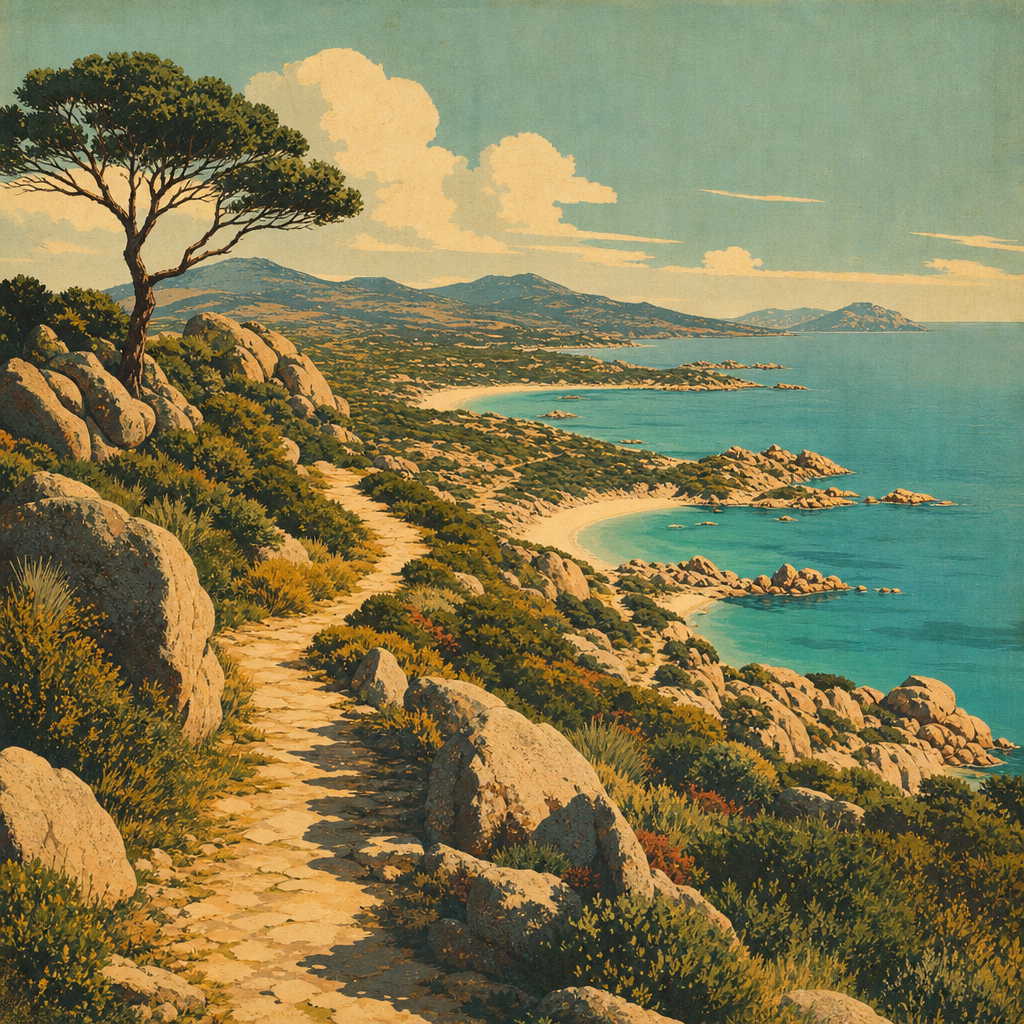
Exploring the Costa Smeralda on foot offers a way to discover an area that goes beyond its image tied to international tourism. Through walks, panoramic viewpoints, and coastal paths, a landscape emerges where nature, history, and architecture coexist in balance. Moreover, walking makes it possible to observe up close the transformations that have shaped the identity of this part of Sardinia.
- From 1960s Gallura to the Birth of the Costa Smeralda
- Porto Cervo: strolling through squares, the marina, and sea views
- Architecture and landscape
- Walking routes among headlands, beaches, and Mediterranean scrub
- The panoramic viewpoints that tell the story of the coast’s identity
- Cultural memory and transformations of the territory
- A Mediterranean landscape to interpret
From 1960s Gallura to the Birth of the Costa Smeralda
To understand the landscape as it is today, it is useful to look back at its origins. Before the transformation that took place in the 1960s, Gallura was characterized by scattered settlements and a long, sparsely urbanized coastal strip.
Later, the establishment of the Costa Smeralda Consortium marked an important turning point. With the contribution of Prince Karim Aga Khan IV, a vision took shape that focused on enhancing the area through planned tourism development.
Architects such as Luigi Vietti, Michele Busiri Vici, and Jacques Couëlle developed solutions capable of engaging in dialogue with the landscape. As a result, many buildings followed the natural contours of the land and limited their visual impact.
Even today, this approach is recognizable along pedestrian routes and at the most popular viewpoints. In fact, the relationship between buildings, vegetation, and the morphology of the land is one of the area’s distinctive features.
Porto Cervo: strolling among piazzas, the marina, and sea views
Porto Cervo is one of the most significant stops for those who wish to interpret the landscape through a walk. The center develops around a natural inlet that encouraged the creation of the port and marina.
Strolling through the historic core, you come across narrow lanes, stairways, small squares, and panoramic terraces. Moreover, the public spaces are designed to offer continuous views of the sea.
- Porto Cervo Piazzetta
- Walk along the harbor
- Porto Cervo Marina
- Stella Maris Church
- Scenic overlook of the surrounding hills
- Panoramic terraces in the center
The climb up to the Stella Maris church is particularly evocative. From here, you can enjoy sweeping views over the inlet and the surrounding hills. In this way, the relationship between architecture and the environment becomes immediately clear.
At the same time, the different elevations of the center make it possible to observe the harbor from various perspectives. For this reason, a simple walk can turn into a way of interpreting the urban and coastal landscape.
Architecture and landscape
One of the most interesting aspects of the coast is its architectural identity. Unlike many tourist developments of the second half of the twentieth century, here an effort was made to establish a dialogue with the surrounding landscape.
The gentle forms, light-colored plaster, and openings oriented toward the Mediterranean light contribute to a strong visual continuity. However, this is not a simple imitation of local tradition, but rather a contemporary reinterpretation.
- Hotel Cala di Volpe
- Cervo Hotel
- Hotel Romazzino
Seen during a walk, these buildings tell the story of an important phase in twentieth-century Mediterranean architecture.
Moreover, many complexes are nestled among granite rocks and native vegetation. As a result, visitors perceive a visual continuity that accompanies the experience of walking along much of the coast.
Walking routes among promontories, beaches, and Mediterranean scrub
Discovering the Costa Smeralda does not necessarily require long treks. On the contrary, many of the most interesting experiences consist of short scenic walks.
The presence of Mediterranean scrub, granite rocks, and natural coves creates a highly varied environment. In addition, the light continually changes the appearance of the landscape.
- Liscia Ruja
- Capriccioli
- La Celvia
- Prince’s Beach
- Grande Pevero
- Romazzino
These places are not just beach destinations. Indeed, they serve as excellent vantage points for observing the area. The shades of the water, moreover, help define the visual character of the coast.
During the morning hours, the colors appear especially crisp. In the late afternoon, by contrast, the low-angled light highlights rocky outlines and coastal reliefs. As a result, each route offers different scenery depending on the season and time of day.
Additionally, institutional information about the area is available on the Municipality of Arzachena website.
Scenic Viewpoints That Tell the Story of the Coast’s Identity
Scenic overlooks and higher elevations play a fundamental role in interpreting the landscape. From these vantage points, the shape of the coastline and the relationship between the natural environment and settlements can be clearly perceived.
- Heights above Porto Cervo
- Views over the Gulf of Pevero
- Capriccioli Promontories
- Views toward the La Maddalena Archipelago
- Urban panoramic terraces
- High points along the coastal roads
On clear days, the view stretches as far as the islands of the archipelago. As a result, the Mediterranean dimension of this landscape becomes easier to grasp.
In many cases, just a few minutes’ walk is enough to reach a natural overlook. Moreover, these spots make it possible to understand how bays, headlands, and inlets have contributed to the area’s current shape.
Cultural Memory and Transformations of the Territory
Beyond its natural value, the Costa Smeralda retains a strong cultural dimension. Over the decades, different needs have come into play, including environmental protection, economic development, and local identity.
Porto Cervo can be considered an open-air archive of this evolution. At the same time, historic hotels, public spaces, and infrastructure bear witness to an important phase in the history of Mediterranean tourism.
At the same time, the presence of Gallurese traditions and elements tied to local culture continues to characterize the area. Thus, visitors can read the territory not only as a tourist destination, but also as a cultural landscape in constant evolution.
A Mediterranean Landscape to Interpret
Observed at the slow pace of a walk, the Costa Smeralda reveals a complexity that often escapes a quick visit. Beaches, squares, panoramic routes, and architecture all tell of an ongoing relationship between nature and design.
Finally, every view of the sea and every coastal trail helps build a deeper understanding of the area. For this reason, exploring on foot is one of the best ways to understand the landscape of northeastern Gallura.