Arzachena tells the story of a path of growth that brings together local history, landscape, and tourism development. Before the Costa Smeralda became famous around the world, this area already preserved a cultural and archaeological heritage of great value. As a result, understanding its evolution means looking at the connection between Gallurese tradition and contemporary transformations.
- Arzachena and Gallura: a land with deep roots
- The landscape as an element of identity
- Traces of History: From Prehistoric Times to Rural Communities
- The birth of the Costa Smeralda and the transformation of the area
- The role of the Municipality of Arzachena in preserving public memory
- Porto Cervo, an international symbol and part of a broader history
- Continuity, identity, and the cultural value of the area
Arzachena Gallura: Arzachena and Gallura: a land with deep roots
Arzachena occupies a central position in Gallura, a historic region of Sardinia characterized by a strong cultural and scenic identity. In addition, the municipal territory is among the largest on the island and includes environments that are very different from one another.
Gallura is not merely a geographical designation. On the contrary, it represents a cultural system that developed over the centuries through agricultural practices, linguistic traditions, and relationships with the land. For this reason, Arzachena is one of its most significant expressions.
Historical and archaeological sources attest to the area’s very ancient human presence. Indeed, the presence of prehistoric and Nuragic monuments demonstrates a long continuity of settlement. Over time, local communities adapted the landscape to their needs without severing their relationship with the environment.
To better understand this historical complexity, it is useful to consult the information available from the Municipality of Arzachena, which is committed to promoting local heritage.
How has a territory inhabited for millennia been transformed into an international destination without losing the connection to its roots?
The answer does not depend on a single event. Rather, it emerges from the encounter between a long cultural continuity and the profound changes of the second half of the twentieth century.
Arzachena Gallura: The Landscape as an Element of Identity
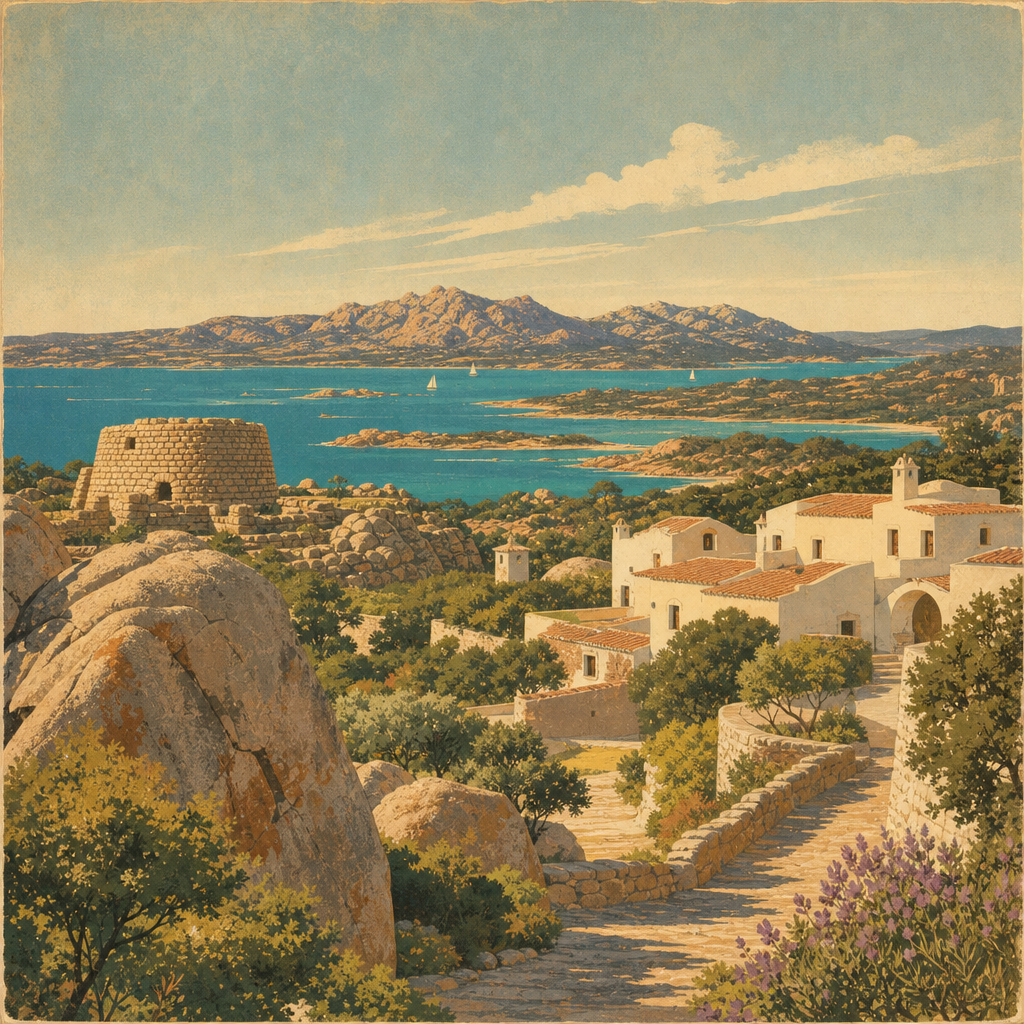
One of the most distinctive aspects of Arzachena is the relationship between nature and human presence. The granite formations shaped by erosion are a defining feature of Gallura. Moreover, they help create an environment of great cultural value.
Alongside the natural elements, a geography shaped by local communities has developed. Paths, stazzi, and agricultural areas tell a story of work and adaptation. As a result, the landscape is not just a backdrop, but the product of a centuries-old relationship between people and the land.
The coastal strip adds another layer of complexity. On one hand, it offers highly appealing beaches and coves; on the other, it maintains a deep connection with the Gallura hinterland.
- The granite formations of Gallura.
- Mediterranean scrubland and coastal ecosystems.
- The ancient rural stazzi.
- The scattered archaeological sites.
- Wetlands and lagoon environments.
- Agro-pastoral settlement systems.
Thanks to this variety, Arzachena has developed strong international appeal without losing its territorial identity.
Arzachena Gallura: Traces of History: From Prehistoric Times to Rural Communities
Arzachena is one of Sardinia’s most important areas from an archaeological point of view. Among the best-known sites are the Giants’ Tomb of Coddu Vecchiu and the nuragic complex of La Prisgiona.
These monuments are not merely cultural attractions. In fact, they make it possible to understand the social organization and practices of the communities that inhabited the area thousands of years ago.
Later, the territory went through several phases of Sardinian history. In the meantime, the stazzi became the fundamental core of local social organization.
The stazzi were places of life, agricultural production, and the transmission of knowledge. Therefore, they contributed to the formation of a culture still recognizable in local traditions.
- The Gallurese language and its variants.
- Agro-pastoral traditions.
- The culture of the stazzi.
- Religious and community festivals.
- Rural craftsmanship.
- Traditional knowledge of the landscape.
Even today, this legacy remains an essential component of the local identity.
The Birth of the Costa Smeralda and the Transformation of the Territory
When Arzachena is discussed internationally, reference to the Costa Smeralda is inevitable. However, this transformation should be understood within a broader territorial history.
In the 1960s, Prince Karim Aga Khan IV recognized great potential in the coastal stretch of Arzachena. Later, together with architects and investors, he promoted a development model that made the Costa Smeralda famous worldwide.
From a historical perspective, it was a significant turning point. In fact, the area gradually shifted from a predominantly rural setting to an international tourist destination.
This change generated economic opportunities and new visibility. At the same time, it altered the relationship between local communities, the landscape, and productive activities.
- Development of new infrastructure.
- Growth in tourism employment.
- Increase in international recognition.
- Enhancement of the coastal landscape.
- Balancing preservation and development.
- Redefining the territory’s image.
According to available historical reconstructions, one of the distinctive elements of the original project was its focus on integrating architecture into the landscape. As a result, the natural environment remained a central component of the local identity.
Is it possible to view the Costa Smeralda not as a separate reality from Gallura, but as a phase of its contemporary history?
Many observers believe so. In this way, it is possible to better understand the transformations without reducing the area’s identity to a single historical period.
The role of the Municipality of Arzachena in preserving public memory
Over the years, the Municipality of Arzachena has taken on an important role in preserving collective memory. It also promotes awareness of its archaeological, historical, and cultural heritage.
Public memory does not consist solely of preserving monuments. Rather, it requires the ability to tell the story of the past to new generations and visitors.
Initiatives dedicated to promoting archaeological sites help build a more complete narrative of the area. In this way, the past remains accessible and meaningful even in the present.
Porto Cervo, an international symbol and part of a broader history
Porto Cervo is one of the most recognizable places in contemporary Sardinia. Over time, it has become an international symbol associated with the Costa Smeralda.
However, its renown cannot be separated from the cultural and geographical context of Arzachena. In fact, granite hills, Gallurese traditions, and local history form the framework within which it developed.
In recent years, several commemorative initiatives have recalled the role of Prince Karim Aga Khan IV in the transformation of the area. These recognitions document a historical period that had a profound impact on local life.
For visitors, Porto Cervo therefore serves as a gateway to a broader history, one in which international prestige and local identity coexist.
Continuity, Identity, and the Cultural Value of the Area
Arzachena’s evolution cannot be explained solely through its success as a tourist destination. Rather, it stems from its ability to preserve traces of its own history while facing profound changes.
In few places in the Mediterranean do prehistoric monuments, the culture of the stazzi, rural landscapes, and contemporary architecture coexist so visibly. For this reason, the area possesses a cultural layering of great value.
Those who visit Arzachena discover that the sea is in constant dialogue with the inland landscape. They also come to understand how the history of the Costa Smeralda fits into a much longer historical trajectory.
In conclusion, the history of the Costa Smeralda does not replace that of Arzachena. On the contrary, it represents one of its most recent chapters. It is precisely this continuity between memory, identity, and landscape that makes the area a unique reality in contemporary Sardinia.