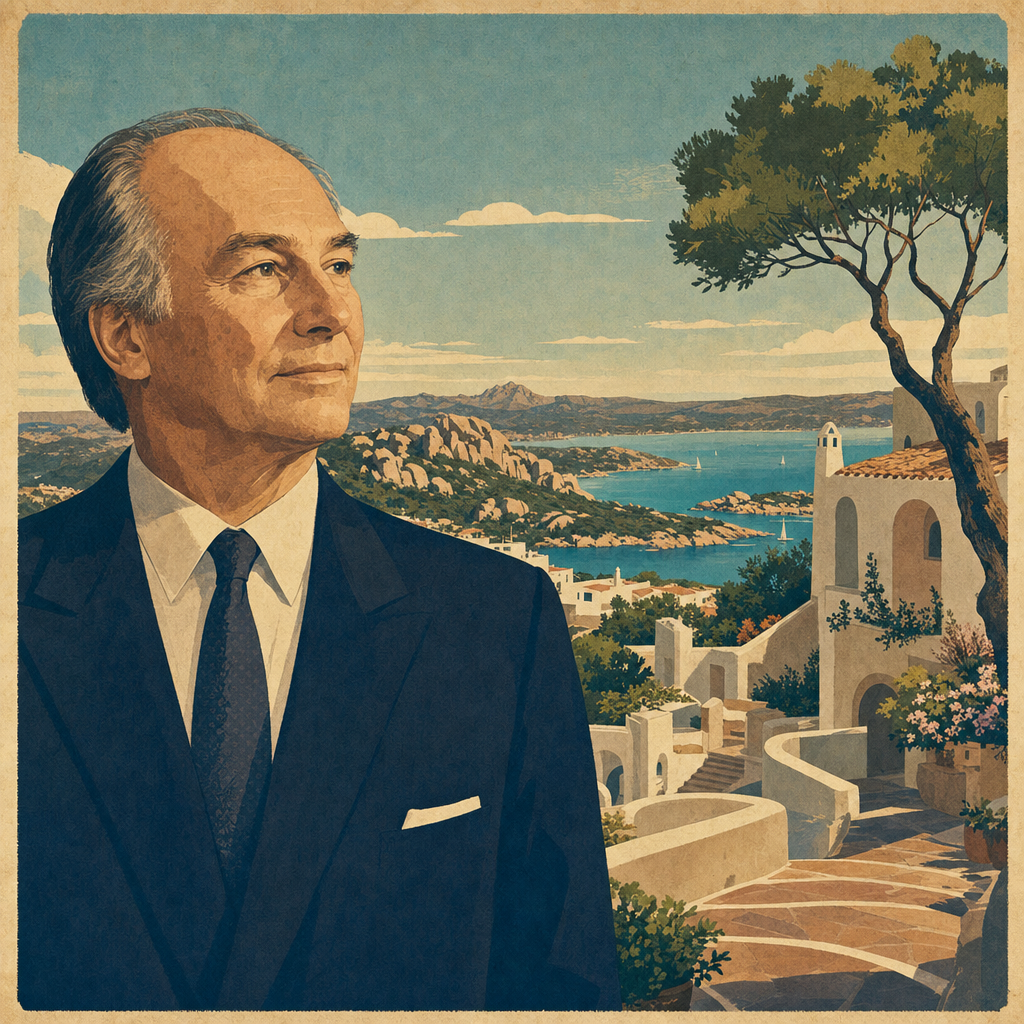
When observing the northeastern coast of Sardinia from above, among granite promontories and wind-carved inlets, it is hard to imagine that until the mid-20th century this stretch of Gallura was almost entirely excluded from the major tourist routes. However, the birth of the Costa Smeralda represents one of the most profound territorial transformations in the contemporary Mediterranean. In this context, at the heart of this transformation stands the figure of Karim Aga Khan IV. Understanding the meaning of Aga Khan Costa Smeralda therefore helps visitors read the landscape not only as a natural setting, but as a cultural, urban, and social project.
- The Historical Context and the Encounter with Gallura
- A Territorial Vision Between the Mediterranean and Modernity
- Porto Cervo and the Idea of a Coastal City
- Architecture, landscape, and local identity
- Relationship with Arzachena and the Gallura Community
- Cultural Heritage and Public Memory
The Historical Context and the Encounter with Gallura
Karim Aga Khan IV was born in 1936 and received an international education that soon led him to move between Europe, the Middle East, and North America. Subsequently, in 1957 he assumed the role of spiritual leader of the Ismaili community, gaining global visibility. Shortly afterward, in the late 1950s, he visited the Gallura coast for the first time. At that time, the area appeared isolated, with minimal infrastructure and an economy based mainly on agriculture and pastoralism.
At the time, Gallura was far removed from the international tourism circuits that were transforming other parts of the Mediterranean. As a result, Arzachena remained largely rural, and the coast was not yet perceived as a structured economic resource. Precisely for this reason, the encounter between the prince and this territory took place at a stage of potential, rather than of development already underway. Later on, this condition would favor more controlled planning.
In 1962, the Consorzio Costa Smeralda was founded. From that moment on, this organization coordinated land acquisition, urban planning, and the promotion of the project. As a result, a coherent and unified model of development took shape. The concept of Aga Khan Costa Smeralda thus began to define a new approach to coastal tourism, offering an alternative to the intensive urban development widespread in those years.
This was not an improvised undertaking. On the contrary, the project was conceived as a territorial laboratory, capable of influencing the way tourism was envisioned in Italy. For an overview of the prince as a historical figure, readers can learn more in the Encyclopaedia Britannica entry on Aga Khan IV.
A Territorial Vision Between the Mediterranean and Modernity
Aga Khan IV’s vision for the Costa Smeralda was based on a delicate balance. On one hand, it aimed to attract high-end international tourism. On the other, it sought to preserve the landscape and local traditions. In those years, this choice went against the grain compared with many examples of aggressive coastal development.
According to historical sources, the project drew inspiration from a cultured and restrained idea of the Mediterranean. For this reason, urban planning rules limited building heights and discouraged large, compact volumes. Moreover, the fragmentation of built spaces followed the natural topography. In this sense, the land was not to be dominated, but interpreted.
This approach had direct effects on Arzachena and its coastal hamlets. Gradually, new roads and essential services emerged. At the same time, tourism became a central component of the local economy. The model of Aga Khan Costa Smeralda thus showed how economic growth and landscape protection could coexist, despite criticism and debate.
Porto Cervo and the Idea of a Coastal City
Porto Cervo represents the symbolic and functional heart of the Costa Smeralda. Its creation did not follow a rigid urban grid. On the contrary, the settlement grew in clusters overlooking a natural harbor. Karim Aga Khan IV supported this development as a center for services and connections, preventing it from becoming a mere hotel complex.
The Piazzetta in Porto Cervo, for example, was conceived as a public meeting space. Over time, it has become a recognizable place in the collective imagination. Furthermore, the marina was designed to take advantage of the bay’s natural configuration. In this way, recreational boating was integrated into the landscape without altering its scale.
Over the years, Porto Cervo has acquired its own cultural layering. As a result, international events and artistic initiatives have helped define its identity. For this reason as well, the link between the destination and the concept of Aga Khan Costa Smeralda remains central to the recent history of Gallura.
Architecture, landscape, and local identity
A key element of the project concerns its architecture. From the outset, professionals were brought in to reinterpret the materials and forms of local tradition. Thus, the so-called “Emerald style” was born, characterized by irregular volumes, light-colored plaster, and a restrained use of stone.
The buildings engage with the surrounding landscape. In particular, granite, Mediterranean scrub, and natural light become an integral part of the project. In addition, the use of local skilled workers encouraged a transfer of expertise. As a result, the architectural intervention also contributed to enhancing Gallurese identity.
Relationship with Arzachena and the Gallura Community
The relationship between Karim Aga Khan IV and the region was not merely entrepreneurial. On the one hand, Arzachena underwent a rapid transformation, which required institutional dialogue and adaptation. On the other, job opportunities increased, but questions also arose about the relationship between development and preservation.
According to administrative sources, the impact on employment was significant, especially in the construction and service sectors. However, there was no shortage of discussion about the role of private capital and the public good. These debates are an integral part of the history of Aga Khan Costa Smeralda and help us interpret it critically.
Cultural Heritage and Public Memory
Karim Aga Khan IV’s legacy on the Costa Smeralda goes beyond infrastructure. Indeed, it is reflected above all in the creation of a shared territorial identity. Dedications, commemorative works, and institutional references have made this memory visible over time.
It is important to distinguish between myth and historical reality. Aga Khan IV did not create Gallura, but recognized its potential. Ultimately, the result was a convergence of vision, capital, and local expertise. Today, walking between Porto Cervo and the surrounding bays, visitors can perceive this layering. Understanding Aga Khan Costa Smeralda therefore means reading a significant chapter in the contemporary history of the Mediterranean.