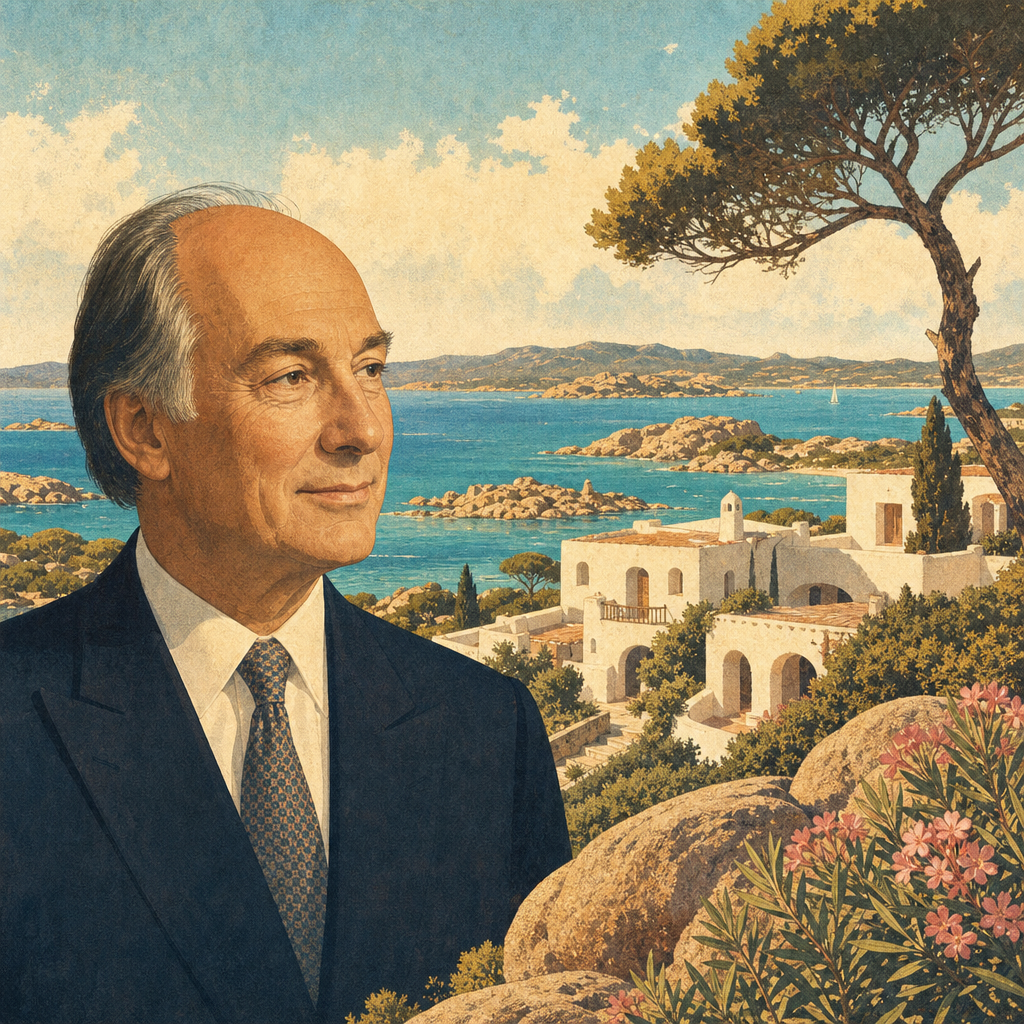
Before the name Costa Smeralda entered the international vocabulary of tourism, this stretch of Gallura was a succession of natural landings, granite hills, and pastures sloping down toward a clear sea. The transformation was not sudden. On the contrary, it arose from a vision for the region capable of bringing together landscape, architecture, and accessibility. It is within this framework that the relationship between Karim Aga Khan IV and Alisarda takes shape, a decisive bond in connecting Sardinia to the world.
- The historical context and the arrival of an entrepreneurial vision
- Alisarda and Gallura’s accessibility
- Porto Cervo as an Urban and Cultural Project
- Landscape and architecture as a common language
- Local communities and public memory
- A legacy that connects Sardinia to the world
the historical context and the arrival of an entrepreneurial vision
In the 1950s and 1960s, coastal Gallura remained on the margins of the major tourist flows. Arzachena, in particular, relied above all on a rural economy. However, the area preserved an extraordinary natural heritage, still lacking the infrastructure needed to make it accessible. It is precisely against this backdrop that Karim Aga Khan IV arrives, and his presence soon takes shape as a concrete development project.
According to historical accounts, the encounter with Sardinia’s northeastern coast happened almost by chance. Yet, from the very beginning, the Aga Khan sensed the potential for orderly growth. He did not envision mass tourism. On the contrary, he imagined development in harmony with the landscape and with local communities. This approach would leave a lasting mark on the identity of the Costa Smeralda.
In 1962, the Costa Smeralda Consortium was established. The organization coordinated urban planning and entrepreneurial expertise, laying the foundations for the project. At this stage, Alisarda became an integral part of the overall vision, because without efficient connections, every territorial plan would have remained incomplete.
Alisarda and Gallura’s Accessibility
Every territorial development project requires adequate infrastructure. In the case of the Costa Smeralda, accessibility was the key element. For this reason, the creation of Alisarda responded to a concrete need: to provide stable connections between northeastern Sardinia and the rest of Italy and Europe.
In those years, in fact, connections with the island were limited and irregular. As a result, Alisarda helped reduce geographic isolation, making the area’s tourism development sustainable. In this way, private enterprise also took on a function of public interest, anticipating models of integration between business and the local area.
Over time, Alisarda would evolve to become part of the history of Italian civil aviation. However, its original role remains central. Without an efficient transportation network, Porto Cervo could not have established itself as an international hub. Likewise, Arzachena would not have benefited from the economic and employment opportunities that still characterize the area today.
It is no coincidence that the Alisarda case is often cited in studies on the evolution of regional air transport in Italy. As the Italian Civil Aviation Authority also notes, the development of local airlines played a decisive role in overcoming the geographical barriers of the major islands.
Porto Cervo as an Urban and Cultural Project
Porto Cervo did not originate as a historic city. Instead, it is a deliberate urban project. Its foundation reflects the idea of creating a space that is both functional and symbolic. Here, the vision of Karim Aga Khan IV takes shape through careful direction, entrusted to architects and urban planners called upon to interpret Mediterranean identity.
The marina becomes the heart of the settlement. It is not merely a nautical infrastructure. It is also a public space. Around it, therefore, squares and pedestrian routes develop, designed on a human scale. This approach distinguishes the Costa Smeralda from other models of intensive development widespread during the same period.
In this way, Porto Cervo takes on a value that goes beyond its tourist function. It represents the place where the initial vision takes shape. To better understand the broader territorial context, it is useful to explore the history of Arzachena and Costa Smeralda, inseparable elements of this project.
Landscape and architecture as a common language
A lasting aspect of the Aga Khan’s legacy concerns architecture. The buildings do not dominate the landscape. On the contrary, they blend in discreetly through local materials, understated colors, and measured volumes. As a result, this Mediterranean language becomes one of the defining features of the Costa Smeralda.
It is, moreover, a collective effort. The Aga Khan promotes an approach based on respect for natural contours and the conscious use of resources. Today, these choices appear forward-looking. At the time, however, they represented a deliberate cultural stance that ran against the grain.
For this reason, visitors perceive a widespread sense of coherence. Walking through Porto Cervo means entering a lived-in environment, not an artificial one. This result, too, is tied to the integrated vision that brings together Alisarda, the Costa Smeralda, planning, and architecture.
Local communities and public memory
Every territorial transformation involves local communities. In the case of the Costa Smeralda, the dialogue with Arzachena develops over time. On one hand, new economic opportunities emerge; on the other, the need for cultural preservation grows. The territory changes its role, but it does not lose its identity.
Over time, the figure of the Aga Khan has entered public memory. Events and institutional initiatives recognize his contribution to the region’s development. However, the debate remains open. This dialogue shows that development is never a linear process, but rather a continuous balance among different interests.
A Legacy Connecting Sardinia to the World
Today, Karim Aga Khan IV’s legacy is reflected in the very structure of the territory. Decisions on accessibility and planning continue to influence the present. In this sense, Alisarda represents much more than an airline: it is the instrument that made dialogue between Sardinia and the world possible.
Understanding this history ultimately allows us to look beyond the destination’s immediate image. The Costa Smeralda thus emerges as a coherent project, born from the meeting of entrepreneurial vision and territorial responsibility. An experience that continues to raise questions about the future of Mediterranean tourism.