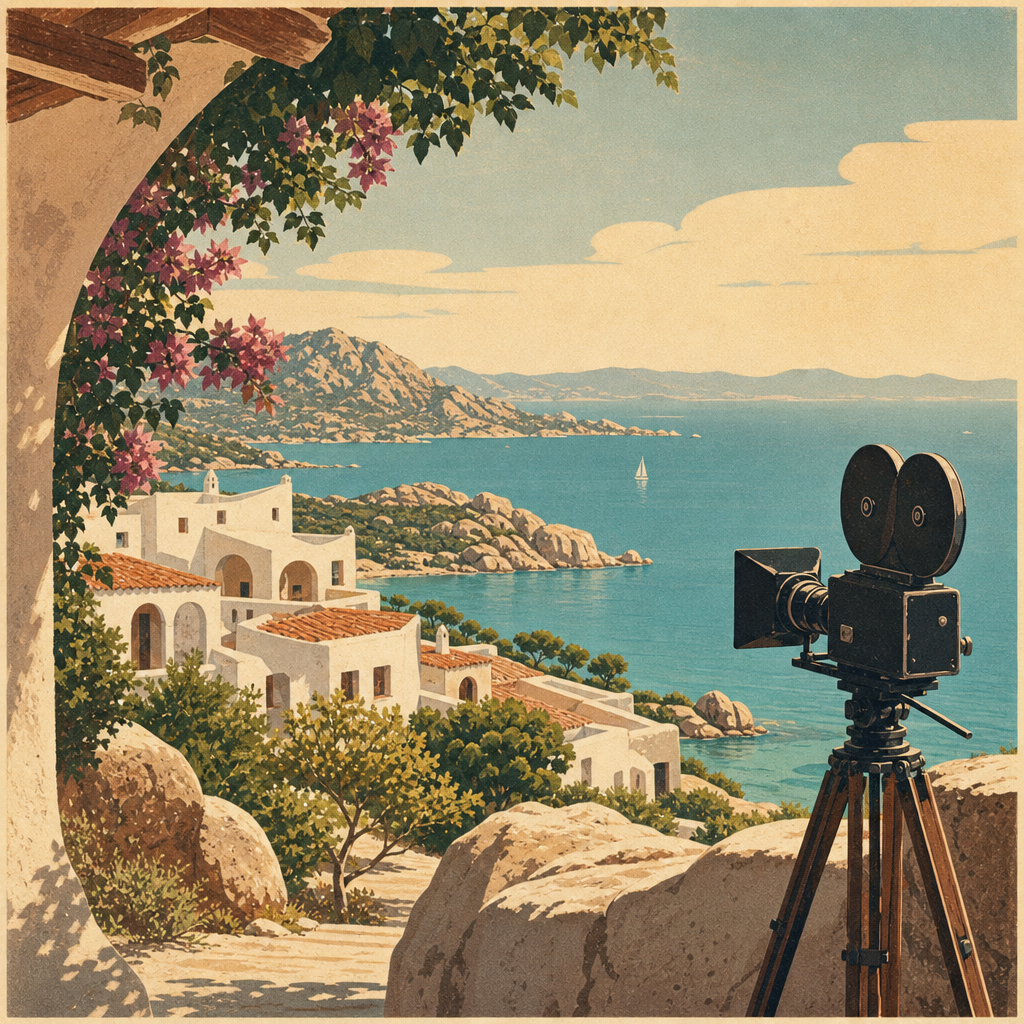
Costa Smeralda and cinema represent a pairing that has helped define the image of one of the Mediterranean’s most recognizable regions. Amid wind-sculpted granite rocks, turquoise waters, and architecture designed to engage in dialogue with the landscape, this part of northeastern Gallura has become much more than a renowned tourist destination. Moreover, its history shows how a place can be transformed into a cultural icon through the power of images, urban planning, and visual representations.
- From the coasts of Gallura to the birth of the destination
- Costa Smeralda and cinema: the territory as image
- Porto Cervo, small squares and public spaces as urban scenography
- Costa Smeralda and cinema: the landscape as visual storytelling
- Architecture, historic hotels, and a dialogue with nature
- Beaches, marina, and symbolic sites of visual memory
- A cultural backdrop in the heart of the Mediterranean
From the coasts of Gallura to the birth of the destination
To understand the connection between landscape and visual culture, it is necessary to start from the origins. Until the mid-twentieth century, this area of Sardinia retained a predominantly natural character. In fact, the territory was dominated by Mediterranean scrub, granite promontories, and small landing places.
The early 1960s marked a decisive turning point. Prince Karim Aga Khan IV and a group of international investors saw in these shores the potential to develop an innovative project, one capable of combining tourism, respect for the landscape, and Mediterranean identity.
The founding of the Costa Smeralda Consortium in 1962 marked the starting point of an important transformation. In particular, the goal was to create a destination that maintained a strong connection with Sardinia’s natural and cultural context.
From its earliest developments, the Costa Smeralda stood out for its ability to generate powerful images. As a result, photographs of unspoiled bays and sea views began appearing in international magazines.
andTo learn more about the origin of the area’s name, it is useful to read this account of the name Costa Smeralda.
In addition, historical and institutional information is available on the official website of the Costa Smeralda Consortium.
When a territory becomes instantly recognizable through a photograph, it acquires a symbolic dimension that goes beyond its geographical reality.
Costa Smeralda and cinema: the territory as image
Costa Smeralda’s renown does not stem solely from the beauty of its landscape. Rather, what proved decisive was its ability to transform natural elements into recognizable visual symbols.
The sea with its emerald hues, the rocks shaped by the elements, and the Mediterranean vegetation have created an iconographic repertoire established over time. Moreover, photographers, filmmakers, and journalists have used these elements to convey a particular vision of the Mediterranean.
One of the most interesting aspects concerns the harmony between the natural environment and architecture. In many tourist destinations, the built environment dominates the landscape. Here, by contrast, most of the developments were designed to blend in with the surrounding area.
Over the decades, this image has spread through cinema, editorial photography, documentaries, and travel reports. In this way, each representation has fed a collective imagination that still immediately identifies the destination today.
Porto Cervo, Piazzettas, and Public Spaces as Urban Scenery
Porto Cervo is probably the best-known symbol of the Costa Smeralda. Designed as the main center of the area’s new development, it represents a significant example of how urban planning and landscape can work together.
The village was not conceived as a traditional city. Rather, it was envisioned as a Mediterranean village characterized by winding streets, human-scale buildings, and constant views of the sea.
The small piazzas play a central role in the visitor experience. Through pedestrian walkways and panoramic views, they create a constant dialogue between architecture and landscape.
The marina has also taken on strong symbolic significance. Moreover, its direct relationship with the bay has helped create one of the most famous images of the contemporary Mediterranean.
- Visual continuity between sea and architecture.
- Small squares as places for meeting and observation.
- Pedestrian paths that enhance the panoramic views.
- Integration of buildings with Mediterranean vegetation.
- Presence of spaces that preserve the area’s historical memory.
Costa Smeralda and Cinema: The Landscape as Visual Storytelling
The relationship between Costa Smeralda and cinema goes beyond the mere presence of audiovisual productions set in the area. Rather, it concerns the way the landscape is perceived and transformed into narrative.
Over time, Sardinia and Gallura have attracted directors and photographers interested in natural settings of striking aesthetic impact. As a result, the Costa Smeralda has stood out for its ability to offer locations that seem made to be filmed.
Cinematic and photographic images have often highlighted certain recurring elements:
- The contrast between granite and the sea.
- The intense brightness of the coasts.
- The discreet presence of architecture.
- The natural geometries of the bays.
- The dialogue between boats and landscape.
Not all representations have had the same cinematic significance. However, the area has developed a strong association with the idea of a natural set.
For many observers, Costa Smeralda and cinema evoke an open-air landscape theater, where nature itself creates settings capable of telling stories.
How much of the Costa Smeralda’s international fame stems from its physical characteristics, and how much from the way cinema and photography have portrayed it over the years?
Architecture, Historic Hotels, and a Dialogue with Nature
One of the most original aspects of the Costa Smeralda is the relationship between architecture and the environment. During the development of the area, efforts were made to create a design language that respected the natural characteristics of the coastline.
Architects such as Luigi Vietti helped define a recognizable style. In addition, they used irregular volumes, soft colors, and materials in harmony with the landscape.
Historic hotels represent an important part of this cultural heritage. Properties such as the Cala di Volpe, the Cervo Hotel, and the Romazzino are considered significant examples of this approach.
- Materials in harmony with the local landscape.
- Color palettes inspired by the surrounding nature.
- Volumes adapted to the coastal morphology.
- Open spaces and panoramic terraces.
- Integration with Mediterranean vegetation.
As a result, architecture became an integral part of the images that made the area famous.
Beaches, the marina, and symbolic sites of visual memory
The beaches of the Costa Smeralda occupy a central place in the collective imagination. Locations such as Liscia Ruja, Capriccioli, Grande Pevero, Piccolo Pevero, and La Celvia have become symbols of the destination.
However, their renown does not depend solely on environmental quality. In fact, these places encapsulate the landscape identity of the entire area.
The Porto Cervo marina also plays a fundamental role in the area’s visual memory. Moreover, the dialogue between nautical infrastructure and the natural environment creates a composition that has been photographed countless times.
Alongside the most famous locations are secluded bays and lesser-known scenic routes. In this way, visitors can grasp the continuity between the original landscape and the transformations that followed.
A cultural backdrop in the heart of the Mediterranean
Defining the Costa Smeralda as a stage setting means recognizing the role that geography, history, architecture, and visual representation have played in shaping its identity. Therefore, it is not merely a tourist backdrop.
Since the 1960s, Costa Smeralda and cinema have established an enduring presence in the international imagination. In addition, photography and visual communication have helped spread this representation.
Behind every photograph and every frame, however, remains the reality of a living region. Finally, it is precisely in the dialogue between memory, transformation, and identity that Costa Smeralda and cinema continue to offer a cultural and tourism-oriented lens through which to understand the area.