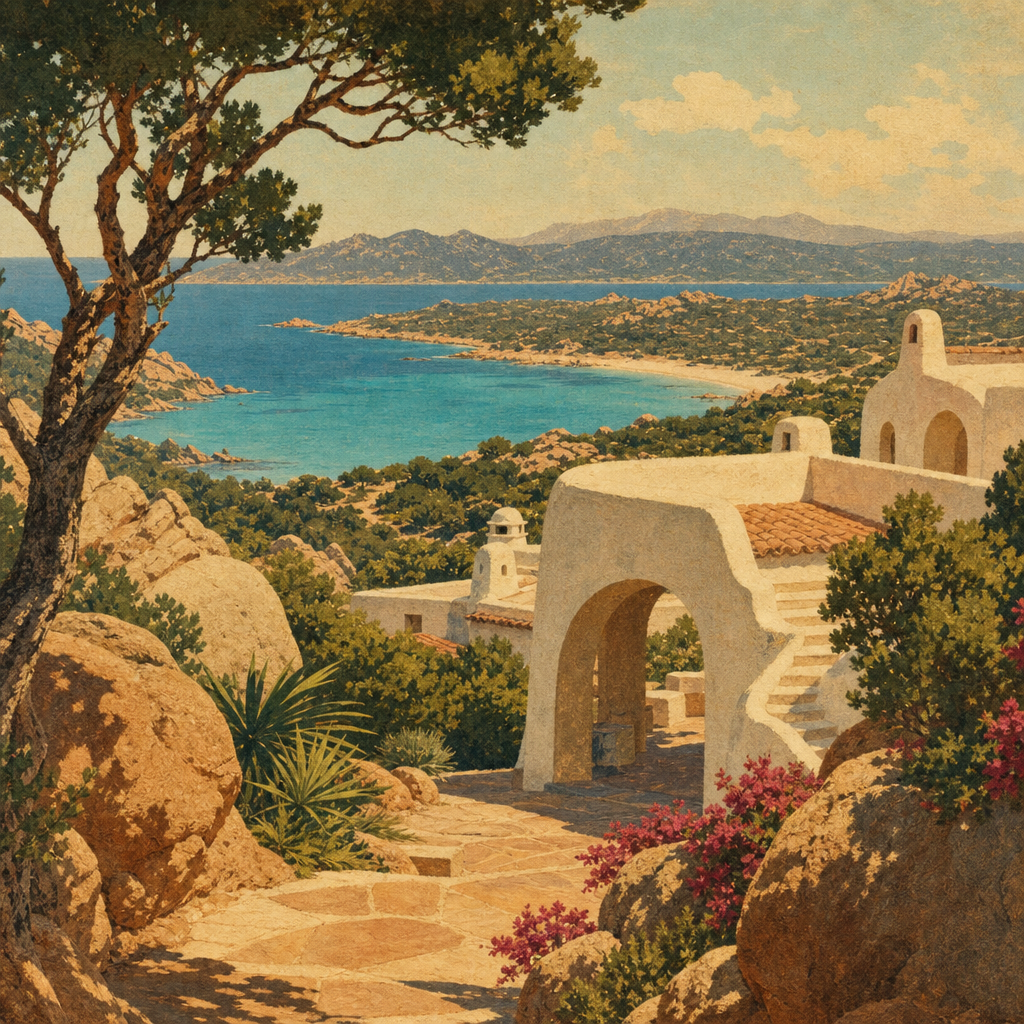
The story of the myth of the Costa Smeralda was born from the encounter between landscape, architecture, tourism, and communication. Today, this part of Gallura is associated with famous beaches and an international image of the Mediterranean. However, its renown does not stem solely from its natural beauty. On the contrary, it is the result of a long cultural construction involving designers, photographers, travelers, and the media. For this very reason, understanding how this image was formed helps distinguish between symbolic narrative and historical reality.
- The birth of the Costa Smeralda: the history of a territorial project
- Myth, history, and reality: distinguishing the layers of the narrative
- Porto Cervo and the Construction of a Symbolic Place
- Architecture, Landscape, and Mediterranean Identity
- Photographs, travelers, and media: how a global image is born
- The Costa Smeralda and the Arzachena Area
- Beyond the myth: cultural memory and landscape transformation
The Birth of the Costa Smeralda: History of a Territorial Project
Until the mid-twentieth century, the northeastern coast of Gallura was sparsely urbanized. Later, in the early 1960s, Prince Karim Aga Khan IV and a group of investors identified great tourism potential in the area. The goal, however, was not merely to build hotels. The aim was to create a recognizable destination integrated into the landscape.
With the founding of the Costa Smeralda Consortium in 1962, precise urban planning and architectural criteria were established. As a result, the development of the area followed a coordinated vision that contributed to the formation of the myth of the Costa Smeralda.
To better understand the area’s geographical and cultural context, it is useful to explore the territory of Arzachena. In addition, institutional information is available on the website of the Municipality of Arzachena.
Myth, History, and Reality: Distinguishing the Layers of the Narrative
When discussing the Costa Smeralda, it is important to distinguish between myth, history, and territorial reality. In fact, these layers often overlap, but they do not coincide.
History deals with documented facts: the founding of the Consortium, the design of Porto Cervo, and the development of tourism infrastructure. Myth, on the other hand, belongs to the realm of the imagination. It is the representation of an exclusive, elegant, and profoundly Mediterranean place.
As for the local reality, it is more complex. It includes local communities, archaeological heritage, traditions, and economic transformations. For this reason, the myth of the Costa Smeralda can be fully understood only by considering these three levels together.
Porto Cervo and the Construction of a Symbolic Place
If there is one symbolic place, it is Porto Cervo. Created as the main center of the tourism project, over time it has become the heart of the local imagination.
The small squares, terraces, and pedestrian pathways were designed to enhance the landscape. In addition, the urban layout evokes Mediterranean villages while being the result of modern planning.
- The Piazzetta of Porto Cervo.
- The marina.
- The Stella Maris Church.
- The historic hotels.
- Scenic routes overlooking the sea.
As a result, Porto Cervo has become much more than a tourist resort. Today, it represents one of the central elements of the myth of the Costa Smeralda.
Architecture, Landscape, and Mediterranean Identity
One of the area’s most distinctive aspects is the relationship between architecture and the natural environment. From the outset, the designers avoided invasive models. Instead, they favored solutions capable of engaging with the land.
Architects such as Michele Busiri Vici, Jacques Couëlle, and Luigi Vietti helped define a recognizable style. The buildings followed the contours of the terrain and showcased local materials such as Gallura granite.
- Use of local granite.Integration with the Mediterranean scrub.
- mythRestrained volumes.
- yPathways adapted to the topography.
- ythCourtyards and small squares.
- storyPanoramic sea views.
Thanks to these choices, architecture played a decisive role in the destination’s international reputation. Moreover, this design language strengthened the perception of a unique and immediately recognizable place.
Costa Smeralda myth historyPhotographs, travelers, and the media: how a global image is born
No territorial myth takes hold without being told. That is why photographs, reports, and travel accounts have played a fundamental role.
In the 1960s came the phase of international discovery. Later, the 1970s consolidated the destination’s Mediterranean image. Subsequently, between the 1980s and 1990s, its renown became global. With the 2000s, however, the internet and digital media further expanded the circulation of images. Today, attention is increasingly focused on sustainability and cultural heritage.
Photographers selected views that showcased the sea, granite rocks, and architecture. At the same time, journalists and travelers helped spread the myth of the Costa Smeralda well beyond Sardinia’s borders.
However, media representation tends to favor certain aspects over others. For example, Gallura’s historical heritage often receives less attention than its coastal imagery. As a result, many visitors first come to know the area through images and only later through its history.
The Costa Smeralda and the Arzachena Area
To truly understand this reality, it must be considered within the broader context of Arzachena and Gallura.
The area is home to nuraghi, giants’ tombs, and important archaeological remains. In addition, the inland areas reveal a Sardinia different from the one shown on tourist postcards.
- Porto Cervo.
- Liscia Ruja.
- Capriccioli.
- Romazzino.
- Cala di Volpe.
- Pevero.
- The marina of Porto Cervo.
As a result, the territory should be understood as a collection of landscapes, memories, and cultural relationships that predate the contemporary tourist era. At the same time, the growth of tourism has transformed the local economy, creating new opportunities and new challenges for the protection of the landscape.
Beyond the Myth: Cultural Memory and the Transformation of the Landscape
The Costa Smeralda represents one of the most significant examples of the construction of a territorial image in the Mediterranean. Indeed, its fame derives from the combination of landscape, planning, architecture, and communication.
Understanding the myth of the Costa Smeralda means distinguishing documented history from symbolic narrative. It also means recognizing the role of the real territory that made this image possible.
Ultimately, the myth of the Costa Smeralda continues to influence the international perception of the Mediterranean. And yet, behind the most famous images remain Gallura, Arzachena, and a much broader, more complex territorial history. Moreover, its evolution shows how a landscape can become a global symbol without entirely losing its connection to its local roots.