The Hotel Cala di Volpe is much more than a famous hotel on the Costa Smeralda. Over the decades, it has become an architectural and cultural symbol capable of representing the identity of an entire region. Set among sheltered bays, granite rocks, and turquoise waters, it has played a decisive role in shaping the Costa Smeralda’s international image. Moreover, its architectural language has strengthened the connection between design and the Mediterranean landscape. For this reason, the hotel complex is often considered one of the most significant examples of the dialogue between architecture, nature, and territorial vision developed in northeastern Sardinia.
- Hotel Cala di Volpe: The Origins of the Costa Smeralda and the Birth of a Territorial Project
- Hotel Cala di Volpe: Cala di Volpe and the Architectural Language of the Costa Smeralda
- Architecture and the Mediterranean landscape: a constructed dialogue
- The Formation of an International Visual Identity
- A symbol of memory, tourism, and the representation of the territory
Hotel Cala di Volpe: The Origins of the Costa Smeralda and the Birth of a Territorial Project
Before the transformation that took place in the 1960s, Sardinia’s northeastern coast was characterized by small rural settlements and a deep relationship with the natural environment. Later, the vision of Prince Karim Aga Khan IV gave impetus to a territorial project that brought together architecture, infrastructure, and landscape.
Professionals such as Michele Busiri Vici and Jacques Couëlle helped define a design language consistent with the Mediterranean context. As a result, the Costa Smeralda developed a recognizable identity without resorting to urban planning models foreign to the territory.
This approach was not aimed solely at the construction of hospitality facilities. On the contrary, it sought to create an overall image of the territory, grounded in the enhancement of the landscape and its historical characteristics. Therefore, each new intervention was conceived as part of a broader vision.
To explore the cultural and territorial context in greater depth, it is also useful to read Costa Smeralda: Mediterranean lifestyle and identity.
Hotel Cala di Volpe: The Cala di Volpe and the Architectural Language of the Costa Smeralda
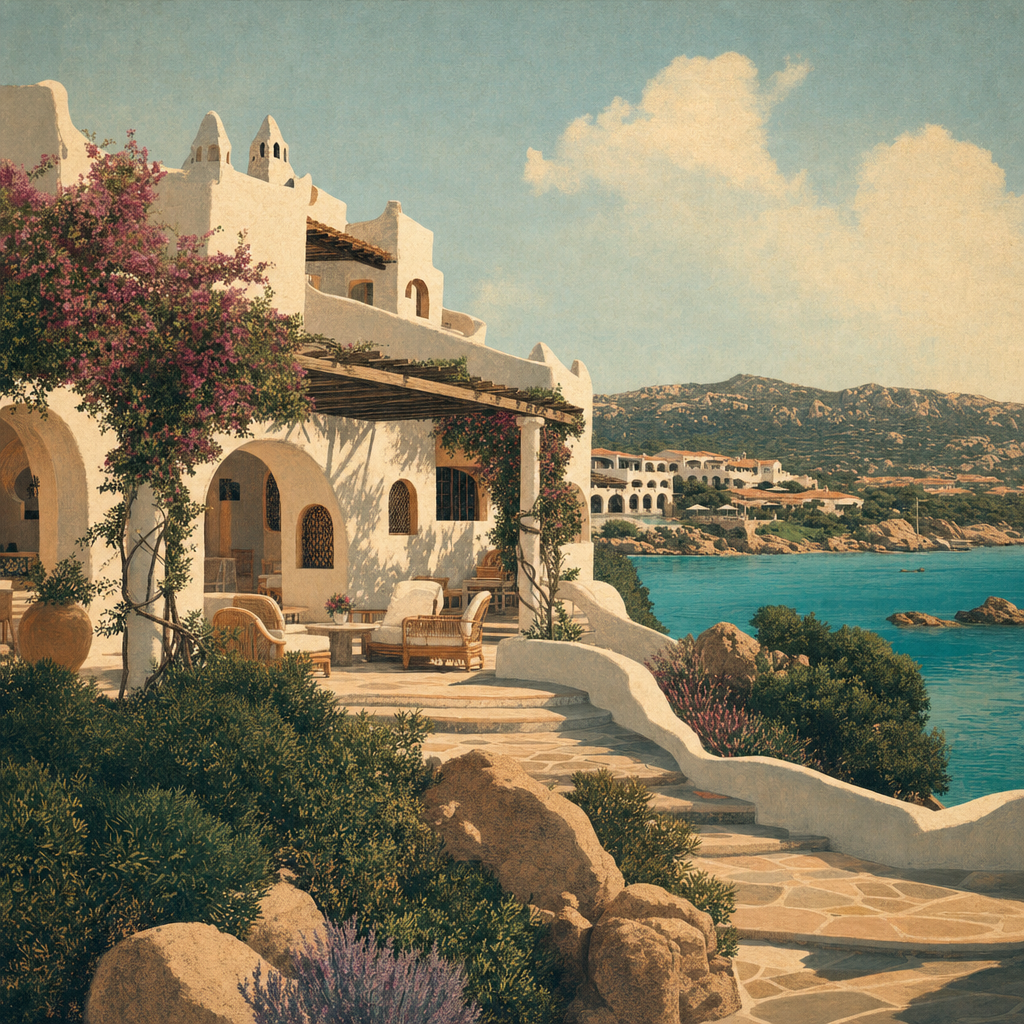
Opened in 1963, the Cala di Volpe is one of the most significant works from the early phase of development of the Costa Smeralda. Generally associated with the design vision of Jacques Couëlle, the building evokes a Mediterranean village overlooking the sea.
The structure follows the natural contours of the bay. It also avoids rigid geometries, favoring soft, organic lines. Turrets, porticoes, and terraces help create a harmonious whole.
One of the most interesting aspects lies in the reinterpretation of Mediterranean vernacular architecture. In fact, the project does not copy traditional models, but reworks them through a contemporary lens. For this reason, the building has become one of the most recognizable images of the Costa Smeralda.
Over time, photographs and reports have spread this image internationally. Thus, the structure has become a powerful visual symbol of the area.
At the same time, the interior and exterior spaces were conceived as parts of a single architectural narrative. The common areas open toward the sea, while the pathways guide the eye along the bay. As a result, the guest experience is not limited to the building, but encompasses the entire natural setting.
Another relevant element is the structure’s ability to convey a sense of belonging to the place. Although the hotel has become a globally known destination, it retains clear references to the materials, forms, and atmospheres of the… Therefore, its success derives not only from luxury, but also from the strength of its architectural identity.
Architecture and Mediterranean Landscape: A Built Dialogue
One of the distinctive elements of the Costa Smeralda is the relationship between the built environment and the natural surroundings. In the case of Cala di Volpe, the bay is not merely a backdrop. On the contrary, it becomes an integral part of the architectural experience.
- Colors inspired by the earth and local stone.
- Restrained volumes in relation to the natural setting.
- Pathways that follow the contours of the land.
- Enhancement of the sea views.
- Widespread presence of Mediterranean vegetation.
- Visual continuity between architecture and landscape.
The openings and common spaces are designed to engage in dialogue with the light and the sea. As a result, visitors perceive a constant relationship between nature and design.
Moreover, the choice to integrate the building into the landscape helped define a recognizable model for the Costa Smeralda. Rather than dominating its surroundings, the architecture seeks a balance with the forms of the coastline. This principle, applied in various works throughout the area, encouraged the creation of a coherent visual identity.
Mediterranean light plays an equally important role. At different times of day, surfaces, shadows, and perspectives change continuously. As a result, the building appears to be in constant dialogue with the natural environment. This dynamism reinforces the perception of an architecture that belongs to the place rather than being imposed upon it.
For a historical overview of the area, you can also consult the information provided by the Consorzio Costa Smeralda.
The formation of an international visual identity
The fame of the Costa Smeralda does not depend solely on its natural qualities. In fact, photographs, magazines, and film productions have helped spread a distinct image of the region.
In this context, Cala di Volpe has taken on a central role. Its organic forms and relationship with the bay made it immediately recognizable. Moreover, the continuity between architecture and landscape reinforced the idea of an elegant and harmonious Mediterranean.
Since the 1960s, images of the hotel have appeared in international publications devoted to travel, architecture, and lifestyle. As a result, the property has become one of the main symbols associated with the Costa Smeralda. Many visitors first came to know the area through these visual representations.
Later, the spread of photo shoots and audiovisual content solidified this perception. Not only the sea and beaches, but also the buildings entered the collective imagination. In particular, the Cala di Volpe helped define the idea of a destination capable of combining exclusivity, landscape, and design culture.
This process has had effects that go beyond the tourism sector. Indeed, it has influenced the way the Costa Smeralda is described and interpreted even today. Therefore, the hotel complex can be considered a central element in building the area’s international reputation.
A Symbol Between Memory, Tourism, and Representation of the Territory
Over time, the hotel also took on symbolic value tied to the memory of Costa Smeralda’s founding phase. As the area transformed and grew, the property continued to represent the project’s original principles: attention to the landscape, architectural quality, and integration with the environment.
For many observers, Cala di Volpe represents a landmark in the history of Mediterranean resort architecture. However, its significance is not confined to the hotel sector. Rather, it conveys a particular idea of development, in which the enhancement of the local area plays a central role.
Even today, visitors, scholars, and architecture enthusiasts regard the complex as an example of balance between function and representation. On the one hand, the building meets the demands of international hospitality. On the other, it maintains a strong relationship with the geographical context that surrounds it.
Today, the complex continues to stand as an important testament to the founding phase of the Costa Smeralda. It not only recounts a chapter in Mediterranean architecture, but also shows how a building can contribute to the construction of a place’s international identity. Ultimately, the Cala di Volpe demonstrates how architecture, landscape, and the collective imagination can come together to define a symbol destined to endure over time.